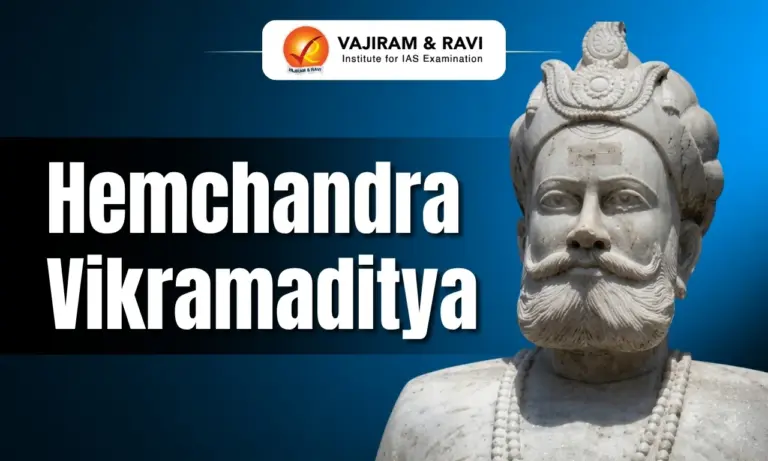
Hemchandra Vikramaditya, popularly known as Hemu, was a 16th century military commander, administrator and ruler who rose from a modest background to the throne of Delhi. He served under the Sur Dynasty and won 22 battles before his defeat at the Second Battle of Panipat on 5 November 1556. His brief rule marked an important phase in the political struggle between the Mughals and Afghans in North India.
Who was Hemu (Hemchandra Vikramaditya)?
Hemu (Hemchandra Vikramaditya) was born around 1501 in Machheri village near Rajgarh in the Alwar region. His family later moved to Qutabpur in Rewari, where he received his education and developed skills in administration, trade, horse riding and military affairs.
- Birth and family: Hemu was born in 1501 in a Dhusar Brahmin (Bhargava) family. His father Puran Das was a religious person who later took Sanyas and moved to Vrindavan.
- Early education: Hemu grew up in Qutabpur, Rewari. He studied Hindi, Sanskrit, Persian and Arabic. He also developed an early interest in wrestling and horse riding.
- Early occupation: Rewari stood on an important trading route connecting Iran and Iraq with Delhi. Hemu initially supplied cereals to Sher Shah Suri’s army and later supplied saltpeter used in gunpowder.
- Service under Islam Shah: After Sher Shah Suri died on May 22, 1545, Islam Shah became ruler. He appointed Hemu as Shang-ah-i-bazar, or Market Superintendent, after recognising his administrative ability.
- Rise in administration: Hemu later became Chief of Intelligence and Superintendent of Posts. He also served as Governor of Punjab and Delhi in 1552 and 1553 and became a trusted adviser to Islam Shah.
- Rise under Adil Shah Suri: After Islam Shah’s death in 1554, Adil Shah Suri became ruler. Hemu became his Chief Advisor, Prime Minister and Chief of the Afghan Army and effectively managed major affairs of the state.
Hemchandra Vikramaditya Empire
Hemu rose during the decline of the Sur dynasty and briefly established his authority over Delhi after defeating Mughal forces at Tughlaqabad in October 1556.
- Sur Dynasty connection: Hemu was closely associated with the Sur Empire but was not a member of its ruling dynasty. His influence grew through administrative ability, political judgement and military success.
- Military Expansion: Hemu fought against Afghan rebels and rival claimants across North India. He reportedly fought 22 battles and emerged victorious in all these engagements before Panipat.
- Control of North India: His campaigns extended across regions from Bengal towards Delhi. He defeated opponents including Ibrahim, Sultan Mohammad, Taj Karrani and Ruku Khan Nuhar.
- Opportunity after Humayun’s death: Humayun died on January 26, 1556. Hemu used the resulting Mughal weakness to advance from Bengal and drive Mughal forces from Bayana, Etawah, Sambhal, Kalpi and Narnaul.
- Capture of Agra: Hemu marched towards Agra after defeating Mughal forces. The Mughal governor abandoned the city without fighting, allowing Hemu to capture its treasure and military equipment.
- Independent Rule: After defeating the Mughals at Tughlaqabad, Hemu captured Delhi on October 6, 1556. He declared his independent status and assumed the title Vikramaditya or Raja Bikramjit.
- Administration: Hemu reorganised the army and retained Afghan officers in important positions. He removed corrupt officials, introduced administrative changes and paid attention to the mercantile system.
- Hindu kingdom: Hemu’s coronation took place at Purana Qila in Delhi with religious ceremonies. He issued coins in his own name and sought to establish an indigenous Kingdom after a long period of foreign rule.
- Short reign: Hem Chandra Vikramaditya ruled Delhi for only 29 days. Despite its brevity, his accession was historically significant because a ruler from a non royal background reached the throne of Delhi.


Hemchandra Vikramaditya Battles
Hemu established his reputation through repeated military victories against Afghan rebels, regional opponents and Mughal forces across North India.
Battle of Tughlaqabad
- Mughal defence: Tardi Beg Khan commanded the Mughal forces defending Delhi. Bairam Khan sent Pir Mohammad Sharwani with reinforcements because the Mughal position was under serious threat.
- Hemu’s forces: Hemu advanced with a large army containing 1,000 war elephants, 50,000 cavalry, 51 cannons and 500 falconets, according to the cited historical account.
- Mughal defeat: Hemu kept 300 selected elephants and chosen horsemen in reserve. He used them for a decisive charge after parts of the Mughal army moved away in pursuit.
- Capture of Delhi: Hemu defeated the Mughal forces and secured Delhi after a day long battle. Around 3,000 soldiers were killed, while Tardi Beg fled from the battlefield.
Second Battle of Panipat
- Battle Date: The Second Battle of Panipat of Hemu vs Akbar was fought on 5 November 1556.
- Leadership: It was fought between Hemu’s forces and the Mughal army led by Ali Quli Khan Shaibani under the overall leadership of Akbar and Bairam Khan.
- Initial advantage: Hemu commanded his army from atop the war elephant Hawai. His forces successfully pushed back both wings of the Mughal army during the early stages of the battle.
- Turning point: Hemu was struck in the eye by a Mughal arrow. He became unconscious while his army was close to victory, causing confusion and weakening its battlefield coordination.
- Mughal victory: The loss of Hemu’s leadership caused his forces to disperse. The Mughal army recovered and won the battle.
- Aftermath: Hemu was captured unconscious after the battle. He was subsequently beheaded in the Mughal camp, while Akbar took the title of Ghazi. The battle ended Hemu’s brief rule after his Delhi victory.
Hemchandra Vikramaditya Death
Hemu was captured unconscious after the Second Battle of Panipat and taken to the Mughal camp, where his death became a decisive event in the Mughal restoration.
- Capture: Hemu was found in an unconscious and severely wounded condition after his army dispersed. His war elephant was captured and brought him before the Mughal camp.
- Execution: Bairam Khan asked Akbar to kill Hemu and gain the title of Ghazi. Historical accounts differ on whether Akbar personally struck the fatal blow or refused to kill an already defeated opponent.
- Date of death: Hemchandra Vikramaditya died on 5 November 1556, immediately after the Second Battle of Panipat. His death ended his brief attempt to retain Delhi.
- Treatment of remains: His head was reportedly sent to Kabul, while his body was displayed at a gate of Delhi.
- Family aftermath: Hemu’s family faced Mughal retaliation. His father Puran Das was captured and executed after refusing to change his religion, while Hemu’s wife managed to escape.
Hemchandra Vikramaditya Samadhi
Hemu’s memory survived through the memorial tradition associated with Panipat, where his supporters established a site commemorating his life and final defeat.
- Hemu’s Samadhi Sthal is a memorial site located in Shodapur village in Panipat, Haryana.
- It is associated with Panipat and commemorates the ruler who fought the Mughals in the Second Battle of Panipat.
- The samadhi represents Hemu’s rise from a modest background to the position of ruler of Delhi. His career remains notable for his military achievements and brief imperial rule.
- Hemu is remembered for his administrative ability, military leadership and rapid rise during the political instability of the 16th century. His death strengthened Mughal control over Delhi and North India.

 Last updated on August, 2026
→ UPSC Mains 2026 commenced on 21st August 2026 and will continue through 30th August 2026, as per the official examination schedule.
→ UPSC Mains Question Paper 2026 is out now for Essay & GS Paper 1, 2, 3 & 4.
→ UPSC Mains GS Paper 1 2026 is out now.
→ UPSC Mains GS Paper 2 2026 is out now.
→ UPSC Mains GS Paper 3 2026 is out now.
→ UPSC Mains GS Paper 4 2026 is out now.
→ UPSC Mains Indian Language Paper & English Compulsory Paper are out now.
→ Check out the latest UPSC Syllabus 2026 here.
→ UPSC Mains Admit Card 2026 is now out.
→ Enroll in Vajiram & Ravi’s UPSC Mains Test Series 2027 for structured answer writing practice, expert evaluation, and exam-oriented feedback.
→ Join Vajiram & Ravi’s UPSC Mentorship Program 2027 for personalized guidance, strategy planning, and one-to-one support from experienced mentors.
→ Go through the UPSC Mains Previous Year Papers to enhance your preparation.
→ Download UPSC Mains Essay Paper 2025, UPSC Mains GS Paper-I 2025, UPSC Mains GS Paper-II 2025, UPSC Mains GS Paper-III 2025, UPSC Mains GS Paper-IV 2025, UPSC Mains English (Compulsory) Paper 2025, UPSC Mains Hindi (Qualifying) Paper 2025 here.
→ UPSC has released UPSC Toppers List 2025 with the Civil Services final result on its official website.
→ UPSC Calendar 2027 has been released.
→ Also check Best UPSC Coaching in India
Hemchandra Vikramaditya (Hemu) FAQs
Q1. Who was Hemchandra Vikramaditya (Hemu)?+
Q2. How many battles did Hemu win?+
Q3. When did Hemu become the ruler of Delhi?+
Q4. When did Hemchandra Vikramaditya die?+
Q5. Where is Hemchandra Vikramaditya Samadhi located?+
Q6. What was the full name of Hemu?+
Tags: hemchandra hemchandra vikramaditya