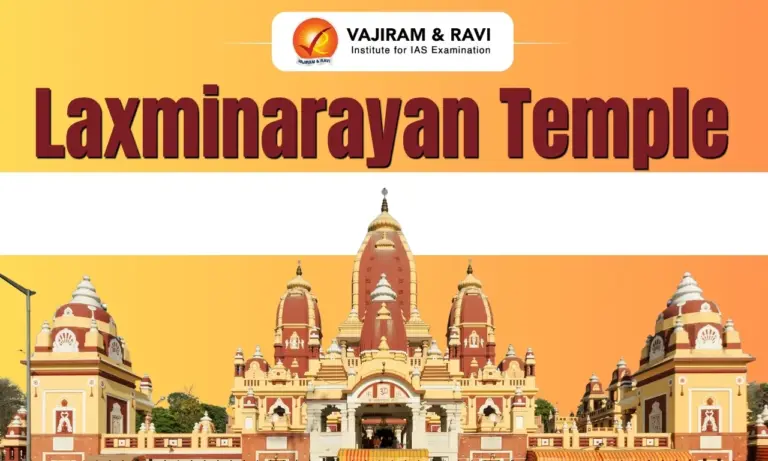
Laxminarayan Temple, also known as Birla Mandir, is one of the most famous Hindu temples in New Delhi. Dedicated to Goddess Laxmi and Lord Narayana, the temple is known for its beautiful architecture, peaceful surroundings and religious significance. It is known for its attractive architecture, detailed carvings, spacious gardens and peaceful atmosphere, the temple is visited by both devotees and tourists.
Laxminarayan Temple History and Architecture
- Laxminarayan Temple, popularly known as Birla Mandir, is one of the well-known Hindu temples in Delhi. It is dedicated to Goddess Laxmi, the goddess of prosperity, and Lord Narayana, the preserver of the universe.
- The foundation stone of the temple was laid in 1933, and the temple was built by Baldeo Das Birla and his son Jugal Kishore Birla. It was completed and opened to devotees in 1939.
- The temple was inaugurated by Mahatma Gandhi, who agreed to attend on the condition that people from all castes would be allowed to enter the temple.
- The temple was designed by Sris Chandra Chatterjee, who was associated with the Modern Indian Architecture Movement. Its design combines traditional Hindu architectural ideas with elements of modern construction.
- Birla Mandir follows the Nagara style of temple architecture, which is commonly found in northern India. The three-storey structure features a tall shikhara, detailed carvings and colourful decorations.
- The temple complex covers around 3 hectares and includes shrines, gardens, fountains and artificial waterfalls. The walls and pillars feature carvings and artistic representations related to Hindu mythology.
- The idols and other decorative elements were made using materials brought from places such as Jaipur, Makrana, Agra, Kota and Jaisalmer. Skilled artisans from Benares were involved in creating the temple’s intricate artwork.
- A 49-metre-high shikhara rises above the main sanctum, adding to the temple’s impressive appearance. The complex also includes Geeta Bhawan, which is associated with Lord Krishna.
Laxminarayan Temple Location and Significance
- Laxminarayan Temple is located in New Delhi, to the west of Connaught Place, making it easily accessible from several important parts of the city.
- The temple is an important religious and tourist attraction in Delhi and is visited by devotees as well as travellers throughout the year.
- Apart from the main shrine, the complex has other religious spaces, including a Buddhist shrine decorated with frescoes depicting important events from the life of Buddha.
- Its combination of religious importance, traditional architecture and landscaped surroundings makes Birla Mandir an important cultural landmark of New Delhi.
- The temple is also remembered for its connection with Mahatma Gandhi’s principle of social equality, as its opening was linked to the condition that people of all castes could enter.
- Beyond its religious role, Birla Mandir represents India’s cultural and architectural heritage. Its artwork, mythology-based carvings and traditional design make it an important place for understanding modern temple architecture in Delhi.
- The temple continues to serve as a place of worship, cultural gathering and spiritual reflection, while also remaining one of the notable heritage attractions of the capital.


 Last updated on August, 2026
→ UPSC Mains Question Paper 2026 is out now for Essay & GS Paper 1, 2, 3 & 4.
→ UPSC Mains GS Paper 1 2026 is out now.
→ UPSC Mains GS Paper 2 2026 is out now.
→ UPSC Mains GS Paper 3 2026 is out now.
→ UPSC Mains GS Paper 4 2026 is out now.
→ UPSC Mains Indian Language Paper & English Compulsory Paper are out now.
→ Check out the latest UPSC Syllabus 2026 here.
→ UPSC Mains Admit Card 2026 is now out.
→ Enroll in Vajiram & Ravi’s UPSC Mains Test Series 2027 for structured answer writing practice, expert evaluation, and exam-oriented feedback.
→ Join Vajiram & Ravi’s UPSC Mentorship Program 2027 for personalized guidance, strategy planning, and one-to-one support from experienced mentors.
→ Go through the UPSC Mains Previous Year Papers to enhance your preparation.
→ Download UPSC Mains Essay Paper 2025, UPSC Mains GS Paper-I 2025, UPSC Mains GS Paper-II 2025, UPSC Mains GS Paper-III 2025, UPSC Mains GS Paper-IV 2025, UPSC Mains English (Compulsory) Paper 2025, UPSC Mains Hindi (Qualifying) Paper 2025 here.
→ UPSC has released UPSC Toppers List 2025 with the Civil Services final result on its official website.
→ UPSC Calendar 2027 has been released.
→ Also check Best UPSC Coaching in India
Laxminarayan Temple FAQs
Q1. What is Laxminarayan Temple?+
Q2. Who built Laxminarayan Temple?+
Q3. Who inaugurated Laxminarayan Temple?+
Q4. Where is Laxminarayan Temple located?+
Q5. What is the architectural style of Laxminarayan Temple?+
Tags: art and culture art and culture notes laxminarayan temple