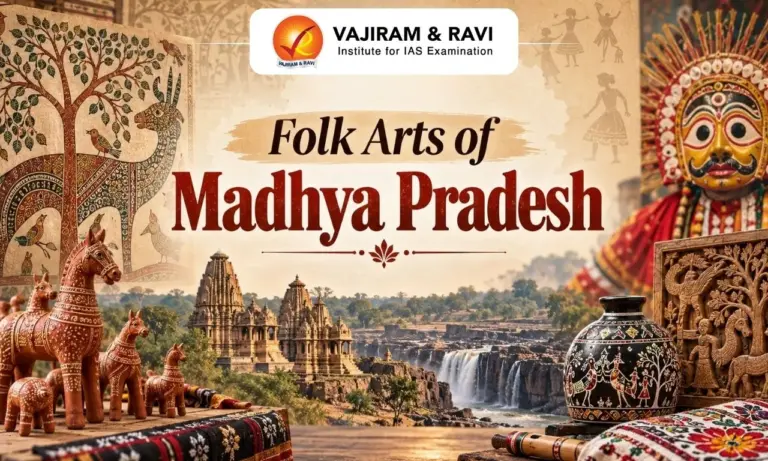
The Folk Arts of Madhya Pradesh reflect the state’s tribal diversity and regional traditions, where painting, weaving, printing, metalwork and crafts are closely linked with nature, rituals, community life and livelihoods.
Major Folk Arts of Madhya Pradesh
The major Folk Arts of Madhya Pradesh encompass a wide range of tribal paintings, body art, textile traditions, handicrafts, metal and clay crafts, folk music, dance and theatre, reflecting the state’s diverse communities, local resources, rituals and everyday life.
Tribal Paintings and Body Art
The tribal traditions of Madhya Pradesh often use nature, animals, deities and community life as their central themes.
- Gond Painting: Practised by the Gond community, it is recognised for colourful depictions of trees, animals, birds and other elements of nature, filled with fine lines, dots and repeated patterns.
- Bhil Art: Traditionally associated with Bhil communities, it uses small dots and rhythmic patterns to fill figures of animals, birds, plants, deities, the sun and moon, giving the paintings their distinctive appearance.
- Pithora Painting: A ritual wall painting, particularly associated with Rathwa and related tribal communities, in which horses are a prominent motif and the paintings are connected with ceremonies, deities and community beliefs.
- Godna: A traditional form of body tattooing associated particularly with Baiga women. Designs include geometric patterns and representations of plants, animals and religious symbols, making the body itself a medium of cultural expression.
Also Read: Tribes of Madhya Pradesh
Textile Printing and Weaving
Traditional textile practices combine local designs with specialised techniques that distinguish one region from another.
- Bagh Print: Practised in Bagh, Dhar district, this is a hand-block printing tradition using carved wooden blocks and traditionally prepared dyes. Its characteristic red-and-black colour combination and floral and geometric patterns are its key identifiers.
- Batik Print: Bhairavgarh near Ujjain is known for this wax-resist technique. Artisans apply wax to selected portions of cloth before dyeing it, creating patterns where the wax prevents the dye from penetrating the fabric.
- Nandana Print: Traditionally practised by the Bhil community in the Neemuch-Mandsaur region, this block-printing tradition uses nature-inspired motifs such as amba (mango), mirch (chilli) and champa kali, often with indigo and other natural colours.
- Chanderi: Produced in Chanderi, Ashoknagar, the fabric is valued for its lightness, fine texture and translucent appearance. Cotton, silk and zari are used to create sarees with delicate borders and traditional motifs.
- Maheshwari: Associated with Maheshwar, this textile tradition is known for its lightweight fabric, contrasting borders and distinctive pallu, produced using cotton, silk and zari. The tradition developed under the patronage of Ahilyabai Holkar.
- Dhurrie Weaving: Produces flat-woven floor coverings using cotton and other fibres. Sironj, Jabalpur, Jhabua and Shahdol are among the known centres.
- Carpet Weaving: Gwalior has a significant carpet-weaving tradition influenced by Persian techniques, with floral and geometric designs commonly used.
Dolls and Decorative Crafts
Traditional doll-making preserves local clothing styles, tribal characters and stories through handcrafted figures.
- Batto Bai Dolls: Associated with Gwalior, these handmade dolls use materials such as cloth, clay, bamboo and wire, with their costumes and appearance reflecting regional traditions.
- Jhabua Dolls: Made largely in the tribal belt of Jhabua, these wooden dolls depict humans, animals, deities and tribal characters, providing a visual representation of local folklore and everyday life.
- Paper Mache: Practised in Ujjain, Bhopal, Ratlam and Gwalior, artisans convert paper pulp into lightweight decorative objects such as masks, animals, birds and dolls.
Metal, Stone and Clay Crafts
The material used in these crafts often comes directly from the local environment, while traditional techniques are passed from one generation to another.
- Dhokra Craft: Practised by the Bharewa community of Betul, it uses the lost-wax casting technique to create non-ferrous metal objects, particularly figures of animals, tribal people and deities.
- Bell Craft: Tikamgarh is associated with bell-metal work, through which artisans make lamps, animals, toys and religious figures using traditional casting methods.
- Stone Carving: Madhya Pradesh has a strong stone-carving tradition, visible in areas such as Gwalior and Vidisha, while the wider heritage of stone sculpture is prominently represented by Khajuraho.
- Terracotta: Practised in regions such as Jhabua, Mandla, Betul and Bundelkhand, artisans shape locally available clay into animals, idols, toys and household objects.
- Basketry: Bamboo, cane and grasses are woven into baskets, storage containers and household articles. Communities including Basor, Baiga, Gond, Turi and Korku have traditionally contributed to this craft.
Jewellery and Embroidery
Traditional ornamentation combines aesthetic value with social and cultural significance.
- Traditional Jewellery: Tribal communities use silver, glass, lac, beads, seeds and cowries to make ornaments. The Benda is a traditional head ornament, while jhanjars are distinctive silver ornaments.
- Zardozi: Practised particularly in Bhopal, this decorative embroidery uses metallic threads, sequins, beads and other embellishments to create richly decorated textiles.
Folk Music, Dance and Theatre
The Folk Arts of Madhya Pradesh are also expressed through performance traditions that connect music, dance, theatre and community festivals.
- Matki: A popular Malwa folk dance, traditionally performed by women carrying earthen pots (matkis) and balancing them while dancing.
- Karma: A tribal dance associated with Karma worship, particularly among communities of eastern and central Madhya Pradesh; it is performed with rhythmic singing and dancing during community celebrations.
- Baredi: A traditional folk dance associated particularly with the Bundelkhand region, performed during festive and social occasions.
- Saila: A tribal group dance performed in parts of Madhya Pradesh, characterised by coordinated movements and rhythmic use of sticks.
- Rai: A vibrant folk dance of Bundelkhand, traditionally associated with women performers known as Bedni, and accompanied by folk music and rhythmic movement.
- Maanch: The traditional folk theatre of Malwa, combining dialogue, music, singing and performance to narrate stories from mythology, history and social life.
- Folk Songs: Regional traditions include songs associated with festivals, seasons and social occasions; Bhojali, Sanja songs, Chaiti and Kajri are examples found in the broader folk-song tradition of central and northern India.


 Last updated on Sep, 2026
→ UPSC 2027 Notification will be released on 13 January 2027 at upsconline.nic.in.
→ Check out the latest UPSC Syllabus 2026 here.
→ Download UPSC Model Answers for Mains 2026
→ UPSC Mains Question Paper 2026 is out now for Essay & GS Paper 1, 2, 3 & 4.
→ UPSC Calendar 2027 has been released.
→ Enroll in Vajiram & Ravi’s UPSC Mains Test Series 2027 for structured answer writing practice, expert evaluation, and exam-oriented feedback.
→ Join Vajiram & Ravi’s UPSC Mentorship Program 2027 for personalized guidance, strategy planning, and one-to-one support from experienced mentors.
→ Go through the UPSC Mains Previous Year Papers to enhance your preparation.
→ UPSC has released UPSC Toppers List 2025 with the Civil Services final result on its official website.
→ Also check Best UPSC Coaching in India
Folk Arts of Madhya Pradesh FAQs
Q1. What are the major Folk Arts of Madhya Pradesh?+
Q2. Which traditional craft uses the lost-wax technique?+
Q3. What is Maanch?+
Q4. What is Godna?+
Q5. What is unique about Gond Painting?+
Q6. Which tribal communities are associated with Pithora Painting?+
Tags: folk arts of madhya pradesh