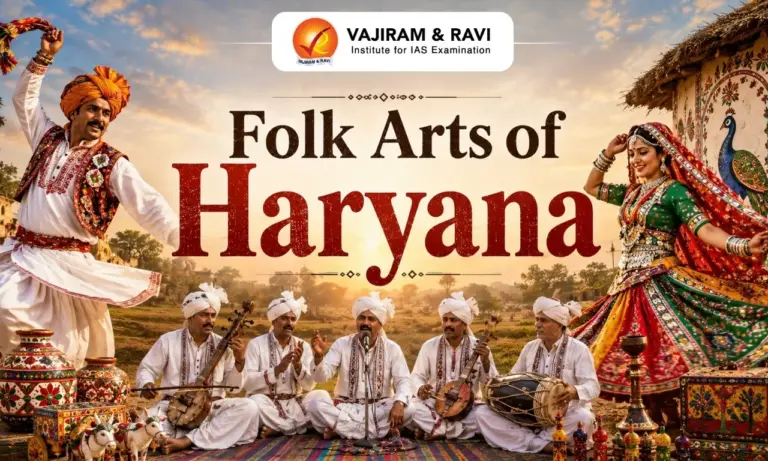
The Folk Arts of Haryana are traditional forms of creative expression developed within local communities and closely connected with rural life, festivals, agriculture, religious beliefs and social customs. They include folk dances, theatre, music, devotional art, embroidery, weaving and traditional handicrafts.
Major Folk Arts of Haryana
The major Folk Arts of Haryana include performing traditions such as Saang, Ragini and folk dances, along with visual and craft traditions such as Sanjhi, Phulkari, Panipat Durries and traditional pottery.
Folk Dances of Haryana
Haryana’s folk dances are closely connected with seasonal celebrations, festivals, weddings, religious traditions and the agricultural cycle.
- Ghoomar: A graceful circular dance performed mainly by women during weddings, festivals and other auspicious occasions. The dancers move in circles and twirl their flowing ghagras, creating the characteristic movement of the dance.
- Loor: A traditional dance performed by unmarried girls, particularly in the Bangar region, during the spring season around Holi. The songs often take the form of a conversation or question-and-answer exchange between the performers.
- Phag: A seasonal folk dance performed by farmers during Phalgun. Both men and women can participate, and it is associated with the spring and harvest season.
- Dhamal: An energetic male folk dance, particularly associated with the Ahir community of the Gurgaon region. It is traditionally performed when the crop is ready for harvest.
- Khoria: A women’s folk dance related to the Jhumar style and steps, popular in central Haryana. It is connected with agricultural activities, harvest and community life.
- Jhumar: Jhumar is specially performed by young married women. It is named after the Jhumar ornament and is also called Haryanvi Gidda in some parts of the state.
- Daph: A folk dance named after the daph, a large frame drum used to provide its rhythmic accompaniment.
- Gugga/Gogaji Dance: A devotional dance associated with Gugga Pir, a popular folk deity worshipped in Haryana and neighbouring regions. The tradition is particularly connected with beliefs surrounding protection from snakebites.
Folk Theatre and Musical Traditions
Haryana has a distinctive tradition of folk theatre and narrative singing, through which mythology, legends, romance, moral values and social experiences are communicated to local audiences.
- Saang: Haryana’s best-known folk theatre tradition, combining acting, dialogue, singing, music and dance. Performances are traditionally staged in an open space on a raised platform called an akhada. Male performers historically played both male and female roles. Stories are drawn from mythology, epics, historical legends and popular romances, including themes such as Harishchandra, Heer-Ranjha, Mirabai and Padmavat.
- Ragini: A distinctive Haryanvi folk-poetic and musical tradition closely associated with Saang. It consists of narrative verses dealing with love, separation, heroism, morality, philosophy and social life. Ragini provides an important musical component of Saang but is also performed independently.
Devotional and Visual Folk Arts
Haryana’s visual folk traditions are often connected with religious beliefs, household rituals and seasonal festivals, particularly among rural communities.
- Sanjhi: A traditional devotional wall art associated with the worship of Goddess Sanjhi. It is traditionally created by rural women during Navratri. Figures are made on walls using clay or cow dung and decorated with materials such as mica, flowers and coloured elements. The creation of Sanjhi is accompanied by devotional songs and rituals.
Traditional Embroidery and Textile Arts
Haryana’s textile traditions developed largely through community-based skills, with embroidery and weaving being used for clothing, household articles and ceremonial purposes.
- Phulkari: A traditional form of embroidery known for floral and geometric patterns worked with coloured thread on fabric. The craft is associated with the wider Haryana-Punjab cultural region and has traditionally been practised by women.
- Bagh: A denser form of embroidery in which the decorative stitching covers a much larger part of the fabric, creating a more heavily patterned appearance than ordinary Phulkari.
- Chope: A related embroidered textile traditionally associated with ceremonial and special occasions.
- Panipat Durries: Traditional flat-woven floor coverings associated with Panipat. They commonly feature stripes, checks and geometric patterns and represent the importance of weaving in the local textile tradition.
Traditional Handicrafts of Haryana
Haryana’s traditional handicrafts are largely based on locally available materials and practical household needs, including pottery, metalwork, reed work and leather craftsmanship.
- Pottery: Traditional potters use clay to make vessels, pitchers and decorative objects. Jhajjar is particularly known for its pottery tradition, while pottery is also practised in other parts of the state.
- Sarkanda Work: A traditional craft using sarkanda reed grass to produce useful and decorative articles. It is associated with areas such as Rewari, Sonipat and Panipat.
- Brassware: Traditional metalworking involving the production of brass utensils and other objects. Rewari and Jagadhari are notable centres.
- Leather Jutti: Traditional handmade leather footwear associated with areas such as Jhajjar and Rewari.
- Haryana Shawl: Traditional shawl-making influenced by the Kashmiri shawl tradition, with bright colours and decorative patterns.
- Bhiwani Brass Band Instruments: A specialised craft tradition involving the production of brass musical instruments, linking handicraft skills with Haryana’s musical traditions.


 Last updated on Oct, 2026
→ UPSC 2027 Notification will be released on 13 January 2027 at upsconline.nic.in.
→ Check Nobel Prize 2026 Winners List here.
→ Download PIB PRiSM Monthly Magazine 2026 here.
→ Check UPSC Monthly Current Affairs Magazine The Recitals here.
→ Check out the latest UPSC Syllabus here.
→ Download UPSC Model Answers for Mains 2026
→ UPSC Mains Question Paper 2026 is out now for Essay & GS Paper 1, 2, 3 & 4.
→ UPSC Calendar 2027 has been released.
→ Enroll in Vajiram & Ravi’s UPSC Mains Test Series 2027 for structured answer writing practice, expert evaluation, and exam-oriented feedback.
→ Join Vajiram & Ravi’s UPSC Mentorship Program 2027 for personalized guidance, strategy planning, and one-to-one support from experienced mentors.
→ Go through the UPSC Mains Previous Year Papers to enhance your preparation.
→ UPSC has released UPSC Toppers List 2025 with the Civil Services final result on its official website.
→ Also check Best UPSC Coaching in India
Folk Arts of Haryana FAQs
Q1. Which Folk Art of Haryana is associated with the Ahir community?+
Q2. Which Folk Art of Haryana is associated with Bangar and Holi?+
Q3. Which Folk Art of Haryana is a devotional wall art?+
Q4. Which Folk Arts of Haryana are associated with traditional embroidery?+
Q5. Which Folk Arts of Haryana use traditional materials such as reed and brass?+
Tags: folk arts of haryana