FCRA Amendment Bill 2026 Latest News
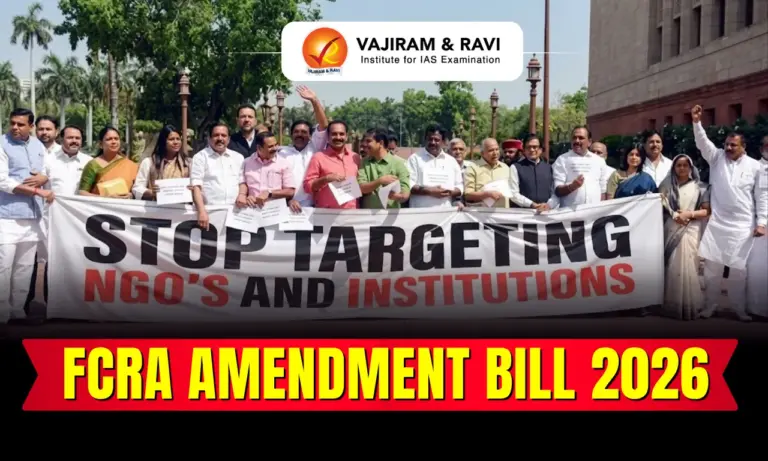
- The Foreign Contribution (Regulation) Amendment Bill, 2026 introduces a statutory framework for a “Designated Authority” to oversee foreign contributions and assets when an organisation’s FCRA certificate is cancelled, surrendered, or ceases to exist.
- While the State has a legitimate interest in regulating foreign funding, the Bill raises deeper constitutional questions about the extent of executive intervention in civil society institutions.
The Core Issue: Regulation vs Control
- The debate is not between civil society and national security.
- The real question: where does the State cross the line from regulating foreign contributions to exercising undue executive control over the institutions receiving them.


What the Bill Introduces
- A ‘Designated Authority’ appointed by the Central government to oversee vesting, supervision, management and disposal of foreign contributions and assets.
- Applies when an organisation’s FCRA certificate is cancelled, surrendered, or ceases to exist (including due to non-renewal).
- Foreign contributions and assets created from them may provisionally vest in this Authority.
- Framed officially as an accountability mechanism to prevent diversion or abuse of such properties.
Expansion Beyond Existing Law
- The existing FCRA already empowers scrutiny of foreign funding — registrations can be withdrawn, cancelled for non-compliance, and penalties imposed for misappropriation.
- Existing law already contains a provision for vesting assets created from foreign funds upon cancellation.
- What’s new: a detailed statutory framework covering provisional vesting, possession, management, restoration, and ultimately permanent vesting and disposal.
- The Designated Authority may, where deemed necessary in public interest, take possession of assets AND undertake management of the organisation’s activities itself.
Why Ownership vs Management Distinction Matters
- Even if the legal distinction between ownership and custody is important, it may not have much practical significance.
- For an institution whose success depends on continuity in management, control is often more important than ownership.
- The ownership of an institution may remain unchanged on paper, but if control over its management changes, its relationship with the government can change significantly.
- A hospital, school or laboratory cannot function effectively simply because it owns property or resources.
- What matters is its independence to manage and use those resources for its charitable purposes.
The Constitutional Test: Proportionality
- The Supreme Court has repeatedly held that even for legitimate state objectives, the means adopted must:
- Bear a reasonable connection to the objective
- Maintain a balance between public purpose and the burden imposed on rights
- Given the Bill’s consequences — provisional vesting and potential management takeover — the safeguards must be commensurately robust.
Safeguards Provided — And Their Adequacy
- The Bill allows for restoration of assets if registration is obtained, renewed, or restored within a prescribed period.
- Provides mechanisms for revision and judicial appeal.
- Open constitutional question: whether these safeguards are sufficiently clear, timely and effective.
The Broader Regulatory Context
- Over the past decade, thousands of FCRA registrations have ceased — for reasons ranging from non-renewal to alleged violations.
- Previously, the consequence was largely loss of eligibility to receive foreign funds.
- Under the new framework, this could extend to provisional management and, if registration isn’t restored in time, permanent vesting and disposal of assets.
Conclusion
- The FCRA Amendment Bill does not question the State’s legitimate authority to regulate foreign contributions, but it significantly expands the consequences of losing FCRA registration — potentially extending State control from asset possession to institutional management.
- Ensuring the Bill’s safeguards meet the constitutional standard of proportionality is essential to prevent regulatory overreach into civil society’s institutional autonomy.
Source: TH

 Last updated on August, 2026
→ UPSC Mains Question Paper 2026 is out now for Essay & GS Paper 1, 2, 3 & 4.
→ UPSC Mains GS Paper 1 2026 is out now.
→ UPSC Mains GS Paper 2 2026 is out now.
→ UPSC Mains GS Paper 3 2026 is out now.
→ UPSC Mains GS Paper 4 2026 is out now.
→ UPSC Mains Indian Language Paper & English Compulsory Paper are out now.
→ Check out the latest UPSC Syllabus 2026 here.
→ UPSC Mains Admit Card 2026 is now out.
→ Enroll in Vajiram & Ravi’s UPSC Mains Test Series 2027 for structured answer writing practice, expert evaluation, and exam-oriented feedback.
→ Join Vajiram & Ravi’s UPSC Mentorship Program 2027 for personalized guidance, strategy planning, and one-to-one support from experienced mentors.
→ Go through the UPSC Mains Previous Year Papers to enhance your preparation.
→ Download UPSC Mains Essay Paper 2025, UPSC Mains GS Paper-I 2025, UPSC Mains GS Paper-II 2025, UPSC Mains GS Paper-III 2025, UPSC Mains GS Paper-IV 2025, UPSC Mains English (Compulsory) Paper 2025, UPSC Mains Hindi (Qualifying) Paper 2025 here.
→ UPSC has released UPSC Toppers List 2025 with the Civil Services final result on its official website.
→ UPSC Calendar 2027 has been released.
→ Also check Best UPSC Coaching in India
FCRA Amendment Bill 2026 FAQs
Q1. What is the FCRA Amendment Bill 2026?+
Q2. What does the FCRA Amendment Bill 2026 change?+
Q3. Why is the FCRA Amendment Bill 2026 constitutionally significant?+
Q4. What is the Designated Authority under the FCRA Amendment Bill 2026?+
Q5. What safeguards does the FCRA Amendment Bill 2026 provide?+
Tags: FCRA Amendment Bill 2026 mains articles upsc current affairs upsc mains current affairs