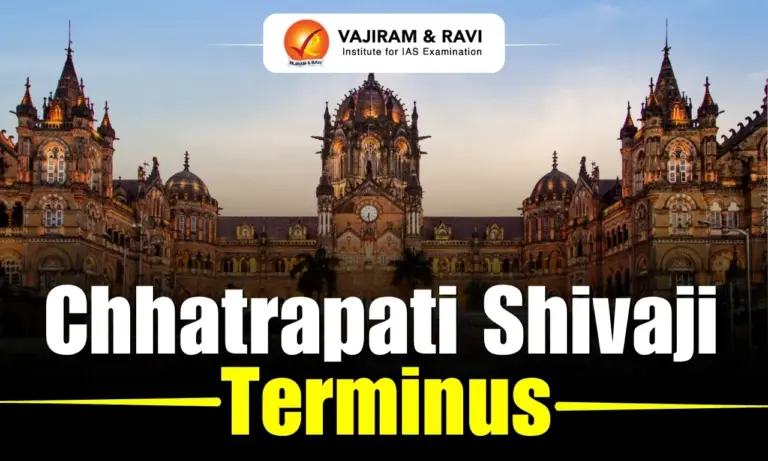
Chhatrapati Shivaji Terminus was formerly called Victoria Terminus. It is a historic railway station in Mumbai, Maharashtra and a major landmark of India’s railway heritage. It was designed by F. W. Stevens and constructed between 1878 and 1887. The building covers 2.85 hectares and represents a distinctive fusion of Victorian Gothic Revival architecture and Indian architectural traditions. UNESCO inscribed Chhatrapati Shivaji Terminus as a World Heritage Site in 2004 for its architectural and cultural value.
Chhatrapati Shivaji Terminus
Chhatrapati Shivaji Terminus is located in southern Mumbai near the Arabian Sea and serves suburban and long distance railway operations.
- Official Name: Its present official name is Chhatrapati Shivaji Maharaj Terminus (CSMT). It was formerly known as Victoria Terminus (VT) and later Chhatrapati Shivaji Terminus (CST).
- Location: The terminus is situated in Mumbai, Maharashtra, in the western part of India. It occupies a strategic position within Mumbai’s historic commercial and transport core.
- Architect: British architect F. W. Stevens designed the building after an initial concept associated with Axel Haig. Stevens developed an elaborate Italian Gothic architectural design.
- Construction Period: Construction began in 1878 and continued for 10 years. The building was completed in 1887 during the 50th anniversary period of Queen Victoria’s reign.
- Original Purpose: The structure was planned as the headquarters of the Great Indian Peninsula Railway. It replaced the earlier Bori Bunder railway station.
- Cost: The construction cost was approximately Rs. 16.14 lakh. The station was considered one of the largest buildings erected in Asia during its period.
- Railway Role: Chhatrapati Shivaji Terminus functions as a major terminal for suburban and long distance trains. The headquarters of Central Railway are also located within the complex.
- Station Code: The mainline station uses the code CSMT, while the suburban railway code is ST. The older abbreviations VT and CST also remain commonly used.
Chhatrapati Shivaji Terminus History
The history of Chhatrapati Shivaji Terminus reflects Mumbai’s transformation into an important railway, commercial and maritime centre during the colonial period.
- Bori Bunder Station: The terminus replaced the Bori Bunder railway station. Bori Bunder served the Great Indian Peninsula Railway and was connected with Mumbai’s growing port and trading activities.
- Victoria Terminus: The new station was named Victoria Terminus in 1887. The name commemorated Queen Victoria, who was then Empress of India.
- Renaming in 1996: In March 1996, Victoria Terminus was renamed Chhatrapati Shivaji Terminus. The new name honoured Chhatrapati Shivaji Maharaj, the 17th century Maratha ruler.
- Renaming in 2017: The station was renamed Chhatrapati Shivaji Maharaj Terminus in July 2017. The change added the honorific Maharaj to the existing name.
- UNESCO World Heritage Recognition: UNESCO inscribed the terminus on the World Heritage List in 2004. The recognition highlighted its architectural excellence and cultural interchange.


Chhatrapati Shivaji Terminus Architecture
The Chhatrapati Shivaji Terminus architectural design combines Victorian Italianate Gothic Revival elements with Indian traditions, creating a distinctive style associated with historic Mumbai.
- Architectural Style: The building follows High Victorian Gothic architecture adapted to Indian conditions. Italian Gothic influences appear alongside forms inspired by traditional Indian palace architecture.
- Building Plan: The structure has a C shaped plan arranged symmetrically around an east-west axis. Its unusual ground plan contributes to its distinctive architectural character.
- Central Dome: A prominent octagonal ribbed masonry dome crowns the building. It carries a 16 foot – 6 inch high female figure representing Progress with a flaming torch and wheel.
- Decorative Features: The façade contains stone carvings, pointed arches, turrets, gargoyles, floral designs, animal figures, human reliefs, stained glass and decorated rose windows.
- Materials: Local yellow Malad stone forms much of the building. Italian marble, polished granite and white limestone were also used in selected architectural elements.
- Structural Innovation: The central dome used dovetailed ribs and was constructed without conventional centering. This demonstrated advanced structural techniques for the late 19th century.
Chhatrapati Shivaji Terminus UNESCO World Heritage Site
UNESCO recognises Chhatrapati Shivaji Terminus for its outstanding architectural value and its representation of cultural interaction in colonial India.
- Chhatrapati Shivaji Terminus became a UNESCO World Heritage Site in 2004.
- The site demonstrates an important exchange between Victorian Italianate Gothic Revival architecture and Indian traditional architectural forms.
- It represents an outstanding example of late 19th century railway architecture. Its design combines Gothic Revival features, Indian elements and advanced structural solutions.
- The heritage property covers 2.85 hectares. A protected buffer zone of 90.21 hectares surrounds the property to control harmful development pressures.
- Maharashtra declared the building a Heritage Grade I structure on 21 April 1997. Its protection operates under Mumbai’s heritage regulations and railway administration.
- The Ministry of Railways holds the legal rights over the property. The Divisional Railway Manager, Mumbai Division of Central Railway, oversees its management and maintenance.
Chhatrapati Shivaji Terminus Significance
Chhatrapati Shivaji Terminus remains significant for its historical, architectural, cultural and transport value, linking Mumbai’s railway development with its urban heritage.
- Cultural Fusion: The terminus demonstrates how British architects and Indian craftsmen combined different architectural traditions. This created a distinctive architectural expression unique to Mumbai.
- Railway Heritage: It is among the finest functional railway station buildings of the world. Its continued railway use connects its heritage value with modern urban transport.
- Mumbai Symbol: The building became a symbol of Mumbai’s emergence as a major mercantile port. It represented the city’s growing economic importance during the late 19th century.
- Public Access: The heritage building has been open for public viewing on working days since December 2012. A heritage gully was inaugurated near platform 18 in April 2018.
- National Importance: Chhatrapati Shivaji Terminus combines railway technology, architectural innovation and Indian craftsmanship. Its UNESCO status makes it an important landmark of India’s built heritage.

 Last updated on Oct, 2026
→ UPSC 2027 Notification will be released on 13 January 2027 at upsconline.nic.in.
→ Check Nobel Prize 2026 Winners List here.
→ Download PIB PRiSM Monthly Magazine 2026 here.
→ Check UPSC Monthly Current Affairs Magazine The Recitals here.
→ Check out the latest UPSC Syllabus here.
→ Download UPSC Model Answers for Mains 2026
→ UPSC Mains Question Paper 2026 is out now for Essay & GS Paper 1, 2, 3 & 4.
→ UPSC Calendar 2027 has been released.
→ Enroll in Vajiram & Ravi’s UPSC Mains Test Series 2027 for structured answer writing practice, expert evaluation, and exam-oriented feedback.
→ Join Vajiram & Ravi’s UPSC Mentorship Program 2027 for personalized guidance, strategy planning, and one-to-one support from experienced mentors.
→ Go through the UPSC Mains Previous Year Papers to enhance your preparation.
→ UPSC has released UPSC Toppers List 2025 with the Civil Services final result on its official website.
→ Also check Best UPSC Coaching in India
Chhatrapati Shivaji Terminus FAQs
Q1. What is Chhatrapati Shivaji Terminus?+
Q2. Who designed Chhatrapati Shivaji Terminus?+
Q3. When was Chhatrapati Shivaji Terminus built?+
Q4. When did Chhatrapati Shivaji Terminus become a UNESCO World Heritage Site?+
Q5. What was Chhatrapati Shivaji Terminus formerly called?+
Tags: chhatrapati shivaji terminus shivaji terminus