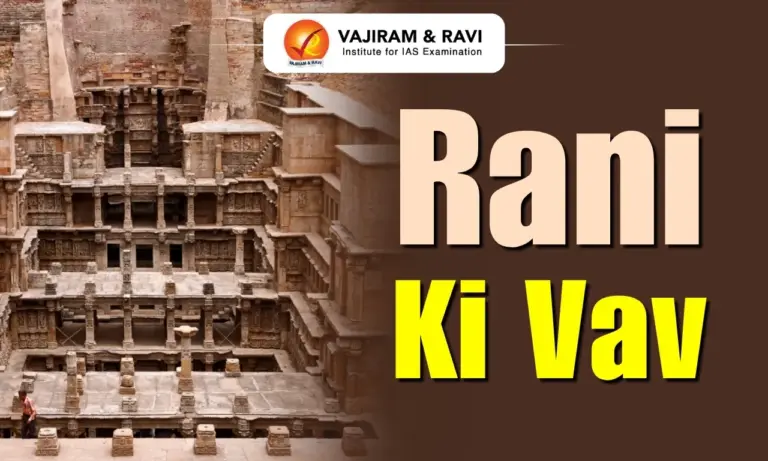
Rani Ki Vav, also called the Queen’s Stepwell, is a historic stepwell at Patan in Gujarat. It stands on the banks of the Saraswati River. It was built in the 11th century CE as a memorial to a king. It combines water management, religious symbolism and detailed stone carving. Rani Ki Vav is also an important example of the Maru-Gurjara architectural tradition.
Rani Ki Vav
Rani Ki Vav is a major subterranean water structure that shows the high level of stepwell construction achieved in medieval Gujarat.
- Location: Rani Ki Vav is located at Patan, Gujarat, on the banks of the Saraswati River. It is oriented along an east-west axis and forms a major historic monument of the region.
- Construction: Construction is attributed to Udayamati, the queen of the 11th century Chaulukya king Bhima I. It was initially created as a memorial for the king.
- Period: Rani Ki Vav belongs to the 11th century CE. The stepwell represents the mature stage of the traditional Indian practice of creating underground water sources and storage structures.
- Purpose: The structure served both religious and functional purposes. It was designed as an inverted temple that emphasised the sanctity of water while providing access to groundwater.
- Structure: Rani Ki Vav contains a stepped corridor, four pavilions, a tank and a deep well. The pavilions increase in storeys towards the western end of the structure.
Rani Ki Vav History
Rani Ki Vav passed through centuries of environmental and historical changes before its excavation and restoration in modern times.
- Chaulukya Period: Rani Ki Vav was constructed during the rule of the Chaulukya dynasty. A 1304 text, Prabandha-Chintamani by Jain monk Merutunga, records Udayamati’s construction of the stepwell at Shripattana, the historic name associated with Patan.
- Construction Date: Merutunga’s account states that the stepwell was commissioned in 1063 and completed after 20 years. Another architectural interpretation places its construction around 1032 based on similarities with the Vimalavasahi temple at Mount Abu.
- Flooding and Silt: The Saraswati River later flooded the structure and caused extensive silting. Geo tectonic changes in the 13th century altered the riverbed and eventually stopped Rani Ki Vav from functioning as a water well.
- Rediscovery: Henry Cousens and James Burgess recorded the buried structure in the 1890s. Only the well shaft and a few pillars were visible because most of the stepwell remained underground.
- Excavation: Excavations conducted under the Baroda State in the 1940s revealed Rani Ki Vav.
- Restoration: The Archaeological Survey of India undertook major excavation and restoration between 1981 and 1987.


Rani Ki Vav Architecture and Structures
Rani Ki Vav is renowned for combining functional water architecture with elaborate sculpture and the distinctive Maru-Gurjara style.
- Dimensions: The stepwell is approximately 65 metres long, 20 metres wide and 28 metres deep. Its western well shaft is 10 metres in diameter and reaches a depth of 30 metres.
- Seven Levels: The structure is divided into seven levels of stairs. These levels descend towards the underground water space and contain richly carved architectural and sculptural elements.
- Deepest Level: The fourth level is the deepest part of the stepped structure. It leads to a rectangular tank measuring 9.5 metres by 9.4 metres at a depth of 23 metres.
- Pavilions and Pillars: Four multi storeyed pavilions are arranged along the stepped corridor. Rani Ki Vav contains 212 pillars, along with decorated walls, beams, brackets and columns.
- Sculptural Wealth: More than 500 principal sculptures and over 1,000 minor sculptures decorate the stepwell. They present religious, mythological and secular imagery, including references to literary traditions.
- Deities: Sculptures include Brahma, Vishnu, Shiva, Ganesha, Kubera, Lakulisha, Bhairava, Surya, Indra, Hayagriva, Lakshmi, Parvati, Saraswati, Chamunda, Durga and the Saptamatrikas.
- Vishnu Imagery: Vishnu receives particular prominence through representations such as Sheshashayi Vishnu, Vishwarupa Vishnu and the Dashavatara. These sculptures form an important part of the religious imagery of the monument.
- Decorative Motifs: The carvings include Apsaras, animals, birds, plants, Kalpavriksha, kirtimukhas and makaras. Geometric lattice patterns and designs resembling local Patola textile traditions also appear in the decoration.
Rani Ki Vav UNESCO World Heritage Site
Rani Ki Vav received international heritage recognition because of its exceptional combination of water architecture, craftsmanship, religious imagery and structural design.
- UNESCO Inscription: Rani Ki Vav was added to the UNESCO World Heritage List on 22 June 2014. It is recognised for its Outstanding Universal Value as an exceptional subterranean stepwell.
- UNESCO Criteria: The monument satisfies Criterion (i) for outstanding artistic and creative achievement and Criterion (iv) as an exceptional example of a subterranean water resource and storage structure.
- Integrity: Most major architectural components survive, although some pavilion storeys are missing. Silting after the 13th century flooding helped preserve the monument and many sculptures for more than seven centuries.
- Authenticity: Rani Ki Vav retains strong authenticity in its materials, design, workmanship and substance. Limited reconstruction was undertaken where structural support was necessary, with reconstructed portions kept visually distinguishable.
- Protection: Rani Ki Vav is a Monument of National Importance protected under the Ancient Monuments and Archaeological Sites Act of 1958, as amended in 2010. The Archaeological Survey of India manages the property.
- Protected Zone: A 100 metre non development zone surrounds the architectural structure. Its buffer zone is incorporated into the Second Revised Development Plan to control unsuitable development around the heritage property.
Rani Ki Vav Significance
Rani Ki Vav represents the intersection of water management, religious thought, architecture and artistic expression in medieval India.
- Water Architecture: Stepwells developed as distinctive subterranean water systems across the Indian subcontinent. Rani Ki Vav represents an advanced stage of this architectural tradition, combining practical water access with monumental design.
- Cultural Value: The monument presents a large visual world of gods, goddesses, celestial beings, people, animals, birds and plants. Its sculptures preserve important aspects of religious and secular artistic traditions.
- Architectural Importance: Its seven levels, pavilions, tank, well shaft and extensive carvings demonstrate the architectural and craftsmanship achievements associated with the Maru-Gurjara tradition.
- National Recognition: Rani Ki Vav was declared a Monument of National Importance and was named India’s “Cleanest Iconic Place” at the 2016 Indian Sanitation Conference.
- Rani Ki Vav on Note Currency: Since July 2018, Rani Ki Vav has been depicted on the reverse of the ₹100 banknote of the New Series, giving the monument wider national recognition.

 Last updated on Oct, 2026
→ UPSC 2027 Notification will be released on 13 January 2027 at upsconline.nic.in.
→ Check Nobel Prize 2026 Winners List here.
→ Download PIB PRiSM Monthly Magazine 2026 here.
→ Check UPSC Monthly Current Affairs Magazine The Recitals here.
→ Check out the latest UPSC Syllabus here.
→ Download UPSC Model Answers for Mains 2026
→ UPSC Mains Question Paper 2026 is out now for Essay & GS Paper 1, 2, 3 & 4.
→ UPSC Calendar 2027 has been released.
→ Enroll in Vajiram & Ravi’s UPSC Mains Test Series 2027 for structured answer writing practice, expert evaluation, and exam-oriented feedback.
→ Join Vajiram & Ravi’s UPSC Mentorship Program 2027 for personalized guidance, strategy planning, and one-to-one support from experienced mentors.
→ Go through the UPSC Mains Previous Year Papers to enhance your preparation.
→ UPSC has released UPSC Toppers List 2025 with the Civil Services final result on its official website.
→ Also check Best UPSC Coaching in India
Rani Ki Vav FAQs
Q1. Where is Rani Ki Vav located?+
Q2. Who built Rani Ki Vav?+
Q3. Why is Rani Ki Vav Famous?+
Q4. When did Rani Ki Vav become a UNESCO World Heritage Site?+
Q5. Which architectural style is used in Rani Ki Vav?+
Q6. Rani Ki Vav is located in which Indian State?+
Q7. Rani Ki Vav is depicted on which Indian Currency Note?+
Tags: rani ki vav