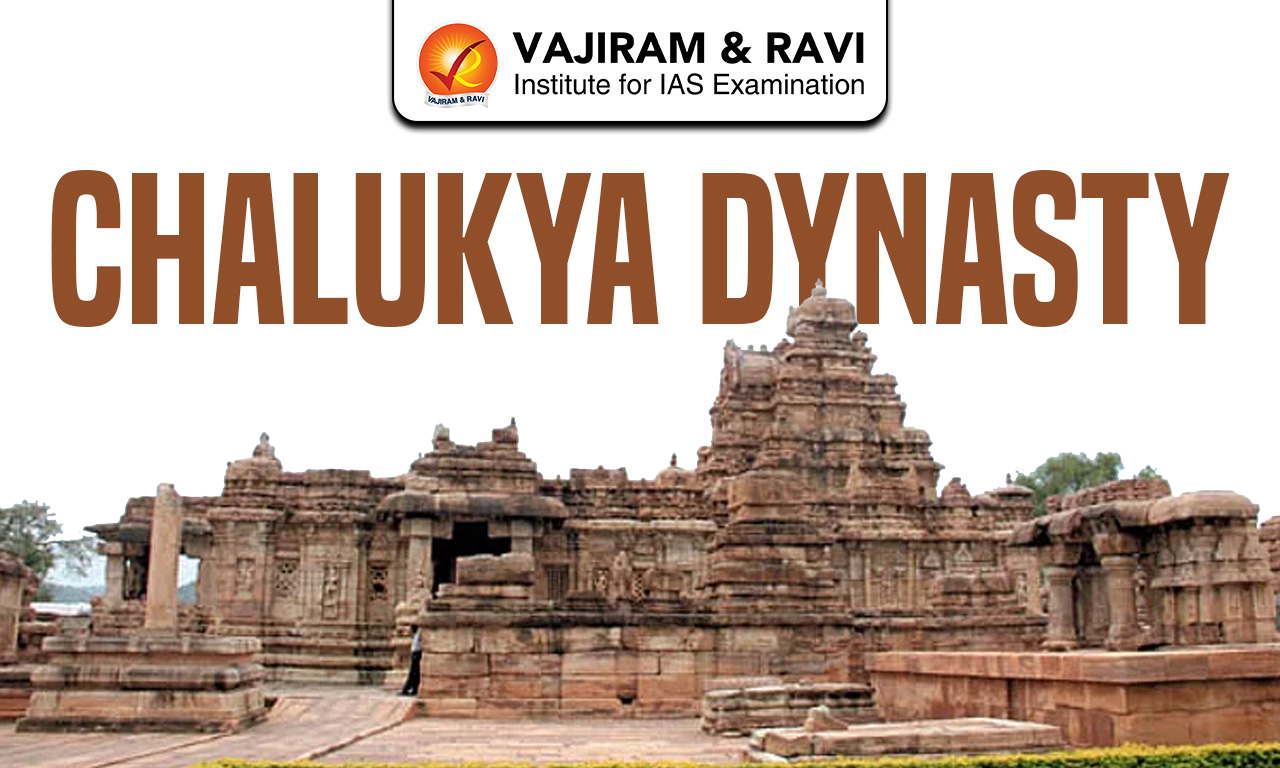
The Chalukya Dynasty was one of the most influential dynasties in early medieval India, ruling large parts of the Deccan region between the 6th and 12th centuries. They laid the foundation for political stability, cultural development, and architectural innovation in South India. The Chalukyas are especially remembered for their powerful rulers, efficient administration, religious tolerance, and remarkable temple architecture.
Chalukya Dynasty Origin and Rise
The Chalukya Dynasty emerged in the 6th century in the Deccan region, with its base in present-day Karnataka. Under the leadership of Pulakesin I, the dynasty established a strong kingdom at Badami and gradually expanded into a powerful empire.
- The dynasty was founded by Pulakesin I around 543 CE, marking the beginning of Chalukya rule.
- He established his capital at Badami (ancient Vatapi), which became a major political and cultural center.
- The early Chalukyas started as local chiefs under larger powers but gradually gained independence.
- Strategic location in the Deccan plateau helped them control important trade and military routes.
- The use of strong fortifications at Badami provided security and helped consolidate their rule.
- The real expansion of the empire took place under Pulakeshin II, who turned the kingdom into a vast empire.
- Pulakeshin II defeated Harsha, which established the Chalukyas as a major power in India.
- Continuous conflicts with the Pallava dynasty further strengthened their military and political position.
- The Chalukyas unified large parts of the Deccan, creating stability and encouraging cultural growth.
Branches of Chalukya Dynasty
The Chalukya Dynasty was divided into three major branches, each ruling different regions of the Deccan and contributing significantly to Indian history, culture, and architecture.
1. Badami Chalukyas (c. 543-753 CE)
- Founded by Pulakesin I, who established Chalukya power in the Deccan.
- Capital was Badami (ancient Vatapi), a strategically located and well-fortified city.
- This branch marked the beginning of Chalukya political dominance in South India.
- The greatest ruler, Pulakeshin II, expanded the empire across most of the Deccan plateau.
- Pulakeshin II defeated Harsha, stopping northern expansion beyond the Narmada River.
- Maintained long and intense conflicts with the Pallava dynasty, especially under Narasimhavarman I.
- The Pallavas temporarily captured Badami, weakening Chalukya power.
- The administration was well-structured with provinces, districts, and village-level governance.
- Promoted early temple architecture at Aihole, Badami, and Pattadakal, laying the foundation of the Vesara style.
- Encouraged both Sanskrit and Kannada languages in administration and literature.
- Supported multiple religions, including Hinduism, Jainism, and Buddhism.
- Their decline began due to continuous wars and internal weaknesses, leading to their defeat by the Rashtrakutas.
2. Eastern Chalukyas (c. 624-11th Century)
- Founded by Kubja Vishnuvardhana, the brother of Pulakeshin II.
- Established in the Vengi region with capital at Vengi.
- Initially served as a subordinate branch of the Badami Chalukyas but later became independent.
- Ruled for nearly four centuries, making them one of the longest-surviving branches.
- Played a key role in the development and promotion of Telugu language and literature.
- Maintained political stability in the eastern Deccan despite frequent conflicts.
- Frequently involved in wars and alliances with the Chola dynasty.
- Entered into matrimonial alliances with the Cholas, which strengthened political ties.
- Acted as a cultural bridge between northern Sanskrit traditions and southern Dravidian culture.
- Encouraged temple construction and religious activities in the region.
- Their administration followed similar patterns to the Badami Chalukyas but adapted to local needs.
- Eventually merged with the Chola Empire due to increasing political influence and alliances.
3. Western Chalukyas (c. 973-1189 CE)
- Also known as the Kalyani Chalukyas, with capital at Basavakalyan.
- Emerged after the decline of the Rashtrakuta Empire and revived Chalukya power in the Deccan.
- Established a strong and stable kingdom in the later medieval period.
- Known for efficient administration and decentralization of power to local authorities.
- Introduced improved revenue systems and strengthened governance structures.
- Played a key role in the transition of South Indian political and cultural systems.
- Made significant contributions to temple architecture, especially using soapstone for detailed carvings.
- Developed advanced features such as lathe-turned pillars and highly ornate temple designs.
- Their architecture represents a transition between early Chalukya and Hoysala styles.
- Encouraged Kannada and Sanskrit literature, supporting scholars and poets.
- Engaged in conflicts with the Cholas and other regional powers for dominance in the Deccan.
- Gradually declined due to the rise of powerful dynasties like the Hoysalas and Seunas (Yadavas).


Chalukya of Badami
The Chalukyas emerged as a powerful force in the Deccan under the leadership of Pulakesin I (c. 533-566 CE), who transformed a small regional power into an independent kingdom.
Pulakesin I (c. 533-566 CE)
- Founder of the Badami Chalukya dynasty and first independent ruler.
- Established Chalukya power in the Deccan region.
- Made Badami (Vatapi) his capital due to its strong natural defenses of hills and rivers.
- Built a strong hill-fort to secure his kingdom.
- Performed the Ashvamedha sacrifice to declare sovereignty.
- Adopted the title Vallabheshvara.
- Laid the political and military foundation for future expansion.
Kirtivarman I (566-597 CE)
- Son and successor of Pulakesin I.
- Expanded the kingdom through military conquests.
- Defeated the Mauryas of North Konkan, the Nalas of Nalavadi, and the Kadambas of Banavasi.
- Strengthened Chalukya control over Karnataka and surrounding regions.
- Consolidated administrative structure and internal stability.
Mangalesa (597-609 CE)
- Brother of Kirtivarman I; ruled as regent for his nephew.
- Expanded the empire by defeating the Kalachuris of Chedi.
- Established control over a vast region between the eastern and western seas.
- Attempted to retain power instead of handing it to the rightful heir.
- His actions led to a civil war with Pulakeshin II.
Pulakeshin II (609-642 CE)
- One of the greatest rulers of the Chalukya dynasty.
- Defeated Mangalesa in a civil war and ascended the throne.
- Adopted the title Satyashraya.
- Made the Chalukyas the paramount power in the Deccan.
- Defeated southern powers like the Western Gangas and Alupas.
- Northern rulers such as Latas, Malavas, and Gurjaras accepted his supremacy.
- Successfully stopped the advance of Harshavardhana at the Narmada River.
- Conquered the Vengi region and appointed his brother Kubja Vishnuvardhana as governor, leading to the rise of Eastern Chalukyas.
- Initially defeated the Pallava dynasty and occupied northern territories.
- Later defeated by Pallava ruler Narasimhavarman I, who captured Badami.
- Maintained diplomatic relations with Persia; received an envoy from Khosrow II.
- Visited by Chinese traveler Xuanzang.
- Encouraged art, architecture, and learning; Aihole inscription written by Ravikirti.
Vikramaditya I (644-681 CE)
- Son of Pulakeshin II who restored Chalukya power after decline.
- Recovered territories lost to the Pallavas.
- Formed alliances with the Pandyas.
- Invaded and plundered Kanchipuram, avenging his father’s defeat.
- Re-established stability and unity in the empire.
Vinayaditya (681-693 CE)
- Ruled during a period of peace and prosperity.
- Maintained stability and strong administration.
- Focused on consolidation rather than expansion.
Vijayaditya (693-733 CE)
- Had one of the longest and most peaceful reigns.
- Period marked by economic growth and internal stability.
- Encouraged large-scale temple construction and religious activities.
- Strengthened administrative efficiency.
Vikramaditya II (733-745 CE)
- Powerful ruler known for repeated victories over the Pallavas.
- Invaded Kanchipuram multiple times and defeated the Pallavas decisively.
- His victories ended Pallava dominance in the far south.
- Successfully resisted Arab invasions in western India (especially Gujarat region).
- Promoted art and temple architecture.
Kirtivarman II (744-745 CE)
- Last ruler of the Badami Chalukya dynasty.
- Faced internal weaknesses and external threats.
- Defeated by Dantidurga.
- Led to the rise of the Rashtrakuta dynasty.
- Marked the end of the Badami Chalukya rule.
Eastern Chalukyas (c. 624 – 11th Century)
The Eastern Chalukyas were an important branch of the Chalukya dynasty that ruled the eastern Deccan region, particularly the fertile coastal plains of Andhra Pradesh. They were founded by Kubja Vishnuvardhana, the brother of Pulakeshin II, after the conquest of the Vengi region.
Political History and Struggles
- Early rulers after Vishnuvardhana were mostly weak, leading to political instability.
- Between 642 CE and 705 CE, frequent changes in rulers weakened the kingdom.
- Internal family disputes and succession conflicts created instability.
- The rise of the Rashtrakuta dynasty posed a serious threat.
- Rashtrakutas repeatedly invaded and overran the Vengi region.
- Stability was restored under Gunaga Vijayaditya III (848 CE), who resisted Rashtrakuta dominance.
- He initially maintained friendly relations with Rashtrakuta ruler Amoghavarsha but later asserted independence.
- Continuous conflicts with neighboring powers shaped the political structure of the kingdom.
- Eventually, the Eastern Chalukyas were absorbed into the Chola Empire through alliances and succession.
Kubja Vishnuvardhana (624-641 CE)
- Founder of the Eastern Chalukya dynasty.
- Initially served as viceroy under Pulakeshin II.
- Declared independence and established a separate kingdom in Vengi.
- Known by the title Vishamasiddhi (conqueror of difficulties).
- Likely died in battle during conflicts with the Pallavas.
- Succeeded by his son Jayasimha I.
Mangi Yuvaraja (682–706 CE)
- His reign marked the end of a series of weak rulers.
- Faced increasing pressure from the Rashtrakuta dynasty.
- Had to defend the kingdom against repeated invasions.
- Began efforts to stabilize the kingdom.
Rajaraja Narendra (1019–1061 CE)
- One of the most important rulers of the dynasty.
- Established the city of Rajahmundry (Rajahmahendravaram).
- His reign saw cultural and literary development.
- Maintained close relations with the Cholas through marriage alliances.
- Married Amangai Devi, daughter of Rajendra Chola I.
- His son later became a ruler of the Chola Empire, leading to the merger of the two dynasties.
Administration under Eastern Chalukya
- Early administration followed the model of Badami Chalukyas but later developed regional features.
- Based on traditional Hindu political theory like Saptanga (seven elements of the state).
- Important officials included ministers, priests, military commanders, and administrators.
- Key administrative divisions were Vishaya (district) and Kottam (sub-division).
- Royal orders were issued to local officers and village assemblies.
- Land grants were common and often recorded in inscriptions.
- Local chiefs and officers like Manneyas held land assignments.
Religion under Eastern Chalukya
- Hinduism was the dominant religion, especially Shaivism.
- Many rulers called themselves Parama Maheswara (devotees of Shiva).
- Temples were built and religious festivals were organized.
- Buddhism declined during this period.
- Jainism continued to receive support and had strong public presence.
- Jain temples and land grants are mentioned in inscriptions.
- Ruler Vimaladitya was a follower of Jain teachings.
Architecture under Eastern Chalukya
- Temple construction increased due to the popularity of Shaivism.
- Vijayaditya II is said to have built 108 temples.
- Yuddhamalla I built a Kartikeya temple at Vijayawada.
- Bhima I constructed famous temples like:
- Draksharama Temple
- Samalkot Temple
- Developed a distinct architectural style influenced by Pallava and Chalukya traditions.
- Famous temple groups include:
- Pancharama temples
- Biccavolu temples
- Golingeshvara Temple is known for sculptures of Shiva, Vishnu, Agni, and Surya.
Western Chalukyas (c. 973-1189 CE)
The Western Chalukyas, also known as the Kalyani Chalukyas, were a later branch of the Chalukya dynasty that ruled large parts of the Deccan from the late 10th to the 12th century. They revived Chalukya power after the decline of the Rashtrakutas and played a crucial role in the political and cultural history of South India. Their capital was at Basavakalyan (ancient Kalyani).
Origin and Establishment
- Founded by Tailapa II in 973 CE after defeating the last Rashtrakuta ruler.
- Re-established Chalukya authority nearly two centuries after the fall of the Badami Chalukyas.
- Initially ruled from Manyakheta (former Rashtrakuta capital).
- Later shifted capital to Basavakalyan (Kalyani), which became a major political and cultural center.
- Claimed descent from the earlier Chalukyas to legitimize their rule.
- Their rise marks the beginning of a new phase in Deccan politics.
Political Expansion and Conflicts
- Controlled vast regions including Karnataka, parts of Maharashtra, Andhra Pradesh, and Telangana.
- Constantly engaged in wars with the powerful Chola dynasty for control over the Vengi region.
- The Tungabhadra River served as a natural boundary between Chalukya and Chola territories.
- Fought against other regional powers like the Paramaras, Kalachuris, and Hoysalas.
- Maintained a balance of power in the Deccan through both warfare and alliances.
- Period marked by both military conflicts and political stability.
Important Rulers and Their Contributions
We have described in brief all the important rulers of the Western Chalukyas along with their contributions to administration, society, religion, economy, art and architecture.
Tailapa II (973–997 CE)
- Founder of the dynasty.
- Defeated the Rashtrakutas and restored Chalukya prestige.
- Consolidated control over the Deccan region.
Satyashraya (997–1008 CE)
- Defended the kingdom against Chola invasions.
- Maintained territorial integrity during external threats.
Someshvara I (1042–1068 CE)
- One of the most capable rulers.
- Strengthened administration and military organization.
- Developed Basavakalyan as a prominent capital.
- Continued conflicts with the Cholas for dominance in South India.
Vikramaditya VI (1076–1126 CE)
- Greatest ruler of the Western Chalukyas.
- His reign is considered the golden age of the dynasty.
- Introduced the Chalukya-Vikrama Era in 1076 CE.
- Defeated the Cholas and expanded political influence.
- Ensured long-term peace, stability, and prosperity.
- Patronized scholars like Bilhana and Vijnaneshwara.
- Promoted literature, law, and culture.
Administration
- Strong central monarchy supported by ministers and officials.
- Kingdom divided into Mandalas (provinces), Nadus (districts), and villages.
- Local self-government played an important role in administration.
- Feudal system was prominent, with local chiefs (feudatories) controlling regions.
- Land revenue was the main source of income.
- Officers were appointed for tax collection, law enforcement, and justice.
- Inscriptions mention grants to temples, Brahmins, and institutions.
Economy
- Agriculture was the backbone of the economy, supported by irrigation tanks and canals.
- Cultivation of crops like rice, millet, and pulses was common.
- Trade flourished due to control over inland trade routes.
- Trade links existed with other regions of India and possibly overseas.
- Guilds of merchants and artisans played a significant role in economic life.
- Use of coins and land grants facilitated economic transactions.
Religion and Society
- Hinduism was dominant, especially Shaivism and Vaishnavism.
- Rulers built temples and supported religious institutions.
- Patronized Jainism, which had a strong presence in Karnataka.
- Society was organized around temples, which acted as centers of social and economic activity.
- Religious tolerance allowed multiple faiths to flourish.
Art and Architecture
- Developed a unique architectural style known as the Later Chalukya or Kalyani style.
- Used soapstone, which allowed detailed and intricate carvings.
- Introduced lathe-turned pillars, a key architectural innovation.
- Temples featured ornate doorways, sculpted ceilings, and detailed iconography.
- Represent a transitional phase between early Chalukya and Hoysala architecture.
Important Temples
- Mahadeva Temple – Known as the “Emperor among Temples”
- Kashivisvesvara Temple – Famous for intricate carvings
- Dodda Basappa Temple – Unique star-shaped structure
Decline
- Continuous wars with the Cholas weakened the empire.
- Rise of powerful regional dynasties like the Hoysalas and Seunas reduced their influence.
- Internal rebellions and feudal fragmentation weakened central authority.
- Gradual loss of territories led to decline by the late 12th century.

 Last updated on Oct, 2026
→ UPSC 2027 Notification will be released on 13 January 2027 at upsconline.nic.in.
→ Check Nobel Prize 2026 Winners List here.
→ Download PIB PRiSM Monthly Magazine 2026 here.
→ Check UPSC Monthly Current Affairs Magazine The Recitals here.
→ Check out the latest UPSC Syllabus here.
→ Download UPSC Model Answers for Mains 2026
→ UPSC Mains Question Paper 2026 is out now for Essay & GS Paper 1, 2, 3 & 4.
→ UPSC Calendar 2027 has been released.
→ Enroll in Vajiram & Ravi’s UPSC Mains Test Series 2027 for structured answer writing practice, expert evaluation, and exam-oriented feedback.
→ Join Vajiram & Ravi’s UPSC Mentorship Program 2027 for personalized guidance, strategy planning, and one-to-one support from experienced mentors.
→ Go through the UPSC Mains Previous Year Papers to enhance your preparation.
→ UPSC has released UPSC Toppers List 2025 with the Civil Services final result on its official website.
→ Also check Best UPSC Coaching in India
Chalukya Dynasty FAQs
Q1. What was the Chalukya Dynasty?+
Q2. Who founded the Chalukya Dynasty?+
Q3. Who was the greatest ruler of the Chalukyas?+
Q4. What were the main branches of the Chalukya Dynasty?+
Q5. What was the capital of the Chalukyas?+
Q6. What is the Vesara style of architecture?+
Tags: chalukya dynasty geography geography notes