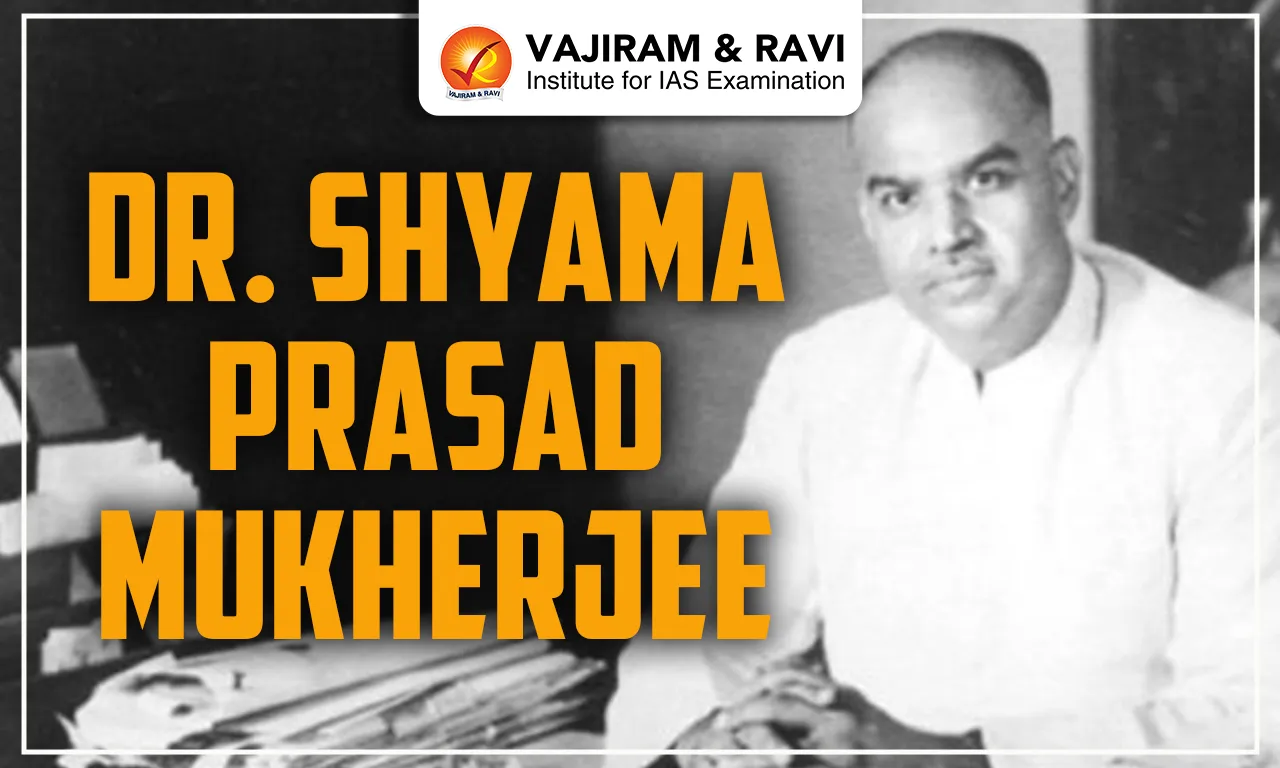
Dr. Shyama Prasad Mukherjee was a nationalist leader, educationist, barrister, and politician who played a crucial role in shaping India’s political discourse after independence. He is best known as the founder of the Bharatiya Jana Sangh, the predecessor of today’s Bharatiya Janata Party (BJP). A strong critic of the Nehruvian policies, Mukherjee emphasized cultural nationalism, national integration, and the importance of self-reliance.
Who was Dr. Shyama Prasad Mukherjee?
Dr. Shyama Prasad Mukherjee was the youngest Vice-Chancellor of Calcutta University (1934-38), where he worked to expand higher education in India. Entering politics during the pre-independence era, he initially worked with the Indian National Congress but later emerged as a strong leader within the Hindu Mahasabha. After independence, he became India’s first Industry and Supply Minister (1947-50) under Prime Minister Jawaharlal Nehru. However, ideological differences led him to resign and eventually form the Bharatiya Jana Sangh in 1951.
Dr. Shyama Prasad Mukherjee Biography
Dr. Shyama Prasad Mukherjee, also known as Dr. Syama Prasad Mookerjee was born on 6 July 1901 in Calcutta (Kolkata), hailed from a distinguished family of academicians and lawyers. This overview shows his personal information and contribution as both an intellectual and a political leader who laid the foundation of a nationalist alternative in Indian politics.
| Dr. Shyama Prasad Mukherjee Biography | |
| Aspects | Details |
|
Full Name |
Dr. Shyama Prasad Mukherjee (Syama Prasad Mookerjee) |
|
Born |
6 July 1901, Calcutta (West Bengal) |
|
Education |
Barrister from Lincoln’s Inn, London |
|
Profession |
Politician, Educationist, Lawyer |
|
Major Positions |
Vice-Chancellor, Calcutta University (1934-38); Industry and Supply Minister (1947-50) |
|
Contribution |
Founder of Bharatiya Jana Sangh (1951) |
|
Died |
23 June 1953, Srinagar (Kashmir) |


Dr. Shyama Prasad Mukherjee’s Early Life and Education
Mukherjee was born into an Educated Family. His father, Sir Ashutosh Mukherjee, was a renowned judge and educationist. Completing his BA and MA in English, Mukherjee pursued law and went on to study at Lincoln’s Inn in London, qualifying as a barrister in 1927. His academic excellence and leadership qualities soon brought him recognition, and by 1934, he was appointed as the youngest Vice-Chancellor of Calcutta University, at just 33 years of age.
Dr. Shyama Prasad Mukherjee’s Political Career
Mukherjee’s political journey began in the Bengal Legislative Council as an independent candidate in 1929. Later, he joined the Indian National Congress but distanced himself due to ideological differences. He became associated with the Hindu Mahasabha during the 1930s and opposed policies that he believed undermined Hindu interests.
After independence, he was inducted into Nehru’s cabinet as the first Industry and Supply Minister. He played a key role in laying the foundation of India’s industrial development by supporting small-scale industries, industrialization plans, and self-reliance. However, his disagreements with Nehru on issues such as Kashmir, Pakistan, and secularism led him to resign in 1950.
Dr. Shyama Prasad Mukherjee Bharatiya Jana Sangh
In 1951, Syama Prasad Mookerjee founded the Bharatiya Jana Sangh, which later evolved into the Bharatiya Janata Party (BJP). The Jana Sangh was built on the principles of cultural nationalism, economic self-reliance, and strong national unity. Under his leadership, the party emerged as an important opposition force, giving shape to a new direction in Indian politics. His vision provided the foundation for future political debates on nationalism, identity, and governance.
Shyama Prasad Mukherjee and Article 370
Dr. Shyama Prasad Mukherjee strongly opposed Article 370 and considered it harmful for India’s unity, constitutional integration and national identity.
- Opposition to Separate Constitutional System: Mukherjee criticised the special constitutional arrangement of Jammu and Kashmir, arguing that a separate constitution and administrative structure weakened the idea of a united Indian nation and encouraged political division within the country.
- Criticism of the Permit System in Kashmir: He opposed the rule requiring Indian citizens to obtain permits and carry identification cards for entering Jammu and Kashmir, considering it inconsistent with the principles of equal citizenship and free movement within India.
- “Ek Desh Mein Do Vidhan” Slogan: Mukherjee popularised the slogan “Ek desh mein do Vidhan, do Pradhan aur do Nishan nahi chalenge,” expressing his belief that one nation should function under one constitution, one leadership system and one national symbol.
- Satyagraha Against Special Status: Bharatiya Jana Sangh, along with Jammu Praja Parishad and Hindu Mahasabha, organised a large scale Satyagraha movement under Mukherjee’s leadership demanding removal of the special provisions granted to Jammu and Kashmir.
Shyama Prasad Mukherjee Contributions
Dr. Shyama Prasad Mukherjee contributed significantly to education, politics, nationalism, social reform and constitutional debates in post independence India.
- Promotion of Indian Languages in Education: During his tenure at Calcutta University, Mukherjee encouraged the use of Indian vernacular languages in higher education and supported greater academic recognition for regional linguistic and cultural studies.
- Support for Bengali Language in Academia: He played an important role in allowing Bengali to gain prominence in university academic activities, including convocation addresses, helping strengthen Indian linguistic identity within educational institutions.
- Leadership in University Administration: Mukherjee introduced administrative and academic reforms at Calcutta University that enhanced institutional functioning and strengthened its reputation as one of India’s major centres of higher learning.
- Contribution to Academic Recognition and Research: As an influential educationist, he promoted intellectual advancement, academic excellence and scholarly recognition through his active involvement with university bodies and educational organisations across India.
- Role in Relief Activities During Crisis: After resigning from the Bengal government in 1942, Mukherjee supported relief operations for flood affected people with the assistance of organisations such as Ramakrishna Mission and Mahabodhi Society.
- Participation in Constitution Making Process: Mukherjee became a member of the Constituent Assembly of India, contributing to debates and discussions during the crucial phase of framing the constitutional foundation of independent India.
- Advocacy for Minority Protection in East Bengal: He strongly raised concerns regarding the condition of Hindus in East Bengal and criticised policies that, according to him, failed to provide adequate security and rehabilitation measures.
- Contribution to Opposition Politics in Parliament: Mukherjee helped strengthen parliamentary opposition by creating the National Democratic Party group in Parliament, providing an organised political alternative during the early post independence years.
- Contribution to Buddhist Cultural Heritage: As president of the Mahabodhi Society, Mukherjee participated in the return and preservation of sacred Buddhist relics brought back to India and later placed inside the Sanchi Stupa.
- Advocacy for Bengali Hindu Homeland Movement: Mukherjee supported the movement demanding Partition of Bengal to safeguard Hindu majority regions and played a leading role in shaping the political demand for the creation of West Bengal within India.
- Public Service During Bengal Political Crisis: While serving in Bengal politics, Mukherjee criticised administrative restrictions, raised public concerns regarding governance and remained active in legislative affairs during politically turbulent periods before independence.
Challenges Faced by Shyama Prasad Mukherjee
Despite his contributions, Syama Prasad Mookerjee faced several challenges:
- Ideological conflicts with the ruling Congress Party.
- Limited organizational strength of the newly formed Jana Sangh.
- Resistance from political rivals regarding his stance on Kashmir and Hindu nationalism.
- Lack of resources and grassroots support compared to the Congress.
Way Forward: Dr. Shyama Prasad Mukherjee’s vision still holds relevance in contemporary Indian politics. His emphasis on national unity, cultural identity, and self-reliance continues to guide political thought.
Dr. Shyama Prasad Mukherjee Legacy
Dr. Shyama Prasad Mukherjee remains one of India’s most significant nationalist leaders, whose ideas shaped post-independence politics. His opposition to Article 370, emphasis on self-reliance, and foundation of the Bharatiya Jana Sangh continue to influence Indian politics.
Dr. Shyama Prasad Mukherjee’s Ideologies
Dr. Shyama Prasad Mukherjee’s ideologies centered around cultural nationalism, economic self-reliance, and strong national unity. He believed that India’s progress depended on connecting its governance with cultural identity. He opposed excessive appeasement in politics and advocated for equal rights for all citizens. His vision of economic policy emphasized small-scale industries, indigenous enterprise, and reducing foreign dependence. His ideological foundation later shaped the Bharatiya Jana Sangh and continues to influence modern Indian politics through the Bharatiya Janata Party (BJP).
Shyama Prasad Mukherjee’s Death
Dr. Syama Prasad Mookerjee’s life came to a sudden end on 23 June 1953 in Srinagar, Jammu and Kashmir. He had entered Kashmir without a permit to protest against Article 370 and was arrested by state authorities. While in custody, his health deteriorated, and he died under controversial circumstances. Many of his supporters believed negligence and political conspiracy were behind his death. His passing created a strong wave of protest across India and turned him into a martyr for the cause of national unity.

 Last updated on Oct, 2026
→ UPSC 2027 Notification will be released on 13 January 2027 at upsconline.nic.in.
→ Check Nobel Prize 2026 Winners List here.
→ Download PIB PRiSM Monthly Magazine 2026 here.
→ Check UPSC Monthly Current Affairs Magazine The Recitals here.
→ Check out the latest UPSC Syllabus here.
→ Download UPSC Model Answers for Mains 2026
→ UPSC Mains Question Paper 2026 is out now for Essay & GS Paper 1, 2, 3 & 4.
→ UPSC Calendar 2027 has been released.
→ Enroll in Vajiram & Ravi’s UPSC Mains Test Series 2027 for structured answer writing practice, expert evaluation, and exam-oriented feedback.
→ Join Vajiram & Ravi’s UPSC Mentorship Program 2027 for personalized guidance, strategy planning, and one-to-one support from experienced mentors.
→ Go through the UPSC Mains Previous Year Papers to enhance your preparation.
→ UPSC has released UPSC Toppers List 2025 with the Civil Services final result on its official website.
→ Also check Best UPSC Coaching in India
Dr. Shyama Prasad Mukherjee FAQs
Q1. Who was Dr. Shyama Prasad Mukherjee?+
Q2. When and where was Dr. Shyama Prasad Mukherjee born?+
Q3. What was Dr. Shyama Prasad Mukherjee’s role in Indian politics?+
Q4. Why did Dr. Shyama Prasad Mukherjee oppose Article 370?+
Q5. When did Dr. Shyama Prasad Mukherjee die?+
Tags: biography dr shyama prasad mukherjee famous personalities important personalities