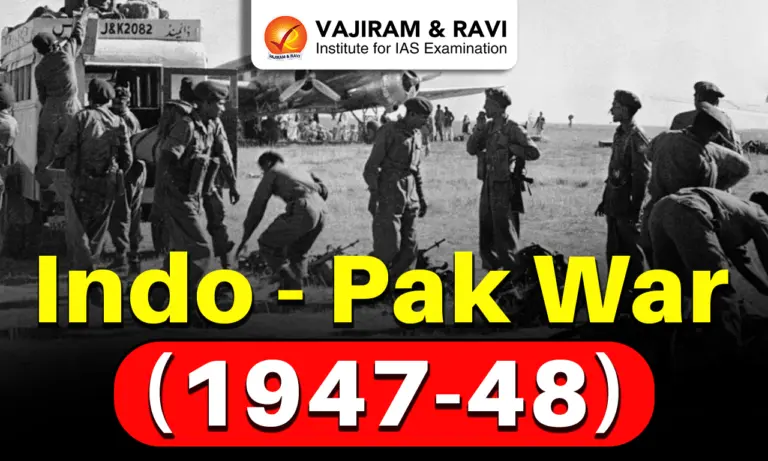
The Indo-Pak War of 1947–1948 was the first military conflict fought between India and Pakistan after both countries gained independence from United Kingdom in 1947. The war was mainly fought over the princely state of Jammu and Kashmir. It began in October 1947 and continued until January 1949, ending with a United Nations-mediated ceasefire. The conflict laid the foundation for future tensions between India and Pakistan and remains an important topic in Indian history and international relations.
Indo Pak War (1947-48) Background
The background of the Indo-Pak War of 1947–1948 was mainly linked to the Partition of British India and the dispute over Jammu and Kashmir after independence in 1947.
- India and Pakistan became independent from United Kingdom in August 1947 after the Partition of British India.
- Around 565 princely states were given the option to join either India or Pakistan.
- Jammu and Kashmir was ruled by Maharaja Hari Singh, who initially wanted to remain independent.
- Kashmir had a Muslim-majority population but was ruled by a Hindu king, creating political tension.
- Pakistan expected Kashmir to join it because of its Muslim-majority population.
- India believed the decision should be based on the legal choice of the ruler.
- In October 1947, tribal invaders supported by Pakistan entered Kashmir and attacked several areas.
- The invasion created fear and instability in the region, forcing the Maharaja to seek military help from India.
- Maharaja Hari Singh signed the Instrument of Accession on 26 October 1947, officially joining Kashmir with India.
- After the Instrument of Accession, Indian troops were sent to Srinagar, leading to the beginning of the Indo-Pak War (1947–48).
Indo Pak War (1947-48) Major Events
The Indo-Pak War of 1947–1948 witnessed several important military and political events that shaped the future of Jammu and Kashmir and relations between India and Pakistan.
- On 22 October 1947, tribal militias supported by Pakistan invaded Kashmir through the northwestern region.
- The invaders captured areas like Muzaffarabad and moved toward Srinagar, creating panic in the valley.
- Maharaja Hari Singh requested military assistance from India to protect Jammu and Kashmir.
- On 26 October 1947, the Maharaja signed the Instrument of Accession, officially joining Jammu and Kashmir with India.
- On 27 October 1947, the Indian Army airlifted troops to Srinagar Airport, marking the formal beginning of India’s military operation.
- The Battle of Srinagar became a major turning point as Indian forces successfully defended the city from invading forces.
- Indian troops recaptured important towns such as Baramulla and Uri from tribal fighters.
- The Battle of Poonch saw heavy fighting, where Indian forces defended civilians and strategic areas from attacks.
- During the Zoji La Operation, the Indian Army used tanks in high-altitude mountain warfare, which was considered a major military achievement.
- Fighting continued across different regions of Kashmir throughout 1948 between Indian and Pakistani-supported forces.
- In January 1948, India approached the United Nations regarding Pakistan’s involvement in Kashmir.
- The United Nations called for a ceasefire and advised both countries to stop military operations.
- The war officially ended on 1 January 1949 with a UN-mediated ceasefire agreement.
- After the ceasefire, Kashmir was divided between Indian-controlled territory and Pakistan-occupied Kashmir (PoK).


Indo Pak War (1947-48) Outcome
The Indo-Pak War of 1947–1948 ended with a ceasefire in 1949, but the conflict permanently changed the political and military relations between India and Pakistan.
- The war ended with a United Nations-mediated ceasefire on 1 January 1949.
- Jammu and Kashmir was divided into two parts after the ceasefire.
- One part remained under the control of India, while the other came under Pakistan’s control, known as Pakistan-occupied Kashmir (PoK).
- A Ceasefire Line was established between the two countries, which later became the Line of Control (LoC).
- Thousands of soldiers and civilians lost their lives during the conflict.
- The war increased political tensions and mistrust between India and Pakistan.
- The Kashmir issue became an international dispute and remained unresolved.
- The conflict led both countries to strengthen their military forces and border security.
- The war established the foundation for future Indo-Pak conflicts, including the Indo-Pakistani War of 1965 and the Kargil War.
- The involvement of the United Nations increased international attention on South Asian politics and regional security.
Indo Pak War (1947-48) Impact
The Indo-Pak War of 1947–1948 had a deep impact on the political, military, social, and international relations of India and Pakistan.
- The war permanently turned Jammu and Kashmir into a major issue between India and Pakistan.
- It increased political hostility and mistrust between the two newly independent nations.
- Both countries started strengthening their armed forces and improving border security after the conflict.
- The war led to the creation of a Ceasefire Line, which later became the Line of Control (LoC).
- Thousands of soldiers and civilians were killed or displaced during the conflict.
- Many families in Kashmir faced long-term social and economic difficulties because of violence and migration.
- The conflict increased the importance of national security and defense planning in India and Pakistan.
- The involvement of the United Nations internationalized the Kashmir dispute.
- The war laid the foundation for future Indo-Pak conflicts, including the Indo-Pakistani War of 1965, Indo-Pakistani War of 1971, and the Kargil War.
- It shaped the foreign policies and defense strategies of both India and Pakistan for many decades.
- The conflict also highlighted the strategic importance of Kashmir in South Asian geopolitics.

 Last updated on Oct, 2026
→ UPSC 2027 Notification will be released on 13 January 2027 at upsconline.nic.in.
→ Check Nobel Prize 2026 Winners List here.
→ Download PIB PRiSM Monthly Magazine 2026 here.
→ Check UPSC Monthly Current Affairs Magazine The Recitals here.
→ Check out the latest UPSC Syllabus here.
→ Download UPSC Model Answers for Mains 2026
→ UPSC Mains Question Paper 2026 is out now for Essay & GS Paper 1, 2, 3 & 4.
→ UPSC Calendar 2027 has been released.
→ Enroll in Vajiram & Ravi’s UPSC Mains Test Series 2027 for structured answer writing practice, expert evaluation, and exam-oriented feedback.
→ Join Vajiram & Ravi’s UPSC Mentorship Program 2027 for personalized guidance, strategy planning, and one-to-one support from experienced mentors.
→ Go through the UPSC Mains Previous Year Papers to enhance your preparation.
→ UPSC has released UPSC Toppers List 2025 with the Civil Services final result on its official website.
→ Also check Best UPSC Coaching in India
Indo Pak War (1947-48) FAQs
Q1. What was the Indo-Pak War (1947–48)?+
Q2. When did the Indo-Pak War (1947–48) begin?+
Q3. Why was the Indo-Pak War (1947–48) fought?+
Q4. Who signed the Instrument of Accession?+
Q5. What was the role of the United Nations in the war?+
Tags: international relations