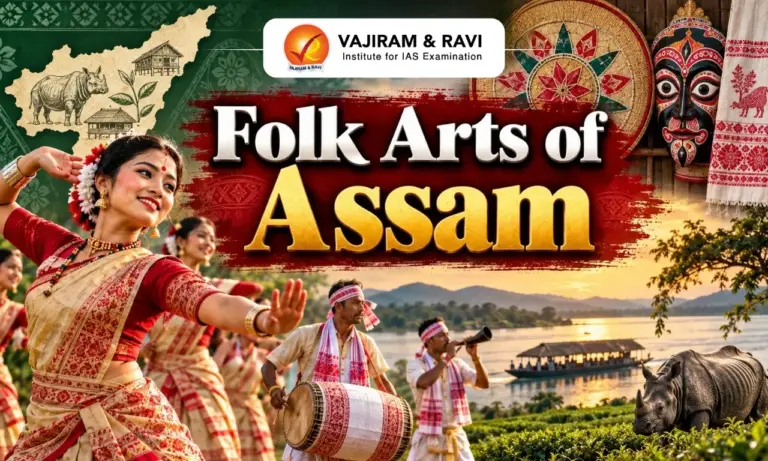
Assam is known for its rich tradition of folk arts, shaped by its diverse communities, festivals, religious practices and everyday life. The Folk Arts of Assam include traditional dances, music, weaving, bamboo and cane crafts, metalwork, pottery and wood carving, many of which remain closely connected with agriculture, seasonal festivals and the Vaishnavite traditions of the state.
Major Folk Arts of Assam
The major Folk Arts of Assam reflect the cultural traditions of communities such as the Assamese, Bodo, Mising and Tea Tribes. They range from lively folk dances and songs to traditional crafts that use locally available materials such as bamboo, cane, clay, wood, silk and metal.
Folk Dances of Assam
- Bihu Dance: Bihu is the best-known folk dance of Assam and is closely associated with Rongali or Bohag Bihu, celebrated in April. Young men and women perform it in groups with lively movements and rhythmic steps, accompanied by instruments such as the dhol, pepa and gogona. The dance is closely linked to the agricultural cycle and the celebration of the Assamese New Year.
- Bagurumba: Bagurumba is a popular dance of the Bodo community, performed mainly by women during Bwisagu, the Bodo New Year festival. The dancers use gentle and flowing movements that are often compared to butterflies, birds and swaying vegetation. Because of this, Bagurumba is popularly known as the “Butterfly Dance.”
- Jhumur Nach: Jhumur Nach, also known as Jhumoir, is associated with the Tea Tribe and Adivasi communities of Assam. It developed in the tea-growing areas of the state and is usually performed in groups, particularly by women. The dance combines coordinated movements with traditional songs and reflects the community’s social and cultural life.
- Deodhani: Deodhani is a ritual dance associated with the worship of Manasa, the snake goddess. It is particularly found in parts of Kamrup and Darrang. Traditionally, the performer may enter a trance-like state during the ritual, giving the dance a strong religious and spiritual character.
- Bhortal Nritya: Bhortal Nritya developed in Barpeta and is associated with the Sankari cultural tradition. It is performed in groups using large cymbals, with dancers creating rhythmic movements and formations. It is commonly performed during festivals and other cultural occasions.
- Gumrag: Gumrag is a dance of the Mising community and is closely associated with Ali-Aye-Ligang, the community’s agricultural festival. The dance reflects the importance of agriculture and the natural environment in Mising life.
Folk Music of Assam
Music forms an integral part of Assam’s festivals and community life. Traditional instruments such as the dhol, pepa, gogona and taal accompany many folk songs and dances.
- Bihu Geet: Bihu Geet is the best-known form of Assamese folk music and is traditionally sung during the Bihu festivals. The songs often express love, youth, nature and everyday rural life. They are performed along with Bihu dance and are accompanied by instruments such as the dhol, pepa and gogona.
- Goalpariya Lokgeet: Goalpariya Lokgeet developed in the Goalpara region of western Assam and is known for its simple and expressive melodies. Its themes include love, rural life and the experiences of mahouts, or elephant handlers. The tradition was brought wider recognition by the renowned singer Pratima Barua Pandey.
- Tokari Geet: Tokari Geet is a form of philosophical folk music associated with the use of the Tokari, a traditional plucked string instrument. The songs explore themes of life, spirituality and the relationship between the human being and the divine.
- Zikir and Zari: Zikir and Zari are devotional musical traditions associated with Ajan Fakir, a 17th-century Sufi saint. They reflect the interaction between Islamic spiritual traditions and Assamese folk culture and form an important part of Assam’s syncretic musical heritage.
-
Deh Bicharar Geet: Deh Bicharar Geet is a form of philosophical folk song associated with the spiritual and mystical traditions of Assam. The songs explore the human body, life, death and the relationship between the individual and the divine.
Folk music in Assam is often accompanied by traditional instruments that give its performances their distinctive rhythm and sound. The dhol provides the main rhythmic base in Bihu performances, while the pepa, traditionally made from buffalo horn, adds a distinctive melody. The gogona, a bamboo jaw harp, is particularly associated with Bihu performances, while taal and the flute are also commonly used.
Narrative and Ritual Traditions
- Ojapali: Ojapali is a distinctive form of narrative performance that combines singing, dance and storytelling. The lead performer, known as the Oja, is accompanied by a group called the Pali. The performances draw on religious and mythological stories. Byah Ojapali mainly draws from the Ramayana, Mahabharata and Puranic traditions, while Sukananni Ojapali is associated with the worship of Manasa and the story of Behula and Lakhindar.
- Bhaona: Bhaona is a traditional form of devotional theatre associated with Srimanta Sankardev’s Vaishnavite movement. It combines dialogue, music, dance and dramatic performance to present religious stories. The Satras of Majuli have played an important role in preserving this tradition.
- Majuli Mask-Making: Mask-making is one of the distinctive artistic traditions of Majuli, particularly associated with Samaguri Satra. The masks are traditionally used in Bhaona to portray characters from religious stories. The craft has been passed down through generations within the Satra tradition.
Traditional Crafts of Assam
Assam’s traditional crafts make extensive use of materials available locally, including bamboo, cane, clay, wood, silk and metal. These crafts have developed not only as forms of artistic expression but also as part of everyday life.
Weaving and Textiles
- Muga Silk: Muga is one of Assam’s most distinctive textile traditions. It is a naturally golden-coloured silk known for its durability and characteristic sheen. Muga is widely used in traditional Assamese clothing and is an important part of the state’s handloom heritage.
- Mising Handloom: The Mising community has a distinctive weaving tradition with its own designs, colours and patterns. Mising textiles are used for traditional clothing and household purposes, and Mising Handloom Products have also been registered under the Geographical Indication (GI) system.
- Gamusa: Gamusa is a handwoven cloth that has become an important symbol of Assamese identity. It is used in everyday life and during religious and social occasions and is often presented as a gesture of respect. During Bihu, the decorated Gamusa presented as a mark of affection and respect is known as Bihuwaan.
Bamboo, Cane and Mat Crafts
- Jaapi: Jaapi is a traditional conical hat made mainly from bamboo or cane and tokoupaat, a type of palm leaf. It was originally used for protection from the sun and rain but has also become an important cultural symbol of Assam, particularly during Bihu celebrations.
- Sital Pati: Sital Pati is a traditional mat made from the murta plant. The plant is cut into thin strips, which are then processed and woven into mats with different patterns. The craft is particularly associated with Cachar in southern Assam.
- Bamboo and Cane Craft: Bamboo and cane are widely used across Assam to make baskets, mats, furniture, household objects and other utility items. The craft reflects the close relationship between Assam’s natural environment and its everyday material culture.
Bell-Metal Craft
- Sarthebari Metal Craft: Sarthebari in Barpeta district is one of Assam’s important centres of traditional bell-metal craft. Artisans make a range of household and ceremonial objects, including kahi, bati, bota and xorai. The craft continues to be an important part of the region’s traditional metalworking heritage.
- Xorai: Xorai is a traditional bell-metal object used to present betel nut, betel leaf, Prasad and other offerings. It is also commonly presented to guests and honoured persons as a symbol of respect and Assamese hospitality.
Terracotta Craft
Asharikandi Terracotta: Asharikandi in Dhubri district is known for its traditional terracotta craft. Local artisans make a variety of clay objects and figurines, including the well-known Hatima Putul, which depicts a mother and child. The craft is an important example of Assam’s rural pottery tradition.
Wood Carving
Wood Carving: Traditional wood carving can be seen prominently in Assam’s Satras and Namghars, where wooden panels, doors and other structures are decorated with figures of animals, birds, flowers and mythical beings. The craft forms an important part of the state’s religious and architectural heritage.


 Last updated on Sep, 2026
→ UPSC 2027 Notification will be released on 13 January 2027 at upsconline.nic.in.
→ Check out the latest UPSC Syllabus here.
→ Download UPSC Model Answers for Mains 2026
→ UPSC Mains Question Paper 2026 is out now for Essay & GS Paper 1, 2, 3 & 4.
→ UPSC Calendar 2027 has been released.
→ Enroll in Vajiram & Ravi’s UPSC Mains Test Series 2027 for structured answer writing practice, expert evaluation, and exam-oriented feedback.
→ Join Vajiram & Ravi’s UPSC Mentorship Program 2027 for personalized guidance, strategy planning, and one-to-one support from experienced mentors.
→ Go through the UPSC Mains Previous Year Papers to enhance your preparation.
→ UPSC has released UPSC Toppers List 2025 with the Civil Services final result on its official website.
→ Also check Best UPSC Coaching in India
Folk Arts of Assam FAQs
Q1. What are the major folk arts of Assam?+
Q2. Which folk dance is associated with the Bodo community of Assam?+
Q3. What is Ojapali of Assam?+
Q4. What is Tokari Geet?+
Q5. What are Zikir and Zari in Assam?+
Tags: folk arts of assam