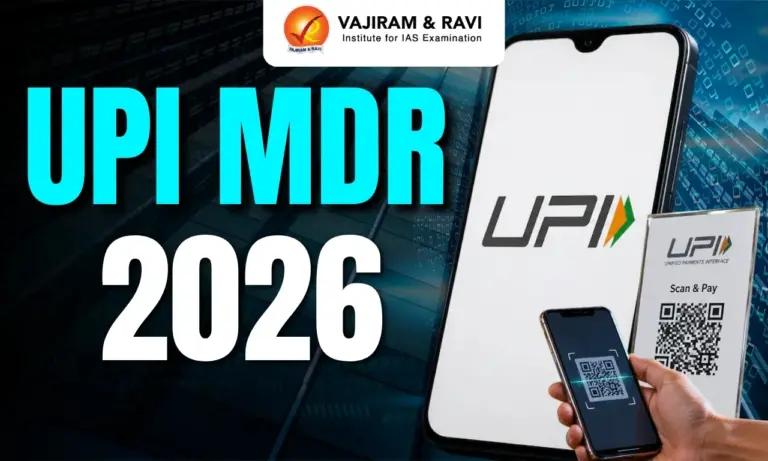
National Payments Corporation of India (NPCI) has introduced a new Merchant Discount Rate (MDR) framework for selected UPI person-to-merchant (P2M) transactions. From October 15, 2026, a 0.4% MDR will apply to eligible UPI merchant transactions above ₹2,000. The new framework is aimed at supporting the long-term sustainability, infrastructure and security of the digital payments ecosystem.
What is UPI MDR?
Merchant Discount Rate (MDR) is a fee associated with accepting digital payments. It is generally paid within the payment ecosystem by the merchant side and is distributed among participating entities such as banks, payment service providers and payment application providers.
In the case of UPI, MDR is being introduced for a specified category of person-to-merchant transactions above ₹2,000. It is important to note that MDR is not a tax collected by the government. The revenue remains within the payment ecosystem to support its functioning and expansion.
Why has NPCI Introduced MDR on UPI Transactions?
UPI has grown into a large-scale digital payment infrastructure handling billions of transactions every month. With the expansion of the network, payment infrastructure requires continued investment in technology, cybersecurity, fraud prevention, server capacity and customer support.
The new MDR framework provides a revenue mechanism within the payment ecosystem while keeping everyday low-value transactions free. NPCI and the government have also emphasised the need to protect small merchants and ordinary users from additional costs.
Major reasons behind the introduction of MDR
- Financial sustainability: A revenue mechanism can support the continued operation and expansion of the UPI ecosystem.
- Infrastructure development: UPI requires continuous investment in payment infrastructure and technology.
- Cybersecurity: Growing digital payments require stronger systems for preventing fraud and cyber threats.
- Innovation: Revenue can support technological improvements and new payment solutions.
- Consumer protection: The framework keeps P2P payments and low-value merchant payments free.
- Support for small businesses: Eligible small merchants continue to receive zero-MDR benefits.
- Reduced dependence on government incentives: A payment ecosystem with its own revenue mechanism can reduce dependence on continued public funding.


What is the New 0.4% UPI MDR Rule?
Under the UPI New Rules 2026 framework, a 0.4% MDR will apply to specified person-to-merchant UPI transactions above ₹2,000 from October 15, 2026.
For example, if an eligible merchant receives a ₹3,000 UPI payment, the standard MDR would be ₹12. Similarly, a ₹50,000 eligible transaction would attract ₹200 MDR. For transactions of ₹75,000 and above, the MDR is capped at ₹300 per transaction.
Impact of UPI MDR on Merchants and Consumers
The new UPI MDR framework will mainly affect eligible merchants receiving higher-value UPI payments, while ordinary consumers will continue to use most UPI services without direct charges. The policy aims to maintain affordable digital payments while supporting the financial sustainability of the UPI ecosystem.
- Consumers: P2P transactions and merchant payments up to ₹2,000 remain free.
- Merchants: Eligible P2M transactions above ₹2,000 will attract 0.4% MDR.
- Small merchants: Eligible small merchants continue to benefit from zero MDR.
- No direct consumer charge: MDR is not intended to be separately recovered from customers.
- Digital payment ecosystem: MDR can provide a revenue stream for maintaining payment infrastructure, cybersecurity and innovation.
- Higher-value transactions: Transactions of ₹75,000 and above have an MDR cap of ₹300 per transaction.
Significance of UPI MDR for India’s Digital Payments Ecosystem
The introduction of UPI MDR is significant because it creates a revenue mechanism for supporting the rapidly expanding digital payments infrastructure while keeping most everyday UPI transactions free.
- Financial sustainability: Provides a revenue stream to support the long-term functioning of the UPI ecosystem.
- Stronger infrastructure: Can support investment in payment technology, processing capacity and system upgrades.
- Better cybersecurity: Growing digital transactions require continuous investment in fraud prevention and cybersecurity.
- Continued innovation: Revenue within the ecosystem can support development of new digital payment solutions.
- Protection of small users: P2P payments and merchant transactions up to ₹2,000 remain free.
- Support for small merchants: Eligible small merchants continue to receive zero-MDR benefits.
- Growth of Digital Public Infrastructure: Strengthens the sustainability of UPI as a major component of India’s Digital Public Infrastructure (DPI).
- Balanced approach: The framework attempts to combine affordable digital payments with the long-term sustainability of payment infrastructure.
About National Payment Corporation of India (NPCI)
National Payments Corporation of India (NPCI) is an umbrella organisation for operating and developing retail payment and settlement systems in India, established as an initiative of the Reserve Bank of India (RBI) and the Indian Banks’ Association (IBA).
- Established: 2008
- Headquarters: Mumbai, Maharashtra
- Legal status: Section 8 company under the Companies Act, 2013
- Key role: Develops and operates retail payment systems in India.
- Major payment systems: UPI, RuPay, IMPS, Bharat BillPay, FASTag (NETC) and AePS.
- Ownership: Promoted by RBI and IBA, with ownership held by member banks.
- Importance: Acts as a key institution in India’s digital payments ecosystem.

 Last updated on Sep, 2026
→ UPSC 2027 Notification will be released on 13 January 2027 at upsconline.nic.in.
→ Check out the latest UPSC Syllabus here.
→ Download UPSC Model Answers for Mains 2026
→ UPSC Mains Question Paper 2026 is out now for Essay & GS Paper 1, 2, 3 & 4.
→ UPSC Calendar 2027 has been released.
→ Enroll in Vajiram & Ravi’s UPSC Mains Test Series 2027 for structured answer writing practice, expert evaluation, and exam-oriented feedback.
→ Join Vajiram & Ravi’s UPSC Mentorship Program 2027 for personalized guidance, strategy planning, and one-to-one support from experienced mentors.
→ Go through the UPSC Mains Previous Year Papers to enhance your preparation.
→ UPSC has released UPSC Toppers List 2025 with the Civil Services final result on its official website.
→ Also check Best UPSC Coaching in India
UPI MDR 2026 FAQs
Q1. What is UPI MDR?+
Q2. When will the new UPI MDR rule come into effect?+
Q3. Will UPI payments above ₹2,000 be charged to consumers?+
Q4. What is the MDR rate for UPI transactions above ₹2,000?+
Q5. What is the maximum UPI MDR that can be charged?+
Q6. Will UPI transactions up to ₹2,000 remain free?+
Tags: digital payment merchant discount rate UPI MDR 2026