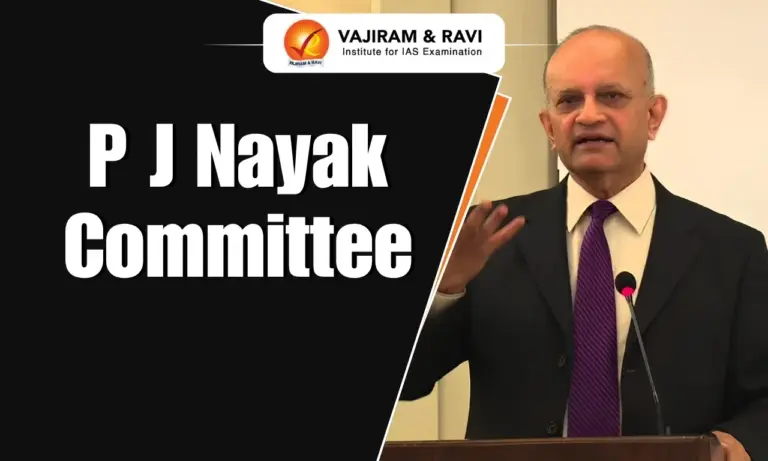
The P J Nayak Committee examined the governance of bank boards in India, with a particular focus on the autonomy and functioning of Public Sector Banks (PSBs). It proposed changes in bank ownership, board composition, senior management appointments and regulatory arrangements to make PSBs more professional, autonomous and accountable.
About P J Nayak Committee
The P J Nayak Committee was constituted by the Reserve Bank of India (RBI) on 20 January 2014 to review the governance of bank boards in India, particularly the governance structure of Public Sector Banks (PSBs).
- The Committee brought together experts from banking, financial regulation, law, management and academia.
- The Committee was chaired by P J Nayak, former Chairman and Chief Executive Officer of Axis Bank.
- It submitted its report, titled “Report of the Committee to Review Governance of Boards of Banks in India,” in May 2014.
P J Nayak Committee Need
The P J Nayak Committee was constituted against the backdrop of concerns over the governance and ownership structure of Public Sector Banks (PSBs).
- PSB boards were not sufficiently empowered to provide effective strategic direction and oversight.
- Government involvement in bank affairs often constrained the autonomy of PSB boards.
- The existing process for appointing directors and senior management needed to become more professional and merit-based.
- Bank boards required greater banking, financial and managerial expertise to deal with increasingly complex operations.
- Frequent changes in senior management made it difficult to maintain continuity in long-term strategy and decision-making.
- The government’s multiple roles as owner, policymaker and provider of directions to PSBs created potential conflicts of interest.
- PSBs faced a different governance environment from private-sector banks, affecting their ability to compete on a level playing field.
- Board oversight of risk management, financial reporting and compliance needed to be strengthened.
- The existing ownership structure of PSBs raised questions about the extent to which government ownership should influence their governance.
- There was a need to clearly distinguish the government’s role as bank owner from the RBI’s role as banking regulator.


Terms of Reference
The P J Nayak Committee was asked to examine whether the existing governance framework was adequate for ensuring effective, independent and professionally managed bank boards.
- Review the regulatory compliance requirements applicable to bank boards and identify areas where they could be rationalised or strengthened.
- Examine whether bank boards were devoting sufficient attention to strategy, growth, governance and risk management.
- Review regulations relating to bank ownership, ownership concentration and representation on bank boards.
- Examine whether bank boards had the appropriate mix of capabilities and independence required for effective governance.
- Examine potential conflicts of interest involving owners, directors and regulators.
- Review the fit-and-proper criteria and tenure requirements for bank directors.
- Examine the existing framework for board compensation.
P J Nayak Committee Recommendations
The P J Nayak Committee proposed changes in the ownership and governance of banks to address the weak autonomy of Public Sector Banks (PSBs), improve board accountability and create a more professional banking system.
- Create a Bank Investment Company (BIC): Transfer the government’s shares in PSBs to an autonomous BIC to separate the government’s role as a shareholder from the day-to-day governance of banks.
- Make BIC a core investment company: The BIC should hold and manage government investments in banks while exercising ownership rights in a professional and commercially oriented manner.
- Empower PSB boards: Give bank boards greater freedom to take decisions on strategy, management and operations, addressing the limited autonomy of PSB boards.
- Establish a Bank Boards Bureau (BBB): Create a professional body to advise on the appointment of Chairmen, Executive Directors and other board members, improving the quality of leadership in PSBs.
- Use BBB as a transition mechanism: The BBB was envisaged as an interim arrangement until the proposed BIC became operational and ownership functions were restructured.
- Professionalise board composition: Ensure that bank boards have people with appropriate banking, financial, legal and managerial expertise, improving their ability to oversee complex banking operations.
- Separate Chairman and CEO: Separate the positions of Non-Executive Chairman and Chief Executive Officer to distinguish board-level oversight from executive management and strengthen accountability.
- Give senior management longer tenures: Provide a minimum five-year tenure for Chairmen and three-year tenure for Executive Directors to ensure continuity in implementing long-term strategies.
- Make RBI the sole banking regulator: Remove the government’s regulatory role over PSBs and place banks under a uniform regulatory framework administered by the RBI, addressing the problem of dual regulation.
- Repeal banking-specific legislation: Repeal the Banking Companies (Acquisition and Transfer of Undertakings) Acts of 1970 and 1980, the State Bank of India Act 1955 and the State Bank of India (Subsidiary Banks) Act, 1959, and incorporate the affected banks under the Companies Act to create a more uniform governance framework.
- Reduce government ownership: After restructuring ownership through the BIC, the government could consider reducing its shareholding below 50%, helping create a more level playing field between PSBs and private-sector banks.
- Strengthen board-level risk oversight: Make risk management a central responsibility of bank boards to improve their ability to identify and manage financial risks.
- Improve financial reporting: Give greater board attention to the integrity of financial reports, helping prevent weaknesses in reporting and recognition of stressed assets.
- Strengthen compliance: Make compliance a key board responsibility to ensure that banks properly follow regulatory and statutory requirements.
- Protect bank customers: Require boards to pay greater attention to customer protection, particularly in relation to the fair treatment of customers and financial products.
- Promote financial inclusion: Make financial inclusion a board-level concern so that commercial banking reforms do not weaken the wider social role of banks.
- Improve human-resource management: Give boards greater responsibility for recruitment, incentives, succession planning, training and skill development, helping PSBs attract and retain capable professionals.
- Reform private-sector bank ownership: Strengthen rules governing ownership concentration, voting rights and board representation in private-sector banks to prevent excessive influence by individual investors or promoters.
- Introduce Authorised Bank Investors: Allow professionally managed and diversified institutional investors meeting fit-and-proper requirements to hold larger stakes in banks, while maintaining safeguards against excessive control.
- Strengthen board independence: Introduce safeguards against conflicts of interest and ensure that directors can exercise independent judgement in the interests of the bank.
P J Nayak Committee Criticism
The recommendations faced criticism mainly over privatisation concerns, social banking objectives and implementation challenges.
- Critics argued that the report could weaken the public-sector character of nationalised banks.
- Reduced government control was seen as a possible threat to priority-sector lending and financial inclusion.
- Questions were raised about the availability of a sufficient leadership talent pool for longer tenures.
- Repealing nationalisation-era laws and reducing government ownership were considered politically difficult.

 Last updated on Oct, 2026
→ UPSC 2027 Notification will be released on 13 January 2027 at upsconline.nic.in.
→ Asian Games 2026 are being held in Aichi-Nagoya, Japan, from 19 September to 4 October.
→ Check Nobel Prize 2026 Winners List here.
→ Download PIB PRiSM Monthly Magazine 2026 here.
→ Check UPSC Monthly Current Affairs Magazine The Recitals here.
→ Check out the latest UPSC Syllabus here.
→ Download UPSC Model Answers for Mains 2026
→ UPSC Mains Question Paper 2026 is out now for Essay & GS Paper 1, 2, 3 & 4.
→ UPSC Calendar 2027 has been released.
→ Enroll in Vajiram & Ravi’s UPSC Mains Test Series 2027 for structured answer writing practice, expert evaluation, and exam-oriented feedback.
→ Join Vajiram & Ravi’s UPSC Mentorship Program 2027 for personalized guidance, strategy planning, and one-to-one support from experienced mentors.
→ Go through the UPSC Mains Previous Year Papers to enhance your preparation.
→ UPSC has released UPSC Toppers List 2025 with the Civil Services final result on its official website.
→ Also check Best UPSC Coaching in India
P J Nayak Committee FAQs
Q1. What is the P J Nayak Committee?+
Q2. Who was the Chairman of the P J Nayak Committee?+
Q3. When was the P J Nayak Committee constituted?+
Q4. When did the P J Nayak Committee submit its report?+
Q5. What were the major recommendations of the P J Nayak Committee?+
Tags: p j nayak p j nayak committee