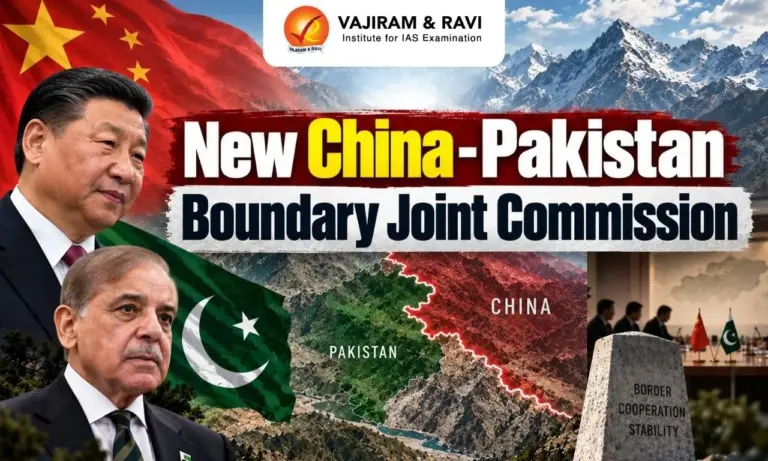
New China-Pakistan Boundary Joint Commission was operationalised in Islamabad in September 2026. Pakistan and China described it as a mechanism for cooperation on border management, joint border surveys, trade flows, cross-border movement and people-to-people connectivity.
India rejected the commission through a statement by Ministry of External Affairs spokesperson Randhir Jaiswal. India reiterated that it has never recognised the China-Pakistan Boundary Agreement of 1963 and maintains that Pakistan cannot enter into arrangements concerning territories that India considers to be under illegal occupation.
Why Has India Objected to the Commission?
India’s objection is primarily linked to the territorial status of Jammu and Kashmir and Ladakh.
India maintains that Pakistan is in illegal occupation of parts of the former princely state of Jammu and Kashmir. Therefore, according to India’s position, Pakistan cannot legally negotiate or establish boundary arrangements with another country involving these territories.
The MEA has also maintained that the 1963 China-Pakistan Boundary Agreement is illegal and invalid and has never been recognised by India.
India’s position can be understood through the following points:
- India considers the entire Union Territories of Jammu and Kashmir and Ladakh to be integral parts of India.
- India does not recognise Pakistan’s authority to enter into agreements concerning territories that India claims.
- India has consistently rejected the 1963 China-Pakistan Boundary Agreement.
- India objects to Chinese activities and infrastructure projects in areas of Pakistan-occupied Jammu and Kashmir.
- India also opposes the China-Pakistan Economic Corridor (CPEC) because parts of it pass through territory claimed by India.
China-Pakistan Boundary Agreement of 1963
The roots of the present dispute go back to the China-Pakistan Boundary Agreement signed on 2 March 1963.
Under the agreement, Pakistan and China reached an understanding on their boundary in areas controlled by Pakistan. The agreement involved the Shaksgam Valley, also known as the Trans-Karakoram Tract.
India rejected the agreement because it considers the territory involved to be part of the former state of Jammu and Kashmir and argues that Pakistan had no legal authority to transfer or negotiate over it.
The Government of India has consistently stated that Pakistan ceded approximately 5,180 sq km of Indian territory in the Shaksgam Valley to China under the 1963 agreement.


Shaksgam Valley
Shaksgam Valley, or the Trans-Karakoram Tract, is a strategically important mountainous region located north of the Siachen Glacier.
- It lies in the Karakoram region.
- India claims the territory as part of Ladakh.
- Pakistan controlled the area before transferring it to China through the 1963 agreement.
- The territory covers approximately 5,180 sq km, according to the Government of India’s stated position.
- It lies close to the Karakoram Pass and Siachen region.
- Its location gives it strategic importance because of its proximity to India, Pakistan and China.
- India has repeatedly objected to Chinese infrastructure activities in the region.
China-Pakistan Economic Corridor and India’s Concerns
CPEC connects China’s Xinjiang region with Pakistan’s Gwadar Port and forms part of China’s Belt and Road Initiative (BRI).
The project includes infrastructure and connectivity projects involving roads, energy, transport and other facilities.
India has consistently objected to CPEC because parts of the corridor pass through Pakistan-occupied Jammu and Kashmir, particularly areas that India claims as its territory.
Therefore, the New China-Pakistan Boundary Joint Commission is also significant in the broader context of CPEC and regional connectivity.

 Last updated on Sep, 2026
→ UPSC 2027 Notification will be released on 13 January 2027 at upsconline.nic.in.
→ Check out the latest UPSC Syllabus here.
→ Download UPSC Model Answers for Mains 2026
→ UPSC Mains Question Paper 2026 is out now for Essay & GS Paper 1, 2, 3 & 4.
→ UPSC Calendar 2027 has been released.
→ Enroll in Vajiram & Ravi’s UPSC Mains Test Series 2027 for structured answer writing practice, expert evaluation, and exam-oriented feedback.
→ Join Vajiram & Ravi’s UPSC Mentorship Program 2027 for personalized guidance, strategy planning, and one-to-one support from experienced mentors.
→ Go through the UPSC Mains Previous Year Papers to enhance your preparation.
→ UPSC has released UPSC Toppers List 2025 with the Civil Services final result on its official website.
→ Also check Best UPSC Coaching in India
New China-Pakistan Boundary Joint Commission FAQs
Q1. What is the New China-Pakistan Boundary Joint Commission?+
Q2. Why was the New China-Pakistan Boundary Joint Commission established?+
Q3. What is the legal basis of the New China-Pakistan Boundary Joint Commission?+
Q4. Why has India rejected the New China-Pakistan Boundary Joint Commission?+
Q5. What is the 1963 China-Pakistan Boundary Agreement?+
Tags: china-pakistan boundary joint new china-pakistan boundary joint commission new china-pakistan boundary joint commission 2026