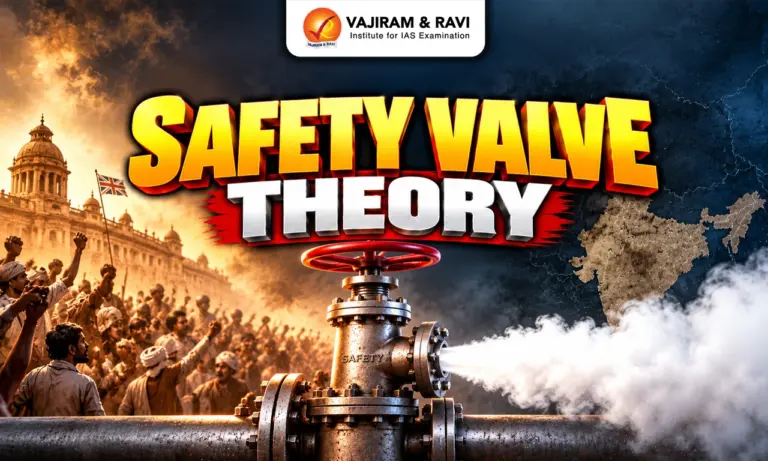
Safety Valve Theory is an explanation of the origin of the Indian National Congress (INC) in 1885. It suggests that the British, concerned about growing political discontent among Indians after the Revolt of 1857, supported the creation of a platform where educated Indians could express their grievances peacefully. The theory is closely associated with A.O. Hume and his role in the formation of the Congress. However, historians have debated and challenged the idea that the Congress was simply created as a British “safety valve,” highlighting the growing Indian political awareness and nationalist movement of the late 19th century.
What is the Safety Valve Theory?
The Safety Valve Theory is a historical explanation about the origin and formation of the Indian National Congress (INC) in 1885. According to this theory, the British colonial government supported the creation of a political platform where growing Indian dissatisfaction could be expressed peacefully instead of developing into another major uprising.
- The theory is closely linked with A.O. Hume, a retired British civil servant who played a leading role in the formation of the Indian National Congress.
- It suggests that the British were concerned about the growing political awareness and discontent among educated Indians during the late nineteenth century.
- After the Revolt of 1857, British authorities remained cautious about the possibility of another large-scale rebellion against colonial rule.
- According to the theory, educated Indians could potentially organize political opposition and mobilize people against British rule.
- Hume therefore proposed creating an organization where educated Indians could discuss their grievances and political demands through constitutional and peaceful methods.
- In this interpretation, the Congress was expected to function as a “safety valve”, allowing political dissatisfaction to be released through an organized platform rather than through revolutionary action.
- The theory also links the formation of the Congress with Lord Dufferin, the Viceroy of India at the time, who is said to have supported Hume’s efforts.
- However, modern historians have questioned whether the Congress was actually created as a British-controlled mechanism to prevent a revolution.
Who Proposed the Safety Valve Theory of the Indian National Congress?
The Safety Valve Theory is mainly associated with interpretations of A.O. Hume’s role in the establishment of the Indian National Congress and the alleged support of British officials.
- A.O. Hume, a retired member of the Indian Civil Service, played a central role in bringing together the early leaders who established the Congress.
- Hume held discussions with Lord Dufferin, the Viceroy of India, regarding the need for a political organization that could provide Indians with a platform to express their views.
- He also received support from several British and Anglo-Indian figures, including Sir William Wedderburn, George Yule, Charles Bradlaugh, John Bright, Sir James Caird and Lord Ripon.
- The involvement of Hume, a former British official, later gave rise to the argument that the Congress had been encouraged or facilitated by the colonial authorities.
- William Wedderburn’s 1913 biography of A.O. Hume played an important role in the development of the Safety Valve interpretation.
- Wedderburn referred to Hume’s discovery in 1878 of seven volumes of reports that allegedly described growing discontent and a possible plan to overthrow British rule.
- According to this account, Hume and Dufferin wanted to establish an organization of educated Indians to channel this dissatisfaction into peaceful political activity.
- Later, R. Palme Dutt developed the argument further and presented the formation of the Congress as part of a broader British strategy to control growing political discontent.
- Lala Lajpat Rai also gave importance to the Safety Valve interpretation and viewed the Congress’s origins through the lens of British attempts to manage Indian political opposition.


Safety Valve Theory and the Formation of the Indian National Congress
The Safety Valve Theory connects the formation of the Indian National Congress in 1885 with British concerns about increasing Indian nationalism and political dissatisfaction.
- The Congress was established in 1885, with A.O. Hume playing a key role in bringing different political groups and leaders together.
- According to the Safety Valve interpretation, the British wanted to provide educated Indians with a constitutional platform where they could present their political and economic grievances.
- The idea was that organized political discussion would act as a buffer between the colonial government and the Indian population.
- Hume’s position as a former British civil servant was considered important because the colonial authorities were less likely to immediately suppress an organization initiated by a British official.
- Gopal Krishna Gokhale later acknowledged the importance of British involvement, arguing that an Indian alone might have faced greater resistance from the colonial authorities while trying to establish such an organization.
- The first session of the Indian National Congress was held in Bombay in December 1885, marking the beginning of an important phase in organized Indian political activity.
- The second session was held in Calcutta in December 1886 under the presidentship of Dadabhai Naoroji and was attended by 436 delegates.
- These delegates largely came from the educated sections of Indian society, including lawyers, journalists, traders, industrialists, teachers and landlords.
- The success of the second session encouraged Congress leaders to hold an annual session every December in different parts of India.
- By 1889, the number of Congress delegates had increased to around 2,000, reflecting the organization’s expanding reach.
- The Congress gradually became a platform where Indians from different regions and communities could raise political, economic and administrative issues.
- Although some sections, including some Muslim leaders, were initially cautious about the Congress, personalities such as Badruddin Tyabji actively participated in its activities.
- Over time, the Congress developed beyond the role suggested by the Safety Valve Theory and became an important organization in the Indian national movement.
Criticism and Historical Significance of the Safety Valve Theory
The Safety Valve Theory remains a debated interpretation of the origins of the Indian National Congress. Modern historical research has questioned the idea that the Congress was simply a British creation.
- One major criticism is that there is no conclusive evidence that the British government deliberately created the Congress to prevent an imminent revolution in India.
- The alleged seven-volume secret report discovered by Hume in 1878 has not been conclusively established through Indian or British archival records.
- The private papers of Lord Dufferin have also been used to challenge the idea of a planned British conspiracy behind the Congress.
- Dufferin reportedly viewed the Congress as representing only a small section of Indian society, which does not fit easily with the idea that he had deliberately created it as an effective safety valve for the entire population.
- Some historians therefore consider the story surrounding the seven-volume report to be unreliable or fictional.
- Imperialist historians used the theory to portray the Congress as an organization created with British assistance and therefore lacking an independent nationalist origin.
- Marxist historians, particularly R. Palme Dutt, developed a related interpretation in which the Congress was seen as part of a political arrangement involving British authorities and emerging Indian bourgeois interests.
- However, another historical interpretation emphasizes the growth of Indian nationalism, political consciousness and organized public opinion during the second half of the nineteenth century.
- From this perspective, the Congress reflected the aspirations of politically aware Indians who wanted a national organization to present their political and economic demands.
- The rise of educated Indian professionals, the spread of modern education, the growth of newspapers and increasing opposition to colonial policies had already created conditions for the emergence of an organized political movement.
- Therefore, the formation of the Congress cannot be explained only through the Safety Valve Theory; Indian political developments and nationalist aspirations also played an important role.
- Despite the controversy surrounding its origins, the Congress gradually developed into a major platform of Indian nationalism.
- Its annual sessions brought political leaders from different regions together and helped create a broader sense of political unity and national consciousness.
- Thus, the Safety Valve Theory is important for understanding the debate over the origins of the Indian National Congress, but it is not sufficient by itself to explain the subsequent growth and significance of the Indian national movement.

 Last updated on Sep, 2026
→ UPSC 2027 Notification will be released on 13 January 2027 at upsconline.nic.in.
→ Asian Games 2026 are being held in Aichi-Nagoya, Japan, from 19 September to 4 October.
→ Check out the latest UPSC Syllabus here.
→ Download UPSC Model Answers for Mains 2026
→ UPSC Mains Question Paper 2026 is out now for Essay & GS Paper 1, 2, 3 & 4.
→ UPSC Calendar 2027 has been released.
→ Enroll in Vajiram & Ravi’s UPSC Mains Test Series 2027 for structured answer writing practice, expert evaluation, and exam-oriented feedback.
→ Join Vajiram & Ravi’s UPSC Mentorship Program 2027 for personalized guidance, strategy planning, and one-to-one support from experienced mentors.
→ Go through the UPSC Mains Previous Year Papers to enhance your preparation.
→ UPSC has released UPSC Toppers List 2025 with the Civil Services final result on its official website.
→ Also check Best UPSC Coaching in India
Safety Valve Theory FAQs
Q1. What is the Safety Valve Theory?+
Q2. Who is associated with the Safety Valve Theory?+
Q3. Why was the Safety Valve Theory proposed?+
Q4. What was the role of A.O. Hume in the Indian National Congress?+
Q5. How is Lord Dufferin connected with the Safety Valve Theory?+
Q6. Why is the Safety Valve Theory criticised?+
Tags: safety valve theory