Right to Vote Latest News
- Recent concerns over electoral roll management and the functioning of ECI have renewed discussion on the legal status and protection of the right to vote in India.
Universal Adult Suffrage in India
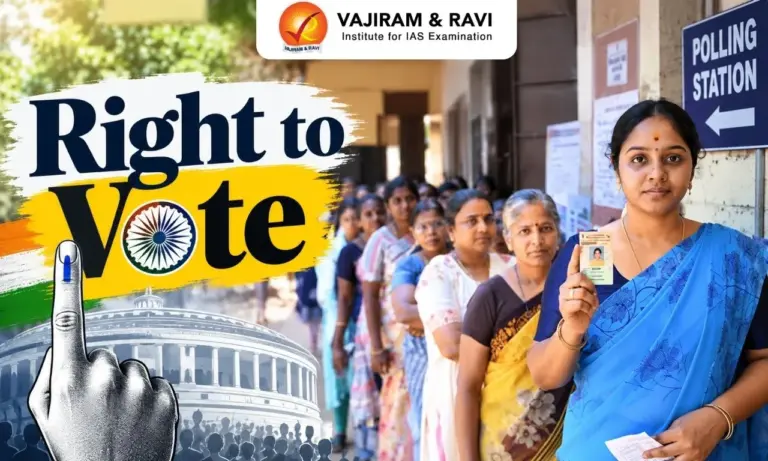
- India adopted universal adult suffrage from the beginning of the Republic, granting adult citizens the right to participate in elections without restrictions based on gender, caste, religion, education or property.
- In the United States, although the 15th and 19th Amendments extended voting rights to African Americans in 1870 and women in 1920, systemic barriers such as poll taxes and literacy tests continued to disenfranchise many for decades.
- India chose immediate, universal inclusion, ensuring democratic equality from the outset and bypassing the prolonged struggles seen elsewhere.
- Article 326 granted every adult citizen the right to vote regardless of gender, caste, religion, education or property.
- This was operationalised through two laws, the Representation of the People Act, 1950, governing preparation and revision of electoral rolls, and the 1951 Act, regulating election conduct, candidature and electoral offences.
- The first general election presented a major administrative challenge, with around 173 million voters, many of whom were illiterate.
- The Election Commission, under the first Chief Election Commissioner Sukumar Sen, introduced election symbols to make participation accessible to voters.


What Is the Legal Status of the Right to Vote?
- The distinction between a fundamental right, constitutional right and statutory right is important because each category carries different levels of legal protection.
- The Constituent Assembly considered whether voting should form part of the Fundamental Rights chapter. However, the proposal was not adopted.
- In Kuldip Nayar v. Union of India (2006), a five-judge Constitution Bench of the Supreme Court held that the “right to elect” is a statutory right, deriving from Section 62 of the Representation of the People Act, 1951, rather than a fundamental or constitutional right.
- A two-judge Bench in Rajbala v. State of Haryana (2015) referred to the right to vote as a constitutional right. However, the larger Constitution Bench ruling in Kuldip Nayar remains the controlling position.
- In Anoop Baranwal v. Union of India (2023), the Supreme Court did not revisit the issue, noting the existing position established by Kuldip Nayar. Justice Ajay Rastogi, in his dissent, argued that the right to vote could be viewed as an expression of Article 19(1)(a) and connected with Article 21.
- Thus, under the position discussed in the source, the right to elect continues to be treated as a statutory right, although its democratic significance has been recognised by the judiciary.
Why Are Electoral Rolls Important?
- The right to participate in elections depends in practice on an accurate electoral roll.
- The Representation of the People Act, 1950 provides the statutory framework for preparation and revision of electoral rolls.
- Section 19 provides that a citizen who is at least 18 years old, ordinarily resident in a constituency and not otherwise disqualified is entitled to registration.
- Under Section 21, the Election Commission is empowered to direct the preparation and revision of electoral rolls. Errors such as:
- omission of eligible voters,
- inclusion of ineligible persons,
- duplicate entries, and
- incorrect voter details
- can affect electoral integrity and the principle of “one person, one vote.”
- The challenge becomes more complex when electoral administration increasingly depends on digital systems.
The Case for Greater Protection
- The debate over making voting a fundamental right centres on the level of constitutional protection that should accompany the franchise.
- Supporters of greater constitutional protection argue that voting is closely connected with democratic participation and that restrictions affecting the franchise should receive stronger judicial scrutiny.
- At the same time, the existing legal framework gives Parliament the authority to regulate electoral participation through legislation, while the Election Commission exercises constitutional powers under Article 324 relating to the superintendence, direction and control of elections.
- The issue therefore involves balancing electoral integrity, administrative regulation and individual participation.
Conclusion
- India’s system combines universal adult suffrage under Article 326 with statutory regulation through the Representation of the People Acts and constitutional supervision by the Election Commission.
- The continuing debate over the legal status of the right to vote highlights a broader constitutional question: how should electoral administration protect both the accuracy of electoral rolls and the individual’s ability to participate in the democratic process?
Source: TH

 Last updated on Sep, 2026
→ UPSC 2027 Notification will be released on 13 January 2027 at upsconline.nic.in.
→ Asian Games 2026 are being held in Aichi-Nagoya, Japan, from 19 September to 4 October.
→ Check out the latest UPSC Syllabus here.
→ Download UPSC Model Answers for Mains 2026
→ UPSC Mains Question Paper 2026 is out now for Essay & GS Paper 1, 2, 3 & 4.
→ UPSC Calendar 2027 has been released.
→ Enroll in Vajiram & Ravi’s UPSC Mains Test Series 2027 for structured answer writing practice, expert evaluation, and exam-oriented feedback.
→ Join Vajiram & Ravi’s UPSC Mentorship Program 2027 for personalized guidance, strategy planning, and one-to-one support from experienced mentors.
→ Go through the UPSC Mains Previous Year Papers to enhance your preparation.
→ UPSC has released UPSC Toppers List 2025 with the Civil Services final result on its official website.
→ Also check Best UPSC Coaching in India
Right to Vote FAQs
Q1. Is the right to vote a fundamental right in India?+
Q2. Which Article provides for adult suffrage?+
Q3. Which law governs electoral rolls?+
Q4. What is the role of Article 324?+
Q5. Why are accurate electoral rolls important?+
Tags: mains articles right to vote upsc current affairs upsc mains current affairs