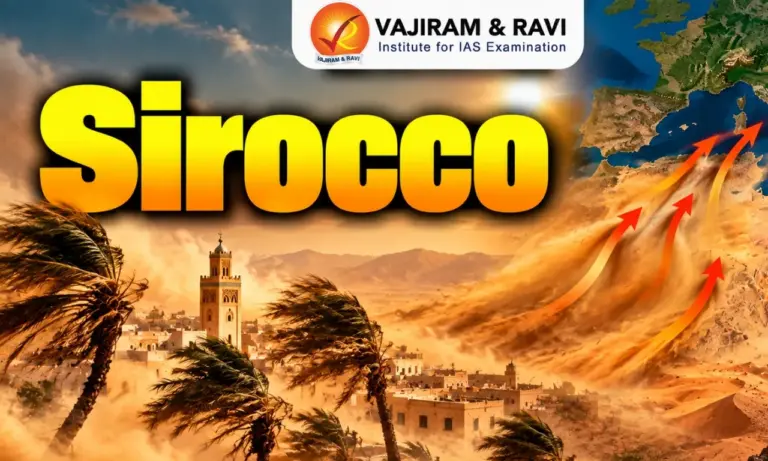
Sirocco is a hot, dry wind that originates over the deserts of North Africa and moves northward across the Mediterranean Sea. As it travels over the sea, it absorbs moisture and can reach southern Europe as a warm, humid and sometimes dust-laden wind. It is an important regional wind associated with changes in weather conditions across the Mediterranean region.
What is Sirocco Wind?
- Sirocco is a warm, generally southerly to southeasterly wind that affects North Africa, the Mediterranean Sea and southern Europe.
- It originates as hot, dry air over the Sahara and other desert areas of North Africa and moves northward towards the Mediterranean.
- Near the North African coast, Sirocco is typically very hot, dry and dusty because the air has travelled over desert regions.
- As the air crosses the Mediterranean Sea, it absorbs moisture from the warm sea surface. Therefore, by the time it reaches southern Europe, it can become hot, humid and uncomfortable.
- Sirocco is therefore different from a completely dry desert wind. Its characteristics change along its route depending on how long it remains over the Mediterranean.
- The term is used broadly for a group of related southerly winds in the Mediterranean region. Different countries and regions use different local names for similar winds.
Sirocco Wind Origin and Formation
- Sirocco generally develops in association with low-pressure systems or depressions moving eastward across the Mediterranean or North Africa.
- As a low-pressure system develops, it draws hot continental air from North Africa northward towards the Mediterranean.
- The air initially remains hot, dry and dust-laden because of its passage over the Sahara and neighbouring desert regions.
- In the Northern Hemisphere, winds circulate anticlockwise around a low-pressure system. This circulation helps transport the warm air northward and eastward towards the Mediterranean and southern Europe.
- Some Sirocco-producing depressions develop over North Africa, while others can develop in or around the western Mediterranean, including the Gulf of Genoa.
- As the hot desert air crosses the Mediterranean, it takes up large amounts of moisture from the sea. This explains why the same wind can be dry and dusty in North Africa but warm and humid in southern Europe.
- The exact nature and strength of a Sirocco depend on the position and intensity of the low-pressure system, the route followed by the air and the length of its passage over the Mediterranean.
Also Read : Desert Ecosystem


Sirocco Wind Characteristics
- Hot and dry near North Africa: The wind originates over desert areas, so it is initially characterised by high temperatures, low humidity and large amounts of dust.
- Hot and humid over southern Europe: After crossing the Mediterranean, the air gains moisture and becomes more humid and oppressive.
- Dust-laden: Sirocco can carry large quantities of Saharan dust. In strong events, dust can reduce visibility considerably and may cause problems for transport, aviation and equipment.
- Strong winds: Sirocco can become gale-force or storm-force, particularly when associated with intense Mediterranean low-pressure systems. The strength varies considerably from one event to another.
- Cloud and rain: Over the northern Mediterranean, the moist air associated with Sirocco can contribute to cloud formation, fog and rainfall.
- Oppressive weather: In southern Europe, Sirocco can produce conditions that feel particularly hot, humid and uncomfortable.
- Variable duration: Individual events may last for several hours and, during stronger episodes, can continue for a day or more.
- Although Sirocco can occur throughout the year, strong events are particularly common during the spring in several parts of the Mediterranean region.
Direction and Movement of Sirocco Wind
- Sirocco generally moves from North Africa towards the Mediterranean, with the wind reaching the Mediterranean and southern Europe from a southerly or southeasterly direction.
- The wind begins over the Sahara and other desert regions of North Africa, where it is hot, dry and often dusty.
- It then travels northward across the Mediterranean Sea.
- During this journey, the warm air absorbs moisture from the Mediterranean. The longer its path over the sea, the greater the potential change in its humidity.
- When it reaches southern European countries, the wind can therefore be hot, humid and sometimes accompanied by low clouds, fog or rain.
- The exact direction is not identical everywhere because it depends on the position and movement of the associated low-pressure system.
- Sirocco may affect parts of Spain, Portugal, France, Italy, Malta, Croatia and Greece, although the local characteristics and names vary from place to place.
Effects of Sirocco Wind
- Reduced visibility: Dust and sand carried from North Africa can create hazy conditions and significantly reduce visibility.
- Saharan dust transport: Strong Sirocco events can transport desert dust across the Mediterranean and into Europe. Satellite observations have documented major Saharan dust outbreaks associated with strong winds and Mediterranean low pressure.
- Poor air quality: High concentrations of airborne desert dust can temporarily worsen air quality and affect sensitive individuals.
- High temperatures: The arrival of hot continental air can cause a sharp rise in temperatures, particularly when the air reaches southern Europe before a following cold front.
- High humidity: After crossing the Mediterranean, the wind becomes moisture-rich, producing a hot, humid and oppressive atmosphere.
- Cloud, fog and rainfall: Moist Sirocco air can contribute to cloud formation, fog and rain over parts of the northern Mediterranean.
- Dusty or coloured rain: When Saharan dust mixes with rainfall, it can produce dust-laden or reddish rain, leaving a layer of dust on vehicles, buildings and other surfaces.
- Rough seas and strong winds: Strong Sirocco events can create hazardous marine conditions and affect coastal activities and transport.
- Agricultural and environmental effects: Deposited Saharan dust can affect vegetation, soil and ecosystems, although the effects vary depending on the amount and composition of the dust.
- Human discomfort: The combination of heat and high humidity can make weather conditions particularly uncomfortable and may contribute to sleep disturbance and other heat-related discomfort.
Sirocco Wind and the Mediterranean Region
- The Mediterranean is the key geographical region through which the Sirocco changes from a hot, dry desert wind into a warmer and more humid Mediterranean wind.
- Along the North African coast, it is generally hot, dry and dusty because the air comes directly from the Sahara.
- Over the Mediterranean Sea, the air absorbs moisture because of the warm sea surface.
- In southern Europe, the wind can therefore bring hot, humid and sometimes dusty weather. It may also be associated with clouds, fog and rainfall in northern parts of the Mediterranean.
- The wind has different local names in different regions. In Libya, a related wind is known as Ghibli; in Tunisia, Chili is used; and in Egypt, Khamsin refers to a hot, dry southerly wind associated with eastward-moving depressions.
- In Spain, related southerly winds include Leveche; in southern France, Marin is a humid southerly wind; while in parts of the Adriatic region, the Sirocco is known as Jugo.
- Thus, Sirocco is best understood as a regional wind system whose characteristics change as hot North African air moves across the Mediterranean.
- Its combination of desert heat, dust, Mediterranean moisture and strong winds makes it an important local wind of the Mediterranean climate.

 Last updated on Sep, 2026
→ UPSC 2027 Notification will be released on 13 January 2027 at upsconline.nic.in.
→ Asian Games 2026 are being held in Aichi-Nagoya, Japan, from 19 September to 4 October.
→ Check out the latest UPSC Syllabus here.
→ Download UPSC Model Answers for Mains 2026
→ UPSC Mains Question Paper 2026 is out now for Essay & GS Paper 1, 2, 3 & 4.
→ UPSC Calendar 2027 has been released.
→ Enroll in Vajiram & Ravi’s UPSC Mains Test Series 2027 for structured answer writing practice, expert evaluation, and exam-oriented feedback.
→ Join Vajiram & Ravi’s UPSC Mentorship Program 2027 for personalized guidance, strategy planning, and one-to-one support from experienced mentors.
→ Go through the UPSC Mains Previous Year Papers to enhance your preparation.
→ UPSC has released UPSC Toppers List 2025 with the Civil Services final result on its official website.
→ Also check Best UPSC Coaching in India
Sirocco Wind FAQs
Q1. What is Sirocco Wind?+
Q2. Where does Sirocco Wind originate?+
Q3. How does Sirocco Wind form?+
Q4. What happens to Sirocco as it crosses the Mediterranean Sea?+
Q5. What are the main effects of Sirocco Wind?+
Q6. When does Sirocco Wind occur?+
Q7. What are the local names of Sirocco Wind?+
Q8. Which regions are affected by Sirocco Wind?+
Tags: geography geography notes sirocco