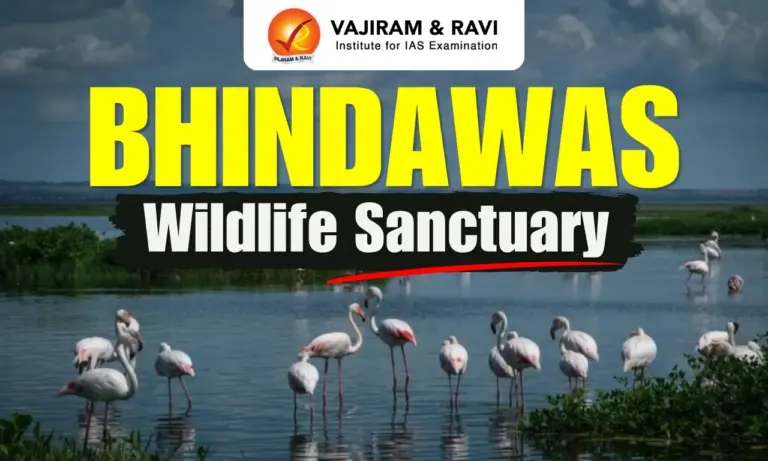
Bhindawas Wildlife Sanctuary is an important freshwater wetland and bird habitat located in Jhajjar district of Haryana. It is a human-made wetland that supports a wide variety of resident and migratory birds throughout the year. The sanctuary is also recognised as a Ramsar Site, highlighting its importance for wetland biodiversity and bird conservation.
Bhindawas Wildlife Sanctuary Location
- Bhindawas Wildlife Sanctuary is located in Jhajjar district of Haryana, around 15 km from Jhajjar town on the Jhajjar-Kasani road and about 105 km from Delhi. The sanctuary covers 411.55 hectares and is one of Haryana’s important freshwater wetland ecosystems.
- It is a human-made freshwater wetland, created mainly to store excess water from the Jawaharlal Nehru (JLN) Feeder Canal during power failures in the Lift Canal System. Rainwater and the canal’s escape channel also contribute to the wetland’s water supply.
- Khaparwas Wildlife Sanctuary is located close to Bhindawas, at a distance of about 1.5 km, making the two wetlands important components of the same wider landscape.
- The sanctuary forms part of an ecological corridor associated with the Sahibi River system, connecting habitats from the Aravalli region of Rajasthan towards the Yamuna through a chain of wetlands and protected areas.
- The wetland has small islands and different water-depth zones that provide suitable places for birds to feed, rest, roost and breed.
Bhindawas Wildlife Sanctuary History
- Bhindawas was formally notified as a Wildlife Sanctuary in 1986.
- It was subsequently recognised as a Bird Sanctuary in 2009, according to commonly cited Haryana wildlife references. This recognition highlighted its importance as a habitat for both resident and migratory birds.
- In 2021, Bhindawas Wildlife Sanctuary was designated a Ramsar Site, or Wetland of International Importance.
- Bhindawas became one of Haryana’s first two Ramsar Sites, along with Sultanpur National Park, giving the state internationally recognised wetland sites.
- The Ramsar recognition reflects the wetland’s importance for migratory birds and its ability to support more than 250 bird species, including several species of global conservation concern.
- The Central Government also notified an Eco-Sensitive Zone extending up to 100 metres around the sanctuary in 2016. This provides a framework for regulating activities that may adversely affect the protected area.


Flora and Fauna of Bhindawas Wildlife Sanctuary
- The vegetation of Bhindawas Wildlife Sanctuary is closely associated with its freshwater wetland environment. It includes emergent aquatic vegetation, reeds, sedges, grasses and vegetation along the wetland margins.
- Species of Typha, Scirpus, Cyperus and Phragmites provide cover and suitable nesting or roosting areas for several waterbirds.
- The surrounding landscape also includes agricultural fields, grassland and scrub vegetation, creating a mix of habitats for birds and terrestrial animals.
- The official Eco-Sensitive Zone notification records a diverse range of plant species associated with the sanctuary and its surrounding landscape, including Acorus calamus, Dalbergia sissoo, Ficus glomerata, Cassia fistula, Mentha spicata, Cymbopogon martini and several other species.
- The sanctuary also supports a variety of terrestrial fauna. Nilgai, jackals, mongoose and hares are among the mammals associated with the sanctuary and its surrounding habitats.
- However, the most important component of Bhindawas’s wildlife is its rich avifauna, which is the main reason for its recognition as an internationally important wetland.
Birds and Migratory Species Found in Bhindawas Wildlife Sanctuary
- Bird diversity is the major attraction of Bhindawas Wildlife Sanctuary. More than 250 bird species use the wetland during different parts of the year for feeding, resting, roosting and breeding.
- The sanctuary lies within the broader Central Asian Flyway, making it an important stopover and wintering habitat for migratory birds travelling between their breeding and wintering grounds.
- During the winter months, the number of migratory waterbirds increases considerably. Species associated with the wetland include Northern Pintail, Common Teal, Gadwall, Wigeon, Bar-headed Goose, Greater Flamingo, Painted Stork, Asian Openbill, Black-necked Stork and Black-winged Stilt.
- Bhindawas is particularly important for species such as the Greylag Goose and Indian Cormorant. The site supports more than 1% of the relevant biogeographic populations of both species, including about 1.74% for Greylag Goose and 2.08% for Indian Cormorant based on the cited population estimates.
- The wetland also supports several globally threatened or conservation-priority species, including the Egyptian Vulture, Steppe Eagle, Pallas’s Fish Eagle, Black-bellied Tern, Greater Spotted Eagle, Eastern Imperial Eagle, Indian Spotted Eagle, Common Pochard, Lesser White-fronted Goose and Sarus Crane.
- The presence of these species, along with its large seasonal concentrations of waterbirds, is an important reason for the sanctuary’s Ramsar recognition.
Ecological Importance of Bhindawas Wildlife Sanctuary
- Bhindawas Wildlife Sanctuary is Haryana’s largest wetland and represents an important example of how a human-made water body can develop into a valuable wildlife habitat. The Ramsar database describes it as a human-made freshwater wetland and records an area of about 412 hectares.
- The sanctuary provides important habitat for resident and migratory birds throughout the year. Its combination of deep water, shallow water, islands and vegetated wetland edges creates different ecological niches.
- Bhindawas has become particularly significant as an alternative habitat for migratory waterbirds when water availability at other major wetlands, including Keoladeo National Park in Rajasthan, is limited. The 2016 Eco-Sensitive Zone notification specifically noted its role as an alternative wintering site for migratory waterfowl.
- The wetland is also important at the landscape level because it forms part of the Sahibi River ecological corridor, helping maintain connectivity between wetlands and wildlife habitats extending from the Aravalli region towards the Yamuna.
- Its proximity to Khaparwas Wildlife Sanctuary further strengthens the ecological value of the landscape by providing connected or complementary habitats for wetland birds and other wildlife.
- As a Ramsar Site, Bhindawas contributes to the conservation of wetland biodiversity, migratory birds and threatened species and highlights the importance of maintaining freshwater ecosystems in the rapidly developing Indo-Gangetic region.
Bhindawas Wildlife Sanctuary Conservation and Major Challenges
- Conservation at Bhindawas focuses on maintaining the water regime, wetland vegetation, bird habitat and overall ecological health of the sanctuary.
- The 100-metre Eco-Sensitive Zone around the sanctuary provides an additional regulatory layer to control activities that could adversely affect the protected wetland. The 2016 notification also provides for ecological restoration, conservation of water bodies, catchment management and watershed management.
- Water management is a major conservation priority because the wetland is human-made and depends partly on managed water inflows. Maintaining suitable water levels is important for sustaining feeding and nesting habitats for waterbirds.
- Invasive aquatic plants, particularly water hyacinth and other invasive vegetation, can spread rapidly and reduce open-water areas. Their management is therefore important for maintaining suitable habitat for wetland birds.
- Human disturbance, pollution, encroachment and changes in surrounding land use can also affect the wetland and its wildlife. Regulated development in the Eco-Sensitive Zone is intended to reduce such pressures.
- Continued anti-poaching measures, habitat management, monitoring of bird populations and protection of nesting and roosting areas are important for maintaining the sanctuary’s ecological value.
- The long-term conservation of Bhindawas requires a balance between water management, biodiversity protection and activities in the surrounding landscape, particularly because the sanctuary is part of a larger ecological corridor rather than an isolated wetland.

 Last updated on Sep, 2026
→ UPSC 2027 Notification will be released on 13 January 2027 at upsconline.nic.in.
→ Asian Games 2026 are being held in Aichi-Nagoya, Japan, from 19 September to 4 October.
→ Check out the latest UPSC Syllabus here.
→ Download UPSC Model Answers for Mains 2026
→ UPSC Mains Question Paper 2026 is out now for Essay & GS Paper 1, 2, 3 & 4.
→ UPSC Calendar 2027 has been released.
→ Enroll in Vajiram & Ravi’s UPSC Mains Test Series 2027 for structured answer writing practice, expert evaluation, and exam-oriented feedback.
→ Join Vajiram & Ravi’s UPSC Mentorship Program 2027 for personalized guidance, strategy planning, and one-to-one support from experienced mentors.
→ Go through the UPSC Mains Previous Year Papers to enhance your preparation.
→ UPSC has released UPSC Toppers List 2025 with the Civil Services final result on its official website.
→ Also check Best UPSC Coaching in India
Bhindawas Wildlife Sanctuary FAQs
Q1. Where is Bhindawas Wildlife Sanctuary located?+
Q2. What is Bhindawas Wildlife Sanctuary famous for?+
Q3. Is Bhindawas Wildlife Sanctuary a Ramsar Site?+
Q4. When was Bhindawas Wildlife Sanctuary established?+
Q5. Which migratory birds are found in Bhindawas Wildlife Sanctuary?+
Q6. What is the ecological importance of Bhindawas Wildlife Sanctuary?+
Q7. What are the major conservation challenges at Bhindawas Wildlife Sanctuary?+
Tags: bhindawas wildlife sanctuary environment environment notes