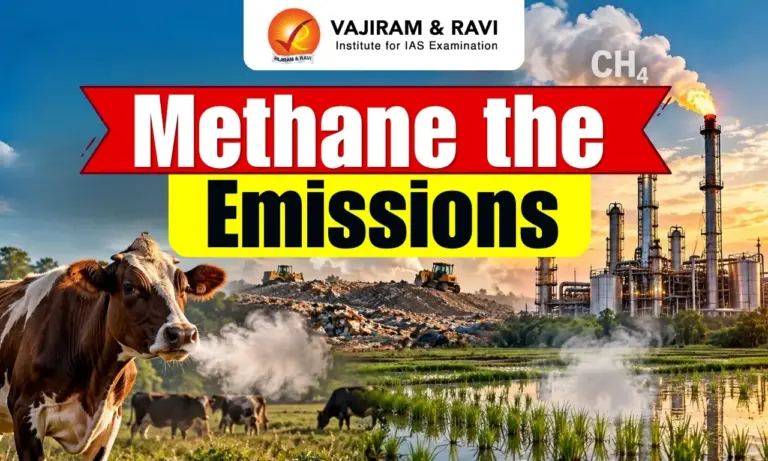
Methane Emissions are a major contributor to climate change because methane (CH₄) is a short-lived but highly potent greenhouse gas. According to the International Energy Agency (IEA), methane is responsible for around 30% of the rise in global temperatures since the Industrial Revolution. Over a 20-year period, methane has more than 80 times the warming potential of carbon dioxide (CO₂).
Unlike CO₂, which can remain in the atmosphere for centuries, methane has an atmospheric lifetime of roughly 12 years. This means that reducing methane emissions can slow the rate of global warming relatively quickly while also improving air quality.
Major Sources of Methane Emissions
Global methane emissions are estimated at around 610 million tonnes annually, with human activities contributing nearly two-thirds of the total. Among anthropogenic sources, agriculture, energy and waste are the major contributors.
- Agriculture: Accounts for around 42% of human-caused methane emissions, mainly from livestock digestion, manure management and rice cultivation.
- Fossil Fuels: The energy sector contributes around 38% of anthropogenic methane emissions, primarily through leaks, venting and flaring during oil, natural gas and coal production.
- Waste: Responsible for about 20% of human-caused methane emissions, mainly from landfills, open dumps and wastewater treatment.
- Wetlands: Wetlands are the largest natural source of methane, as microorganisms produce methane while decomposing organic matter in oxygen-free conditions.
- Coal Mining: Coal mining releases methane trapped in underground coal seams, both during active mining and from abandoned mines.
- Oil and Gas Infrastructure: Methane escapes from oil and gas wells, pipelines, processing facilities, storage systems and other equipment, making leak detection and repair an important mitigation measure.
Methane Emissions in India
India is a major source of methane emissions, with agriculture and livestock accounting for a large share because of the country’s extensive livestock population and rice cultivation. The energy and waste sectors also contribute significantly to methane emissions.
- Livestock: Enteric fermentation in cattle and buffalo is a major source of methane.
- Rice cultivation: Flooded paddy fields create oxygen-free conditions that promote methane production.
- Manure: Decomposition of livestock manure releases methane.
- Coal mining: Methane is released during coal extraction and from abandoned coal mines.
- Waste: Landfills, open dumping and wastewater treatment contribute to methane emissions.
- Agricultural residues: Poor management and burning of crop residues can contribute to methane and other air pollutants.


How Can Methane Emissions Be Reduced?
Methane emissions can be reduced through better agricultural practices, improved waste management, stronger monitoring and methane-control technologies. Since methane has a relatively short atmospheric lifetime, rapid reductions can help slow near-term warming.
- Improve livestock management: Better animal nutrition, health and breeding practices can reduce methane from enteric fermentation.
- Improve rice cultivation: Alternate wetting and drying and other water-management practices can reduce methane from flooded rice fields.
- Manage manure: Anaerobic digesters can capture methane from animal waste and convert it into biogas.
- Control fossil-fuel leaks: Regular leak detection and repair can reduce methane emissions from oil and gas infrastructure.
- Reduce venting and flaring: Capturing methane instead of releasing or burning it can reduce emissions and recover usable energy.
- Improve waste management: Composting organic waste, improving landfill management and capturing landfill gas can reduce methane.
- Strengthen monitoring: Satellites, sensors and direct measurements can help identify major methane-emitting sites and improve enforcement.
- Reduce crop-residue burning: Better residue management can help reduce methane and other pollutants associated with open burning.
Global Methane Tracker
The Global Methane Tracker, published by the International Energy Agency, provides country and regional estimates of methane emissions and information on methane-abatement opportunities.
The latest tracker includes estimates for energy-related methane emissions and examines the potential for reducing emissions from coal, oil and gas operations. Its database was updated in May 2026.
The use of satellites, direct measurements and other monitoring technologies has also improved the ability to identify major methane-emitting facilities and regions.
Global Methane Pledge
The Global Methane Pledge is an international initiative aimed at accelerating reductions in methane emissions. Its focus is particularly important because methane reductions can produce relatively rapid climate benefits.
The Climate and Clean Air Coalition estimates that implementing available methane-reduction measures could substantially reduce human-caused methane emissions this decade.
European Union Methane Regulation
The European Union Methane Regulation is designed to reduce methane emissions associated with the fossil-fuel supply chain. It includes requirements related to monitoring, reporting and verification of methane emissions and measures addressing leaks and venting.
However, the implementation timeline has become a subject of debate in 2026. In September 2026, the European Commission indicated that it planned to propose postponing the entry into force of the methane regulation following pressure from several governments and concerns related to energy supplies.
The European Commission’s proposed approach and any eventual delay remain part of the EU’s ongoing policy process.

 Last updated on Sep, 2026
→ UPSC 2027 Notification will be released on 13 January 2027 at upsconline.nic.in.
→ Asian Games 2026 are being held in Aichi-Nagoya, Japan, from 19 September to 4 October.
→ Check out the latest UPSC Syllabus here.
→ Download UPSC Model Answers for Mains 2026
→ UPSC Mains Question Paper 2026 is out now for Essay & GS Paper 1, 2, 3 & 4.
→ UPSC Calendar 2027 has been released.
→ Enroll in Vajiram & Ravi’s UPSC Mains Test Series 2027 for structured answer writing practice, expert evaluation, and exam-oriented feedback.
→ Join Vajiram & Ravi’s UPSC Mentorship Program 2027 for personalized guidance, strategy planning, and one-to-one support from experienced mentors.
→ Go through the UPSC Mains Previous Year Papers to enhance your preparation.
→ UPSC has released UPSC Toppers List 2025 with the Civil Services final result on its official website.
→ Also check Best UPSC Coaching in India
Methane Emissions FAQs
Q1. What is methane?+
Q2. Why is methane more harmful than carbon dioxide?+
Q3. What is the largest source of human-caused methane emissions?+
Q4. What are the major sources of methane in agriculture?+
Q5. How can methane emissions be reduced?+
Q6. What is the Global Methane Tracker?+
Tags: Methane methane emissions