Optogenetics Latest News
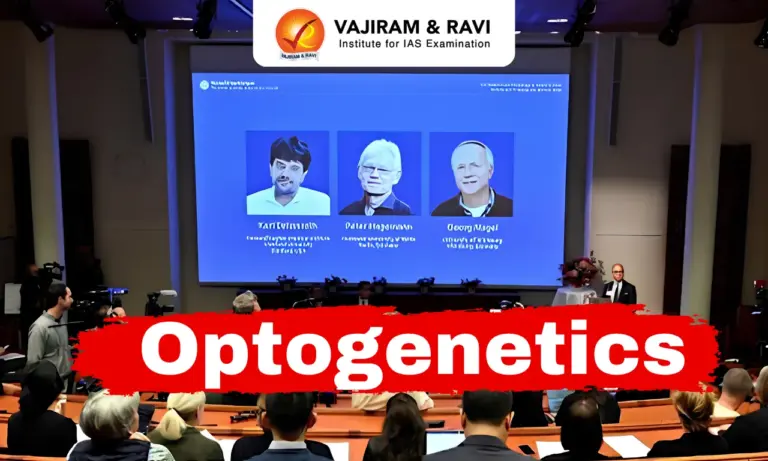
- The 2026 Nobel Prize in Physiology or Medicine has been jointly awarded to Karl Deisseroth, Peter Hegemann, and Georg Nagel for “discoveries concerning light-gated ion channels and optogenetics.”
- Their work created a new scientific field that lets researchers switch specific nerve cells on and off using light — transforming neuroscience from merely observing brain activity to actively controlling it.
The Laureates
- Karl Deisseroth (1971) – Professor of Bioengineering and Psychiatry & Behavioral Sciences, Howard Hughes Medical Institute and Stanford University, USA
- Peter Hegemann (1954) – Professor of Neuroscience, Humboldt University of Berlin, Germany
- Georg Nagel (1953) – Professor of Molecular Plant Physiology, University of Würzburg, Germany


What Are Light-Gated Ion Channels and Optogenetics?
- Light-gated ion channels are proteins acting like tiny doors in a cell’s membrane — but controlled by light instead of chemical signals. When a specific wavelength of light hits the protein, it changes shape and opens, allowing charged particles (ions) to flow through.
- Optogenetics is the technique built on this discovery — it lets scientists switch specific cells on or off using light, by placing light-sensitive proteins called opsins into targeted cells.
- As the Nobel committee put it, optogenetics has transformed neuroscience from observing and reading brain activity to actively writing into it.
The Idea’s Origin: Francis Crick’s Far-Fetched Theory
- The foundation for this field traces back to Francis Crick (Nobel laureate, 1962, for the double helix structure of DNA).
- Crick wanted to activate individual nerve cells to study the mechanisms underlying human consciousness.
- Since nerve signals are extremely rapid, he reasoned light would be the ideal control mechanism. He admitted the idea sounded “far-fetched” — but not impossible.
An Alga That Swims Toward Light
- In the early 1990s, Peter Hegemann studied the unicellular alga Chlamydomonas, which detects light through a tiny orange “eyespot” and swims toward it within half a millisecond — more than 20 times faster than the human eye’s reaction time (~10 milliseconds).
- Hegemann’s Hypothesis: Unlike the human eye, where light-reception and signal-passing involve multiple proteins in sequence, in Chlamydomonas, a single protein might do both jobs at once.
- The Challenge: Isolating this protein was difficult — it became unstable outside the eyespot.
Confirming the Hypothesis: Enter Georg Nagel
- Nagel injected each gene into frog egg cells, which then produced the proteins in their outer membranes.
- Result: Both proteins were confirmed to be ion channels that open in response to light — named channelrhodopsin-1 and channelrhodopsin-2 (ChR-2).
- ChR-2 opened within 0.2 milliseconds of a light pulse, letting positive ions flow and producing an electrical signal — this discovery paved the way for optogenetics.
- In 2003, Hegemann and Nagel published the results of their research, proposing the protein as a tool for generating electrical impulses using light.
From Psychiatric Clinic to Nerve Cells: Karl Deisseroth’s Contribution
- Deisseroth, while training at a psychiatric clinic in the 1990s, became deeply interested in brain function and psychiatric disorders. After hearing of ChR-2, he obtained the gene from Nagel and introduced it into rat nerve cells in petri dishes.
- Result: Blue light provoked a nerve signal that passed to other nerve cells — published in 2005. The technique was formally named “optogenetics” in 2006.
What Optogenetics Has Revealed
- The adult human brain has roughly 90 billion nerve cells, often intermingled despite having entirely different functions.
- Optogenetics lets researchers separate and isolate these circuits, identifying those governing:
- Pain, social behaviour, thirst, food consumption, reward, attention, circadian rhythm, and fever.
- The technique also works beyond the brain — Deisseroth showed forcing the heart to work harder can reinforce anxiety, while other researchers identified gut cells explaining sugar preference over sweeteners.
Moving Toward Treatments
- Optogenetics has deepened understanding of depression, anxiety, schizophrenia, Alzheimer’s, and Parkinson’s disease.
- In ongoing trials for retinitis pigmentosa (a disease destroying the eye’s rods and cones), a channelrhodopsin-like protein placed in a blind person’s retina restored partial vision — enabling them to discern and grasp objects on a table using special light-emitting glasses.
- Researchers hope optogenetics could make cochlear implants (which currently stimulate the auditory nerve electrically) more precise.
Addressing Safety Concerns
- Experts outlined three technical safeguards making misuse unlikely:
- Optogenetics requires genetically modifying neurons to produce light-sensitive proteins human cells don’t naturally make — this needs a deliberate genetic intervention.
- The scalp and skull block most visible light, and what penetrates gets scattered, making precise targeting difficult from outside the body.
- Changing specific neurons’ activity does not by itself grant control over a person’s thoughts or actions.
Conclusion
- What began as Crick’s far-fetched idea and an alga swimming toward light has become a technology that lets scientists flip individual brain circuits on and off with precision once thought impossible.
- From restoring partial vision in the blind to decoding the neural basis of fear and memory, optogenetics has turned neuroscience from a science of observation into one of intervention — while built-in biological safeguards keep it far from the realm of mind control.

 Last updated on Sep, 2026
→ UPSC 2027 Notification will be released on 13 January 2027 at upsconline.nic.in.
→ Asian Games 2026 are being held in Aichi-Nagoya, Japan, from 19 September to 4 October.
→ Check out the latest UPSC Syllabus here.
→ Download UPSC Model Answers for Mains 2026
→ UPSC Mains Question Paper 2026 is out now for Essay & GS Paper 1, 2, 3 & 4.
→ UPSC Calendar 2027 has been released.
→ Enroll in Vajiram & Ravi’s UPSC Mains Test Series 2027 for structured answer writing practice, expert evaluation, and exam-oriented feedback.
→ Join Vajiram & Ravi’s UPSC Mentorship Program 2027 for personalized guidance, strategy planning, and one-to-one support from experienced mentors.
→ Go through the UPSC Mains Previous Year Papers to enhance your preparation.
→ UPSC has released UPSC Toppers List 2025 with the Civil Services final result on its official website.
→ Also check Best UPSC Coaching in India
Optogenetics FAQs
Q1. What is optogenetics?+
Q2. Who received the 2026 Nobel Prize in Medicine for optogenetics? +
Q3. How did Hegemann and Nagel contribute to optogenetics? +
Q4. What has optogenetics revealed about brain function? +
Q5. Can optogenetics be used for medical treatment? +
Tags: mains articles Optogenetics upsc current affairs upsc mains current affairs