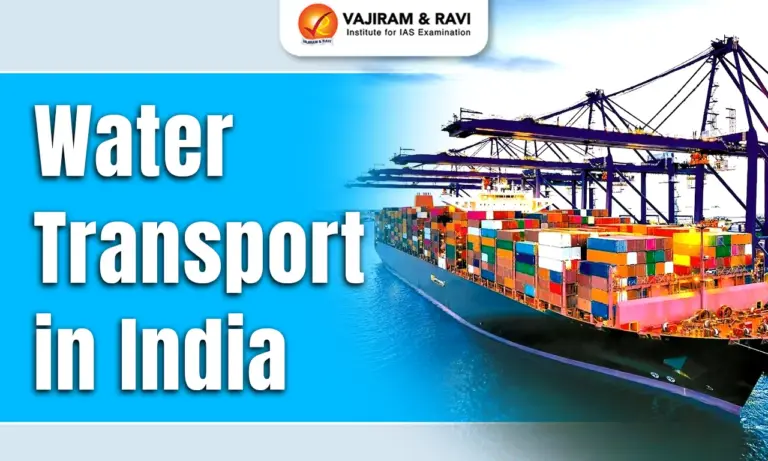
Water Transport in India is an important mode of transportation that facilitates the movement of goods and passengers through rivers, canals, inland waterways, coastal routes and seas. It is particularly suitable for carrying heavy and bulky goods over long distances at relatively low cost and with better fuel efficiency. With the development of National Waterways, ports and multimodal connectivity, water transport is gaining greater importance in India’s transport and logistics network.
Water Transport in India
Water Transport in India is one of the oldest, most economical and energy-efficient modes of transportation. It uses rivers, canals, backwaters, coastal routes and seas to move passengers and cargo. Because waterways provide a natural route and can carry large quantities of bulky goods, they are particularly important for freight movement, foreign trade and multimodal logistics.
India has about 14,500 km of potentially navigable inland waterways, while the National Waterways Act, 2016 declared 111 waterways as National Waterways. As of 2026, the Ministry of Ports, Shipping and Waterways reports that 32 National Waterways have been operationalised, while cargo movement on inland waterways reached 218 million tonnes in 2025-26.
Types of Water Transport in India
Water transport in India can broadly be divided into Inland Water Transport (IWT) and Ocean Transport. While inland waterways facilitate movement through rivers, canals and other inland water bodies, ocean transport connects Indian coastal regions with domestic and international markets.
1. Inland Water Transport
- Inland Water Transport (IWT) involves the movement of goods and passengers through navigable rivers, canals, backwaters, creeks and other inland water bodies. It is particularly suitable for transporting heavy and bulky commodities such as coal, minerals, cement, foodgrains and petroleum products.
- Rivers provide natural routes for inland navigation, while canals are artificial waterways developed mainly for navigation, irrigation or both. Their effectiveness depends on factors such as adequate water depth, navigational infrastructure and year-round navigability.
- India has 111 National Waterways, declared under the National Waterways Act, 2016, which provide a framework for developing waterways, terminals, fairways and other supporting infrastructure.
- Inland waterways offer high carrying capacity and better fuel efficiency compared with road transport for suitable cargo. They can also reduce pressure on highways and railways by shifting a part of bulk freight movement to waterways.
2. Ocean Transport
Ocean transport involves the movement of goods and passengers through coastal and international maritime routes. It plays an important role in domestic coastal connectivity as well as India’s foreign trade.
Coastal Shipping
- Coastal shipping involves the movement of goods and passengers between ports along India’s coastline. It is particularly suitable for bulk commodities such as coal, iron ore and petroleum products and can complement road and rail transport.
Overseas Shipping
- Overseas shipping connects Indian ports with international markets and is essential for India’s maritime trade and global supply chains. Different vessels are used depending on the nature and volume of cargo.


Major Inland Waterways in India
The development of National Waterways is central to India’s strategy for expanding inland water transport. Some of the important waterways include the following:
National Waterway 1
- National Waterway 1 (NW-1) runs along the Ganga-Bhagirathi-Hooghly river system from Haldia/Sagar in West Bengal to Prayagraj in Uttar Pradesh, covering approximately 1,620 km. It passes through West Bengal, Jharkhand, Bihar and Uttar Pradesh and forms one of India’s most important inland freight corridors.
- The Jal Marg Vikas Project (JMVP) focuses on improving navigability and developing terminals and other infrastructure along NW-1. The waterway has strategic importance because it connects the industrial and agricultural hinterlands of northern and eastern India with the maritime gateway region of the lower Ganga.
National Waterway 2
- National Waterway 2 is located on the Brahmaputra River in Assam and provides an important inland navigation route in northeastern India. It has significance not only for cargo movement but also for improving regional connectivity in a geographically challenging area.
- Development of NW-2 can strengthen connectivity between Assam and other parts of the Northeast while supporting the movement of agricultural products, construction materials and other commodities. It also has potential to complement road and rail connectivity in the region.
National Waterway 3
- National Waterway 3 is associated with the West Coast Canal system in Kerala, along with connected waterways. Kerala’s extensive network of backwaters, canals and coastal waterways provides favourable conditions for both passenger and cargo transportation.
- The waterway also has significance for tourism, local transportation and regional connectivity. Greater integration of waterways with roads and other transport systems can improve their economic utility.
National Waterway 4
- National Waterway 4 covers the Kakinada-Puducherry Canal system and connected river stretches in Andhra Pradesh and Tamil Nadu. It provides an important east-coast inland waterway network connecting several riverine and canal-based transport routes.
- The development of NW-4 can improve the movement of bulk commodities and strengthen connections between inland production areas, industrial centres and coastal ports.
National Waterway 5
- National Waterway 5 includes important stretches of the East Coast Canal and river systems associated with the Brahmani and Mahanadi delta regions, particularly in Odisha. Its development can support the movement of bulk cargo and improve connectivity with coastal economic centres.
Other Important Waterways
- Apart from the major waterways mentioned above, several other National Waterways have potential for regional cargo and passenger movement. These include waterways associated with the Barak River system, Goa’s rivers and waterways in eastern and southern India.
- The development of these waterways depends on local conditions such as navigable depth, cargo potential, terminal infrastructure, connectivity with roads and railways, and the availability of suitable vessels.
Also Read: National Waterways in India
Major Ports and Water Transport Infrastructure in India
- India’s maritime transport system depends on an extensive network of major and non-major ports, terminals, shipping services and hinterland connectivity. Ports act as important gateways through which domestic production is connected with international markets.
- The Major Port Authorities Act, 2021 provides the legal framework for the regulation, operation and planning of India’s major ports and provides for the management of major ports through Boards of Major Port Authorities. The current framework covers 12 major ports.
- Efficient port infrastructure is essential for water transport because cargo movement does not end at the waterfront. Road and railway connectivity, cargo-handling facilities, warehousing, logistics parks and digital systems are necessary to ensure smooth movement between ports and their hinterlands.
Significance of Water Transport in India
- Low transportation cost: Waterways generally require lower operating costs than road transport, particularly when large quantities of bulk commodities are transported over long distances. This can help reduce the overall logistics cost of industries dependent on heavy raw materials.
- High carrying capacity: Inland vessels can carry substantial quantities of cargo in a single trip. This makes waterways especially suitable for commodities such as coal, iron ore, cement, foodgrains, fertilisers and other heavy or bulky materials.
- Fuel and energy efficiency: Water transport can move cargo using relatively less energy per tonne-kilometre compared with many land-based modes. Its greater energy efficiency also gives it potential for reducing the carbon intensity of the freight sector.
- Reduction in road and rail congestion: Greater use of inland waterways can shift part of the freight burden away from highways and railway networks. This can help reduce traffic congestion, road maintenance requirements and pressure on existing rail freight corridors.
- Scope for multimodal transportation: Inland waterways can be integrated with roads, railways and ports to create an efficient multimodal transport network. Terminals connected to road and rail networks can help overcome the limitation that waterways cannot usually provide direct door-to-door transportation.
Challenges of Water Transport in India
- Low speed: Inland water transport is generally slower than road, rail and air transport. Therefore, it is more suitable for cargo where transportation speed is less important than cost and carrying capacity.
- Seasonal variations: Changes in river discharge, particularly during dry seasons, can reduce navigable depth in certain stretches. Floods, droughts and variations in water levels can also affect the reliability of inland navigation.
- Siltation and changing river morphology: Rivers frequently experience silt deposition, erosion and changes in their channels. Maintaining adequate navigational depth therefore requires continuous monitoring, dredging and other river-management measures.
- Limited geographical coverage: Waterways do not reach every production centre or consumption market. Cargo therefore needs to be transported between terminals and the final destination through road or rail, making efficient first- and last-mile connectivity essential.
- Infrastructure constraints: Lack of adequate terminals, jetties, cargo-handling facilities, storage infrastructure, navigation aids and maintenance facilities can restrict the wider adoption of inland water transport.
Government Initiatives for Water Transport in India
The Government of India has introduced several initiatives to develop inland waterways, modernise ports, improve navigability and strengthen multimodal connectivity. Major initiatives and programmes supporting water transport in India are discussed below.
Sagarmala Programme
- The Sagarmala Programme, launched in March 2015, is a flagship initiative of the Ministry of Ports, Shipping and Waterways aimed at promoting port-led development. Its focus areas include port modernisation, port connectivity, port-linked industrialisation and development of coastal communities.
- The programme also promotes coastal shipping and inland water transport as part of India’s broader effort to develop efficient and multimodal logistics networks. It seeks to improve the integration of ports with industrial clusters, economic centres and transport corridors.
Jal Marg Vikas Project
- The Jal Marg Vikas Project (JMVP) focuses on developing the navigational and terminal infrastructure of National Waterway 1.
- The project is intended to improve the movement of large vessels and cargo between the Ganga hinterland and the maritime gateway at the lower end of the waterway.
- Development under JMVP includes interventions such as fairway development, multimodal terminals and navigation-related infrastructure. It is an important example of India’s efforts to convert inland waterways into commercially viable freight corridors.
National Waterways Act, 2016
- The National Waterways Act, 2016 declared 111 waterways as National Waterways, creating a common legal framework for their development and regulation. The total length of these National Waterways is about 20,187 km according to current Ministry of Ports, Shipping and Waterways data.
- However, declaration as a National Waterway does not automatically mean that every waterway is fully operational. At present, 32 National Waterways are operational, covering about 5,155 km, and further development is being undertaken based on navigational and cargo potential.
Inland Vessels Act, 2021
- The Inland Vessels Act, 2021 modernised the regulatory framework governing inland vessels in India. It seeks to bring greater uniformity in standards related to registration, safety and navigation of inland vessels across states.
- A modern and standardised regulatory framework is important for increasing private investment and improving the safety and efficiency of inland water transport. The Ministry has subsequently notified additional rules and regulations under the new framework.
PM Gati Shakti
- PM Gati Shakti promotes integrated infrastructure planning by bringing different transport modes into a common framework. For water transport, this can improve coordination between ports, waterways, roads, railways, logistics facilities and industrial centres.
- Such multimodal integration is important because the success of waterways depends not only on navigability but also on efficient movement of cargo before and after its waterborne journey.
National Waterways (Construction of Jetties/Terminals) Regulations, 2025
- The National Waterways (Construction of Jetties/Terminals) Regulations, 2025 provide a framework intended to facilitate the development of jetties and terminals on National Waterways. The regulations are aimed at encouraging infrastructure development and greater participation of private stakeholders.
Maritime India Vision 2030
- Maritime India Vision (MIV) 2030 is a 10-year roadmap of the Ministry of Ports, Shipping and Waterways for the holistic development of India’s maritime sector. It includes 150 initiatives across 10 core themes, covering ports, shipping, inland waterways, logistics, technology, sustainability and global maritime cooperation.
- The vision focuses on port infrastructure, logistics efficiency, shipbuilding, coastal and inland waterway traffic, technology, sustainability and policy reforms to strengthen India’s position as a leading maritime nation.
Way Forward for Water Transport in India
- Develop multimodal connectivity: Waterways should be integrated with roads, railways, ports, logistics parks and industrial corridors so that cargo can move smoothly from the production centre to the final destination.
- Improve navigability: Regular hydrographic surveys, scientific dredging where required, river training and better navigation aids can improve the reliability of National Waterways and allow vessels to operate more efficiently.
- Expand terminals and jetties: Modern terminals with mechanised cargo-handling facilities, storage infrastructure and road-rail connectivity should be developed at locations with strong cargo potential.
- Promote green vessels: Greater adoption of electric, LNG/CNG and other cleaner propulsion technologies can reduce the environmental footprint of inland navigation. Green hydrogen and green methanol can also become relevant as technology and infrastructure mature.
- Encourage private investment: Stable regulations, transparent procedures, improved infrastructure and better cargo aggregation can encourage private operators to invest in vessels, terminals, logistics services and related infrastructure.
- Strengthen digital navigation: Digital systems, vessel tracking, electronic documentation, real-time information and modern navigation aids can improve safety, efficiency and transparency in inland water transport.
- Protect river ecosystems: Infrastructure development should be undertaken with adequate environmental safeguards so that the economic benefits of waterways do not come at the cost of riverine ecosystems and biodiversity.

 Last updated on Oct, 2026
→ UPSC 2027 Notification will be released on 13 January 2027 at upsconline.nic.in.
→ Check Nobel Prize 2026 Winners List here.
→ Download PIB PRiSM Monthly Magazine 2026 here.
→ Check UPSC Monthly Current Affairs Magazine The Recitals here.
→ Check out the latest UPSC Syllabus here.
→ Download UPSC Model Answers for Mains 2026
→ UPSC Mains Question Paper 2026 is out now for Essay & GS Paper 1, 2, 3 & 4.
→ UPSC Calendar 2027 has been released.
→ Enroll in Vajiram & Ravi’s UPSC Mains Test Series 2027 for structured answer writing practice, expert evaluation, and exam-oriented feedback.
→ Join Vajiram & Ravi’s UPSC Mentorship Program 2027 for personalized guidance, strategy planning, and one-to-one support from experienced mentors.
→ Go through the UPSC Mains Previous Year Papers to enhance your preparation.
→ UPSC has released UPSC Toppers List 2025 with the Civil Services final result on its official website.
→ Also check Best UPSC Coaching in India
Water Transport in India FAQs
Q1. What is Water Transport in India?+
Q2. What are the main types of water transport in India?+
Q3. How many National Waterways are there in India?+
Q4. What are the major inland waterways in India?+
Q5. What is the importance of water transport in India?+
Q6. What is the Jal Marg Vikas Project?+
Q7. What are the major challenges of water transport in India?+
Q8. What is the role of Sagarmala in water transport?+
Tags: economy economy notes water transport in india