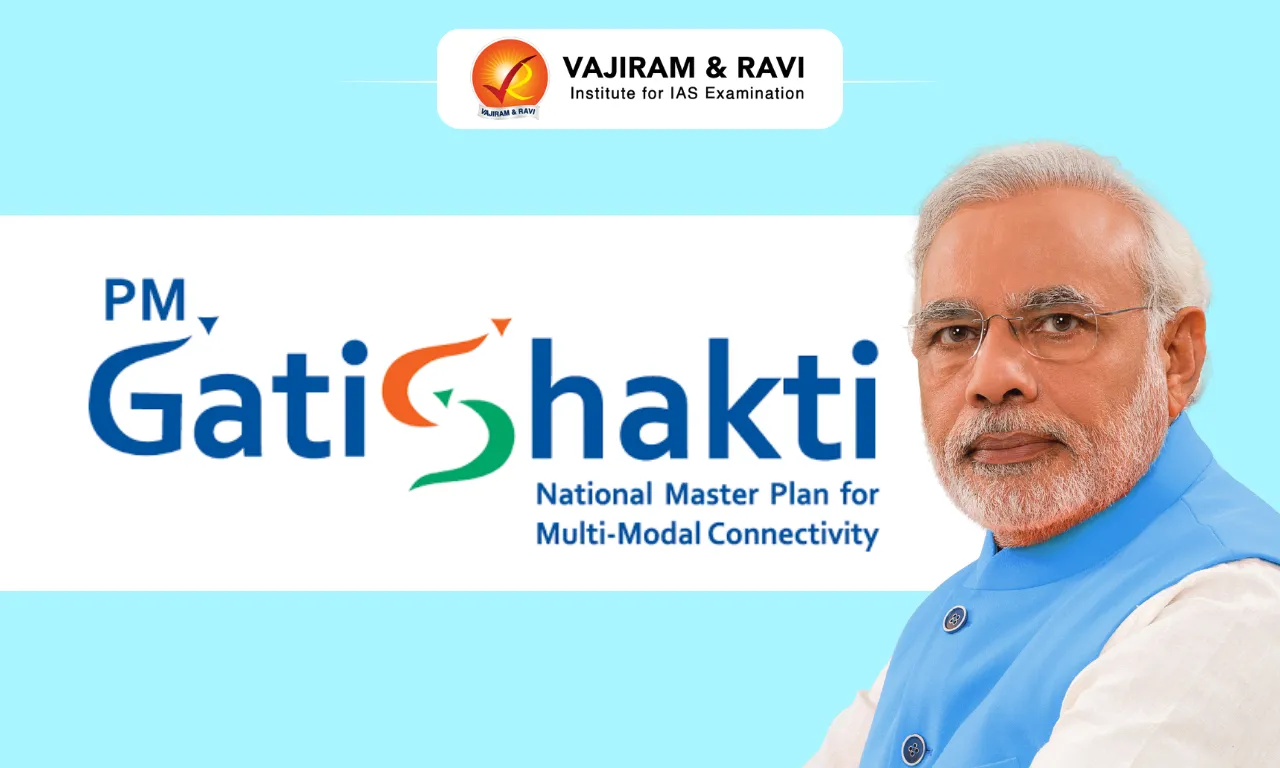
The PM Gati Shakti National Master Plan, launched on 13 October 2021, aims to transform India's infrastructure planning through an integrated and coordinated approach. It addresses fragmented planning, project delays, and high logistics costs by serving as the planning and coordination platform for flagship programmes such as the National Infrastructure Pipeline (NIP), Bharatmala Pariyojana, Sagarmala Programme, Dedicated Freight Corridors, UDAN, and BharatNet.
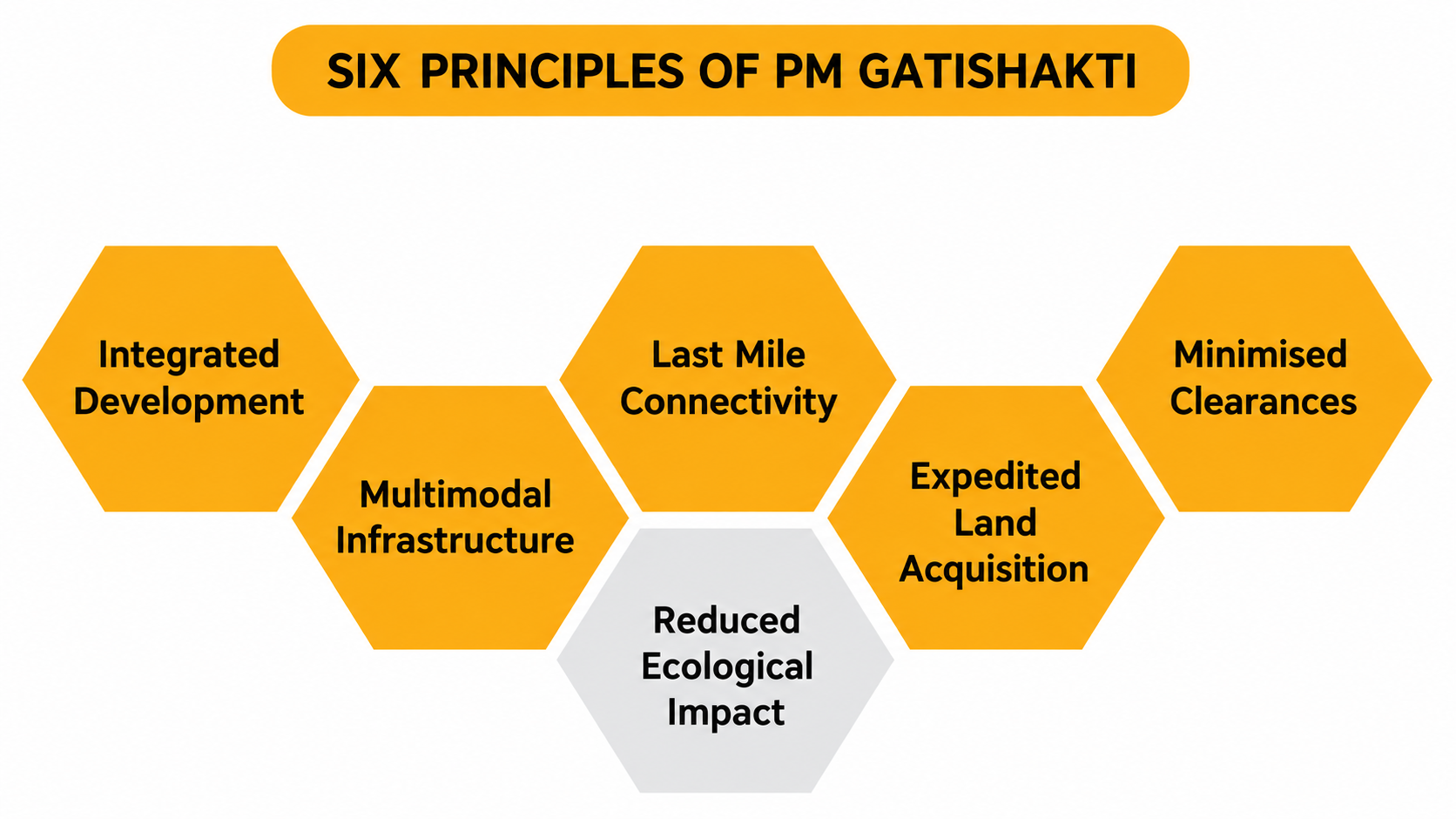
PM Gati Shakti is based on the principles of whole-of-government and cooperative federalism. It integrates Central Ministries and States on a GIS-based platform to promote multimodal connectivity, last-mile linkages, faster project implementation, and efficient infrastructure development.
PM Gati Shakti About
PM Gati Shakti acts as a comprehensive National Master Plan that integrates roads, railways, ports, airports, waterways, logistics, and economic zones on a single digital platform to ensure synchronised infrastructure planning and execution.
PM Gati Shakti Objectives
The major objectives of PM Gati Shakti are integrated infrastructure planning, reduced logistics costs, faster project implementation, ease of doing business, and stronger supply-chain efficiency.
- Ensure integrated and coordinated infrastructure planning by breaking departmental silos among roads, railways, ports, airports, and utilities.
- Reduce logistics costs and accelerate project implementation through synchronised planning, faster approvals, and improved last-mile connectivity.
- Enhance ease of doing business, strengthen supply chain efficiency, and support Aatmanirbhar Bharat and the vision of a $5 trillion economy.
How Projects Under PM Gati Shakti Are Funded
- Central & State Budgets: Projects are primarily financed through budgetary allocations of concerned Union ministries and state governments.
- Special Capital Investment Support: States receive long-term, interest-free capital expenditure loans and other financial assistance under schemes such as the Scheme for Special Assistance to States for Capital Investment.
- Public–Private Partnerships (PPP): Large infrastructure and logistics projects leverage private investment, supported by government measures such as Viability Gap Funding (VGF).
- Institutional & Market Financing: Infrastructure assets may also be financed through InvITs, infrastructure/corporate bonds, municipal bonds and multilateral development financing.


PM Gati Shakti Scheme Features
The major features of PM Gati Shakti are technology-driven planning, multimodal connectivity, GIS-based mapping, and inter-ministerial coordination to enable integrated infrastructure development, reduce delays, and improve efficiency.
- GIS-Based & Data-Driven Digital Platform: The PM Gati Shakti portal is a GIS-enabled portal integrating infrastructure data from 58 Central Ministries/Departments and 36 States/UTs, with 1,800+ data layers covering economic zones, logistics nodes, utilities, land records and social infrastructure, enabling holistic, real-time planning, monitoring and coordination under the PM Gati Shakti National Master Plan.
- PM Gati Shakti acts as the digital planning, coordination, and execution framework for the projects financed and listed under the National Infrastructure Pipeline (NIP)
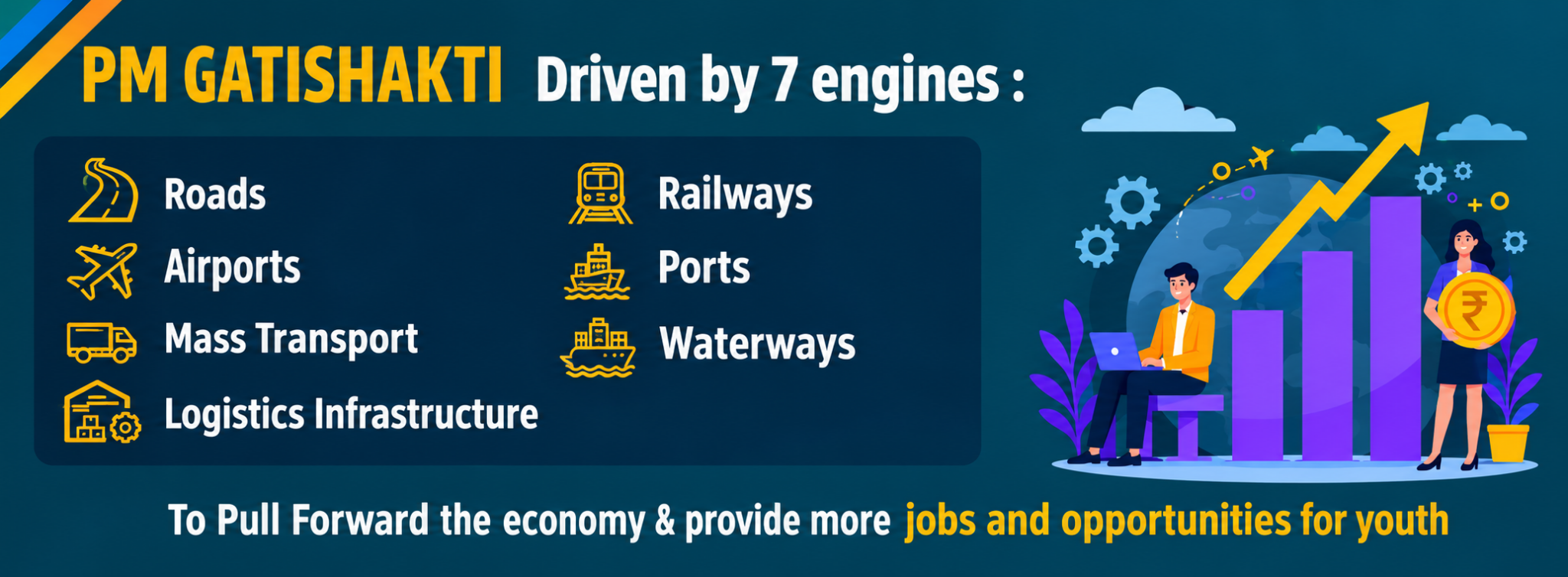
- Integrated Multi-Modal Connectivity: The National Master Plan connects roads, railways, ports, waterways, airports, mass transport, and logistics infrastructure to ensure seamless movement of people and goods.
- Breaking Departmental Silos: The National Master Plan enables coordinated planning among ministries and departments through a unified digital platform, reducing duplication and project delays.
- Focus on Economic Zones: The National Master Plan prioritises connectivity to industrial corridors, textile clusters, pharma hubs, defence corridors, ports, and agricultural zones to boost productivity and investment.
- Sectors under PM Gati Shakti: Roads and highways connectivity, Railways and Dedicated Freight Corridors, Airports and regional air connectivity, Ports, waterways, and maritime infrastructure, Mass transport and logistics infrastructure as an integrated cross-sectoral component.
- Network Planning Group (NPG): The Network Planning Group (NPG) under PM GatiShakti evaluates major Central Government infrastructure projects at the planning stage to ensure integrated and multimodal planning, inter-modal connectivity, synchronised implementation, last-mile connectivity, data-driven decision-making and comprehensive regional development. As of 11 August, 2026,
- 396 projects worth ₹18.66 lakh crore have been evaluated.
- 256 projects have been sanctioned.
- 198 projects are currently under implementation.
PM Gati Shakti Significance
PM Gati Shakti aims to transform infrastructure development by integrating planning, coordination, and execution on a single GIS-based digital platform. It enhances multimodal connectivity, improves project efficiency, and strengthens India's economic competitiveness.
- Reduces Logistics Costs: It aims to reduce logistics costs from 13–14% of GDP to around 8%, improving the competitiveness of Indian industry and exports.
- Accelerates Project Implementation: PMGS NMP integrates 1,800+ GIS-based data layers to eliminate departmental silos, reducing project delays, duplication, and cost overruns.
- Strengthens Multimodal Connectivity: PMGS NMP seamlessly integrates roads, railways, ports, airports, waterways, and logistics infrastructure, improving last-mile connectivity and freight movement.
- Boosts Manufacturing and Industrial Growth: It supports Make in India, Production Linked Incentive (PLI) Schemes, and Industrial Corridors by improving connectivity to manufacturing clusters and reducing logistics costs.
- Promotes Cooperative Federalism: It enables coordinated planning among Central Ministries, States, and implementing agencies, leading to more efficient infrastructure development.
- Enhances Private Investment: Better project planning, faster clearances, and improved coordination strengthen the pipeline of bankable projects and encourage PPP and private sector participation.
PM Gati Shakti Challenges
PM Gati Shakti challenges are institutional coordination gaps, technological and data-related issues, legal constraints, implementation bottlenecks, and capacity limitations that may hinder integrated infrastructure development.
- Data Integration and Interoperability: The absence of standardised data formats, incomplete digitisation of land records, and fragmented government databases hinder seamless data integration and evidence-based planning.
- Data Security and Information Sharing: Sharing sensitive geospatial and infrastructure data raises cybersecurity concerns, while restricted data access for private stakeholders limits effective planning under PPP and National Monetisation Pipeline (NMP) projects.
- Centre–State Coordination Challenges: Differences in institutional capacity, policy priorities, and data-sharing practices across States often delay integrated planning and project execution.
- Land Acquisition and Regulatory Delays: Land acquisition disputes, environmental clearances, rehabilitation issues, and multiple statutory approvals continue to delay infrastructure projects.
- Capacity Constraints: Limited technical, financial, and institutional capacity among implementing agencies, particularly at the State and local levels, affects project planning, execution, and monitoring.
- Legal and Social Challenges: Litigation, environmental compliance requirements, displacement of affected communities, and local resistance often increase project timelines and costs.
PM Gati Shakti Way Forward
PM Gati Shakti has emerged as a major step towards integrated infrastructure development and multi-modal connectivity in India. However, to fully realise the transformative potential of PM Gati Shakti, greater institutional coordination, digital integration, private participation, and sustainable infrastructure planning are essential.
- Deepen Centre–State Integration: Accelerate the preparation of State and District Master Plans (DMPs) to align local infrastructure planning with national economic corridors.
- Enhance Private Sector Participation: Provide secure access to non-sensitive infrastructure data to improve logistics planning, warehousing, and PPP participation.
- Strengthen Multimodal Connectivity: Expand railway freight corridors, inland waterways, multimodal logistics parks, and container terminals to improve seamless freight movement.
- Streamline Land and Regulatory Clearances: Adopt geospatial technology such as GIS-enabled approvals and digitised compliance systems to expedite land acquisition, environmental clearances, and Right of Way (RoW) permissions.
- Leverage Advanced Technologies: Integrate Artificial Intelligence (AI), satellite imagery, remote sensing, drones, digital twins, and predictive analytics for real-time project monitoring, asset management, route optimisation, and evidence-based infrastructure planning.
- Build Institutional Capacity and Promote Sustainable Infrastructure: Strengthen technical capacity through institutions such as Gati Shakti Vishwavidyalaya, while promoting green infrastructure, low-carbon transport, and data-driven planning through tools such as Logistics Ease Across Different States (LEADS).
PM Gati Shakti UPSC PYQs
Q1. The Gati-Shakti Yojana needs meticulous coordination between the government and the private sector to achieve the goal of connectivity. Discuss. (UPSC Mains 2022)

 Last updated on Oct, 2026
→ UPSC 2027 Notification will be released on 13 January 2027 at upsconline.nic.in.
→ Check Nobel Prize 2026 Winners List here.
→ Download PIB PRiSM Monthly Magazine 2026 here.
→ Check UPSC Monthly Current Affairs Magazine The Recitals here.
→ Check out the latest UPSC Syllabus here.
→ Download UPSC Model Answers for Mains 2026
→ UPSC Mains Question Paper 2026 is out now for Essay & GS Paper 1, 2, 3 & 4.
→ UPSC Calendar 2027 has been released.
→ Enroll in Vajiram & Ravi’s UPSC Mains Test Series 2027 for structured answer writing practice, expert evaluation, and exam-oriented feedback.
→ Join Vajiram & Ravi’s UPSC Mentorship Program 2027 for personalized guidance, strategy planning, and one-to-one support from experienced mentors.
→ Go through the UPSC Mains Previous Year Papers to enhance your preparation.
→ UPSC has released UPSC Toppers List 2025 with the Civil Services final result on its official website.
→ Also check Best UPSC Coaching in India
PM Gati Shakti FAQs
Q1. What is the PM Gati Shakti National Master Plan?+
Q2. What are the 7 core pillars of PM Gati Shakti?+
Q3. How many ministries and states are part of PM Gati Shakti?+
Q4. How is PM Gati Shakti different from the National Infrastructure Pipeline (NIP)?+
Q5. What is the target of PM Gati Shakti on logistics costs?+
Tags: pm gati shakti quest upsc economy notes