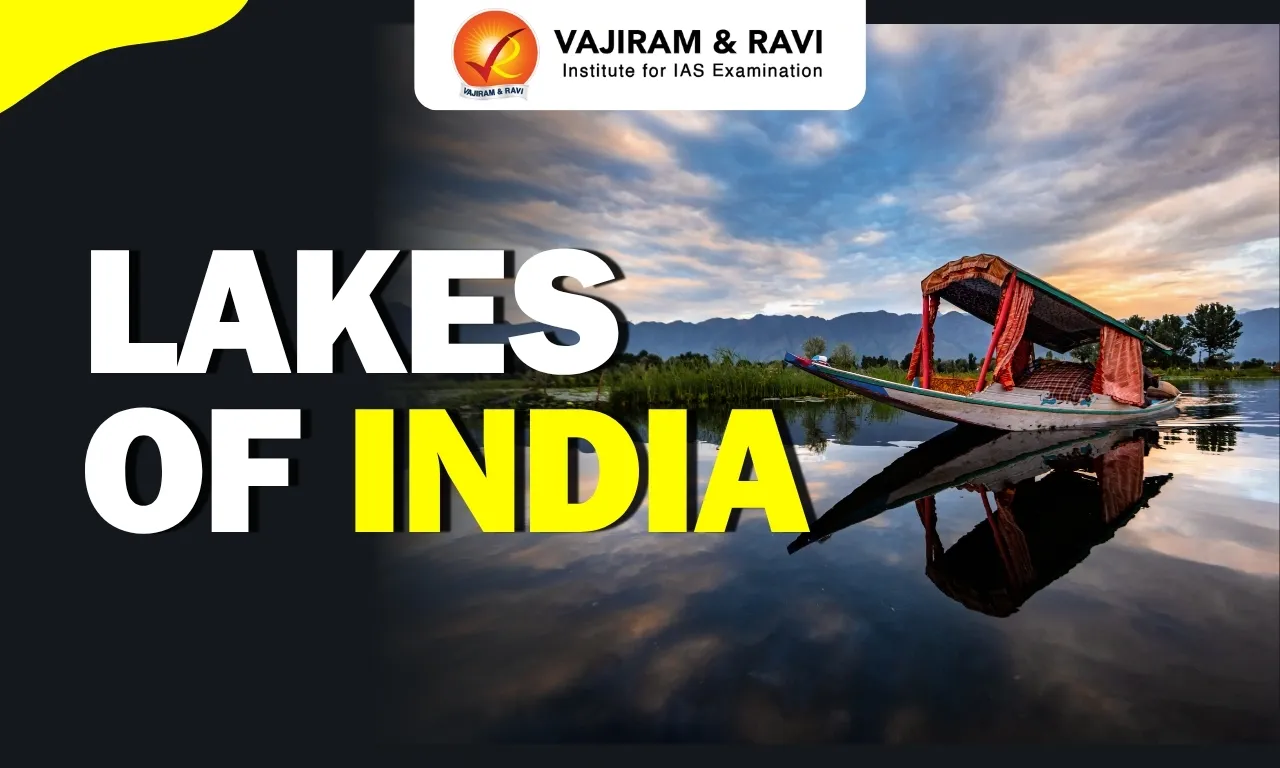
Lakes of India represent diverse natural and human-made water bodies shaped by geological, climatic, fluvial and ecological processes across the country's varied physiographic regions. India’s lake systems range from Himalayan high-altitude lakes and glacial waters to coastal lagoons, oxbow lakes, saline lakes, reservoirs and urban water bodies.
The National Water Data Portal of the National Water Informatics Centre provides state-wise spatial data on surface water bodies larger than 0.1 hectare, with boundaries derived from satellite imagery. India’s lakes support freshwater resources, biodiversity, agriculture, fisheries, tourism and local livelihoods, while several have received international recognition under the Ramsar Convention.
Lakes Meaning
A lake is a relatively large inland body of standing water occupying a depression or basin, generally separated from the sea, although some coastal water bodies may have restricted connections with marine waters.
- Lakes may be natural or artificial, permanent or seasonal, and differ greatly in their size, depth, water chemistry, origin and ecological characteristics. Some receive water from rivers, rainfall, glaciers and springs, while others lose water through rivers, groundwater seepage or evaporation.
- High-altitude water bodies can contain fresh, brackish or saline water and may be either static or connected with inflowing and outflowing streams.
Lakes of India Formation
Lake formation in India occurs through geological, glacial, riverine, coastal, volcanic and human processes, creating water bodies with different shapes, depths, chemistry and ecological characteristics. Major lake-forming processes include:
- Glacial activity: Glacial erosion and subsequent melting can create or fill depressions, producing high-altitude lakes.
- Tectonic movements: Faulting, subsidence and crustal deformation can create basins that accumulate water.
- River meandering: A meander can become isolated from a river channel and develop into an oxbow lake.
- Coastal processes: Sandbars, spits and coastal sedimentation can isolate shallow coastal water bodies from the sea.
- Volcanic and impact processes: Volcanic craters and calderas may become water-filled, while meteorite impacts can independently create crater lakes such as Lonar Lake.
- Landslides: Landslides can block river valleys and create temporary or permanent lakes.
- Glacial moraine deposition: Moraines can obstruct drainage and form glacial lakes.
- Human intervention: Dams and reservoirs create large artificial water bodies for irrigation, drinking water, hydropower and other purposes.
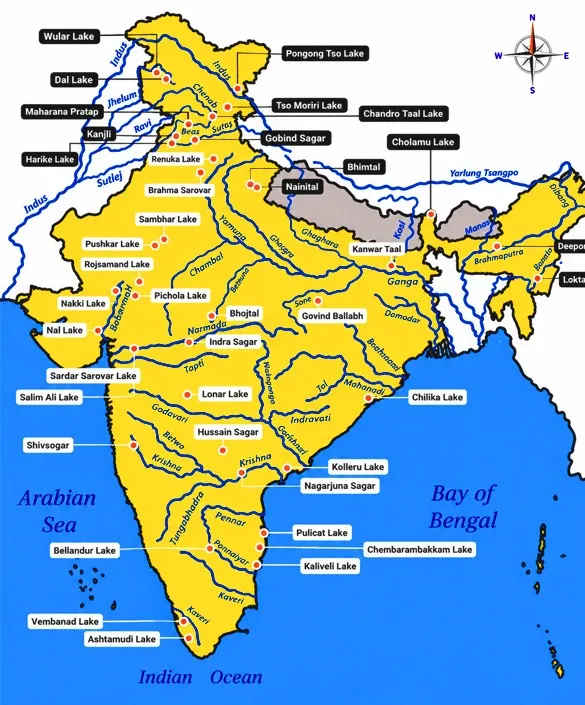


Lakes of India Types
Types of lakes in India can be classified according to their origin, water chemistry, location, drainage characteristics and whether they are natural or human-made.
- Glacial Lakes: Glacial lakes form through processes associated with glaciers, including the melting and retreat of glaciers and the filling of glacial depressions.
- Examples: Gurudongmar Lake in Sikkim.
- Tectonic Lakes: Tectonic lakes develop in depressions created by movements, faulting or deformation of the Earth's crust.
- Examples: Wular Lake is commonly associated with tectonic processes, while several lakes of the Himalayan region occupy tectonic or fault-related basins.
- Oxbow Lakes: Oxbow lakes are crescent-shaped water bodies formed when a meander loop of a river becomes cut off from the main river channel.
- Examples: Kanwar/Kabartal in Bihar and several floodplain lakes and beels of the Ganga-Brahmaputra plains.
- Lagoon Lakes: Lagoon-type lakes occur along coastal areas where shallow water bodies are separated from the sea by sandbars, spits or other coastal features.
- Examples: Chilika Lake in Odisha and Pulicat Lake along the Andhra Pradesh–Tamil Nadu coast.
- Salt Lakes: Salt lakes contain relatively high concentrations of dissolved salts, often because evaporation exceeds freshwater inflow.
- Examples: Sambhar Lake in Rajasthan and several saline lakes of the Ladakh region.
- Freshwater Lakes: Freshwater lakes have comparatively low salinity and may receive water from rainfall, rivers, springs, glaciers or groundwater.
- Examples: Wular Lake, Loktak Lake, Kolleru Lake and Sasthamkotta Lake.
- Brackish Water Lakes: Brackish lakes contain more dissolved salts than freshwater lakes but less salinity than typical seawater.
- Examples: Chilika Lake and Pulicat Lake are important coastal brackish water systems.
- Artificial or Man-made Lakes: Artificial lakes are created or significantly modified through dams, reservoirs, irrigation projects, urban water infrastructure or other human interventions.
- Examples: Govind Ballabh Pant Sagar, Pong Dam Lake, Bhoj Wetland and Tawa Reservoir.
Lakes of India Important List
Major and important lakes of India are distributed across the Himalayas, northern plains, Peninsular Plateau, desert region, coastal belt and urban landscapes.
| Lake | State/UT | Type | Important Specification |
|
Wular Lake |
Jammu & Kashmir |
Freshwater, tectonic |
One of the major freshwater lakes of India, associated with the Jhelum River system. |
|
Dal Lake |
Jammu & Kashmir |
Freshwater, urban lake |
Famous for houseboats, shikaras and tourism, located in Srinagar. |
|
Pangong Tso |
Ladakh |
High-altitude, endorheic, brackish lake |
High-altitude lake in the Changthang region; the atlas records 29,345 ha in the Indian sector. |
|
Tso Moriri |
Ladakh |
High-altitude, endorheic |
Located in the Changthang region; an important high-altitude lake of the western Himalaya. |
|
Tso Kar |
Ladakh |
High-altitude saline lake |
Known for saline deposits and wetlands; situated in the cold-desert landscape of Changthang. |
|
Chandra Tal |
Himachal Pradesh |
Glacial |
High-altitude lake in the Lahaul-Spiti region; its basin is associated with glacial processes. |
|
Suraj Tal |
Himachal Pradesh |
Glacial/high-altitude |
Located in the Lahaul region near Baralacha La; fed mainly by snow and glacier melt. |
|
Rewalsar Lake |
Himachal Pradesh |
Freshwater, natural |
Sacred lake associated with Buddhist and Hindu traditions; located in Mandi district. |
|
Renuka Lake |
Himachal Pradesh |
Natural freshwater |
A prominent natural lake and wetland in the Sirmaur district. |
|
Naini Lake |
Uttarakhand |
Natural freshwater |
Famous lake of Nainital and an important tourism centre in the Kumaon Himalaya. |
|
Bhimtal Lake |
Uttarakhand |
Freshwater |
One of the major lakes of the Kumaon Lake District. |
|
Roopkund Lake |
Uttarakhand |
Glacial/high-altitude |
Small glacial lake in the Himalaya, situated at high elevation. |
|
Kedar Tal |
Uttarakhand |
Glacial |
High-altitude lake in the Gangotri region, surrounded by Himalayan peaks. |
|
Gurudongmar Lake |
Sikkim |
Glacial, high-altitude |
One of Sikkim's major high-altitude lakes, located close to the India-China border. |
|
Cholamu/Tso Lhamu |
Sikkim |
Glacial |
High-altitude lake and source region of the Teesta; the atlas records it at about 5,014 m and 106 ha. |
|
Khangchung Chho |
Sikkim |
High-altitude/glacial |
Located at about 5,303 m, with an area of 172 ha in the atlas study. |
|
Tsomgo Lake |
Sikkim |
Glacial |
Important high-altitude lake near Gangtok; locally significant and tourism-related. |
|
Sela Lake |
Arunachal Pradesh |
Glacial/high-altitude |
Located near Sela Pass, part of the concentration of high-altitude lakes in the Tawang region. |
|
Loktak Lake |
Manipur |
Freshwater, floodplain |
Famous for floating phumdis, an important wetland and ecological resource. |
|
Umiam Lake |
Meghalaya |
Reservoir/artificial |
Major reservoir near Shillong, created by damming the Umiam River. |
|
Deepor Beel |
Assam |
Freshwater floodplain wetland |
Important wetland near Guwahati and a significant habitat for waterbirds. |
|
Kolleru Lake |
Andhra Pradesh |
Freshwater |
Major freshwater lake between the Krishna and Godavari deltaic systems. |
|
Pulicat Lake |
Andhra Pradesh–Tamil Nadu |
Brackish lagoon |
Large coastal lagoon on the Bay of Bengal; important for migratory birds and fisheries. |
|
Chilika Lake |
Odisha |
Brackish coastal lagoon |
One of India's major coastal lagoons; renowned for fisheries, migratory birds and biodiversity. |
|
Ansupa Lake |
Odisha |
Freshwater, oxbow |
Oxbow-type lake associated with the Mahanadi river system. |
|
Lonar Lake |
Maharashtra |
Meteor-impact/crater lake |
Formed in a basaltic terrain by a meteorite impact; notable for its unusual geological and ecological setting. |
|
Vembanad Lake |
Kerala |
Coastal lagoon/backwater |
Major lake-backwater system of Kerala; supports fisheries, transport, agriculture and tourism. |
|
Ashtamudi Lake |
Kerala |
Backwater/lagoon |
Extensive backwater system in Kollam; known for its multiple arms and wetland ecosystem. |
|
Sasthamkotta Lake |
Kerala |
Freshwater |
Important freshwater lake of Kerala and a major source of drinking water. |
|
Vellayani Lake |
Kerala |
Freshwater |
Important freshwater lake near Thiruvananthapuram, with significance for local agriculture and water supply. |
|
Sambhar Lake |
Rajasthan |
Inland saline lake |
India's best-known inland saline lake; important for salt production and migratory birds. |
|
Nalsarovar Lake |
Gujarat |
Freshwater, seasonal wetland |
Extensive shallow wetland-lake system and important habitat for migratory waterbirds. |
|
Thol Lake |
Gujarat |
Freshwater reservoir/wetland |
Important wetland near Ahmedabad and a significant bird habitat. |
|
Hussain Sagar |
Telangana |
Artificial/reservoir |
Historic urban lake between Hyderabad and Secunderabad. |
|
Haflong Lake |
Assam |
Natural freshwater |
Important natural lake and tourism attraction in Dima Hasao district. |
|
Rudrasagar Lake |
Tripura |
Freshwater wetland |
Important wetland and Ramsar site, associated with Neermahal. |
|
Bhoj Wetland / Upper Lake |
Madhya Pradesh |
Artificial/urban freshwater |
Upper and Lower Lakes form the Bhoj Wetland system in Bhopal. |
|
Pichola Lake |
Rajasthan |
Artificial/freshwater |
Historic lake in Udaipur, closely associated with the city's tourism and heritage landscape. |
|
Fateh Sagar Lake |
Rajasthan |
Artificial/freshwater |
Major lake of Udaipur and part of its interconnected lake system. |
|
Jaisamand Lake |
Rajasthan |
Artificial reservoir |
One of the prominent large artificial lakes of Rajasthan, near Udaipur. |
|
Pushkar Lake |
Rajasthan |
Natural/sacred lake |
Sacred lake associated with Pushkar and important religious pilgrimage traditions. |
|
Kanwar/Kabartal Wetland |
Bihar |
Oxbow/floodplain wetland |
Important floodplain wetland associated with the Ganga basin and migratory birds. |
High-Altitude Lakes of India
High-altitude lakes are water bodies occurring at high elevations, concentrated mainly in the Himalayan and trans-Himalayan regions, and are influenced by snowmelt, glaciers, precipitation, springs and permafrost-related processes.
- According to the National Wetland Atlas: High Altitude Lakes of India, high-altitude wetlands are water bodies and other wetland ecosystems located above mean sea level, mainly in the Himalayan region.
- The ISRO Atlas mapped 4,699 high-altitude lakes. Of these, 12 were classified as very large, with an area exceeding 500 hectares. Pangong Tso was the largest recorded in the Atlas, with an area of 29,345 hectares.
- The Atlas also records that high-altitude lakes act as water reservoirs and contribute to river hydrology by storing water during wetter periods and releasing it during drier periods. Important High-Altitude Lakes
- Pangong Tso – Ladakh.
- Tso Moriri – Ladakh.
- Tso Kar – Ladakh.
- Gurudongmar Lake – Sikkim.
- Cholamu/Tso Lhamu – Sikkim.
- Chandra Tal – Himachal Pradesh.
- Suraj Tal – Himachal Pradesh.
- Bhrigu Lake – Himachal Pradesh.
- Kedar Tal – Uttarakhand.
- Roopkund – Uttarakhand.
- Tsongmo Lake – Sikkim.
- Sela Lake – Arunachal Pradesh.
Lakes of India Important Facts
Important facts about lakes of India reflect their diverse origins, water characteristics, geographical settings, ecological roles and connections with rivers, wetlands and human settlements.
- Largest lake in India: Vembanad Lake in Kerala is the largest lake in India.
- Largest man-made lake or artificial lake: Govind Ballabh Pant Sagar (Rihand Reservoir) is one of India's largest artificial reservoirs and is commonly cited as the largest man-made lake in India.
- Largest inland saline lake: Sambhar Lake in Rajasthan is India's prominent inland saline lake and is associated with salt production and wetland biodiversity.
- Largest brackish or saltwater coastal lake/lagoon: Chilika Lake in Odisha is a large brackish coastal lagoon known for fisheries, biodiversity and migratory birds.
- Largest freshwater lake: Wular Lake in Jammu and Kashmir is a major freshwater lake associated with the Jhelum River System.
- Crater lake: Lonar Lake in Maharashtra occupies a meteor-impact crater formed in basaltic terrain and is notable for its distinctive geological setting.
- Oxbow/floodplain lake example: Kanwar/Kabartal in Bihar represents an important floodplain wetland associated with the Ganga basin.
- Floating-island lake: Loktak Lake in Manipur is famous for its floating masses of vegetation known as phumdis.
- Major coastal lagoon: Pulicat Lake, situated along the Andhra Pradesh–Tamil Nadu coast, is a major brackish lagoon supporting fisheries and migratory birds.
- Important lake city: Udaipur in Rajasthan is popularly known as the “City of Lakes”, with lakes such as Pichola and Fateh Sagar forming an important part of its landscape.
- Another city popularly associated with lakes: Bhopal in Madhya Pradesh is widely known as the “City of Lakes”, particularly because of its Upper and Lower Lakes.
- High-altitude lake example: Tso Moriri in Ladakh is an important high-altitude lake located in the Changthang region of the western Himalaya. The ISRO atlas identifies the Ladakh region as having a major concentration of large high-altitude lakes.
- Important urban lake: Dal Lake in Srinagar is a prominent urban lake associated with tourism, houseboats and the distinctive shikara culture of Kashmir.
- Important Kerala backwater lake: Vembanad Lake is a major lake-backwater system of Kerala, supporting fisheries, agriculture, transport, tourism and wetland ecosystems.
Lakes of India and Lake-Associated Ramsar Sites
Lakes under Ramsar Sites in India represent water bodies recognised for their international ecological significance under the Convention on Wetlands. Important lake and lake-associated Ramsar Sites include
- Lakes are inland standing-water bodies, while wetlands are broader ecosystems in which water is the dominant ecological factor.
- Some lakes may qualify as wetlands depending on their ecological characteristics and regulatory classification.
| Ramsar Site | State/UT | Major Characteristic |
|
Glaw Lake |
Arunachal Pradesh |
101st Ramsar Site of India |
|
Patna Bird Sanctuary |
Uttar Pradesh |
Centred around a natural, freshwater rain-fed lake locally known as Patna Jheel. |
|
Gogabil Lake |
Bihar |
Oxbow wetland in the Katihar district |
|
Chilika Lake |
Odisha |
Coastal brackish lagoon |
|
Wular Lake |
Jammu & Kashmir |
Large freshwater lake |
|
Loktak Lake |
Manipur |
Floating phumdi ecosystem |
|
Kolleru Lake |
Andhra Pradesh |
Freshwater lake |
|
Sambhar Lake |
Rajasthan |
Inland saline lake |
|
Tsomoriri Lake |
Ladakh |
High-altitude lake |
|
Ashtamudi Wetland |
Kerala |
Backwater/lake system |
|
Sasthamkotta Lake |
Kerala |
Freshwater lake |
|
Vembanad-Kol Wetland |
Kerala |
Large wetland and backwater system |
|
Rudrasagar Lake |
Tripura |
Freshwater wetland |
|
Lonar Lake |
Maharashtra |
Impact crater lake |
|
Nalsarovar |
Gujarat |
Shallow wetland and lake system |
|
Pong Dam Lake |
Himachal Pradesh |
Reservoir/wetland |
|
Bhoj Wetland |
Madhya Pradesh |
Urban lake/wetland |
|
Surinsar-Mansar Lakes |
Jammu & Kashmir |
Twin lake system |
|
Harike Lake |
Punjab |
Riverine wetland/lake system |
Lakes of India Importance
The importance of lakes in India extends beyond water storage because these ecosystems support hydrological regulation, biodiversity, livelihoods, agriculture, fisheries, tourism and local economies.
- Water storage: Lakes store precipitation, snowmelt, runoff and groundwater-fed water.
- Flood moderation: Wetlands and lakes can temporarily retain excess water during heavy rainfall.
- Groundwater recharge: Some lake systems facilitate interaction between surface water and groundwater.
- Agriculture: Lakes and reservoirs support irrigation and agricultural activities.
- Fisheries: Freshwater and coastal lakes provide habitats for fish and other aquatic organisms.
- Biodiversity: Lakes support aquatic plants, fish, amphibians, reptiles, birds and other organisms.
- Migratory birds: Several lake and wetland systems provide important feeding, breeding and wintering habitats.
- Climate regulation: Wetland ecosystems influence local moisture and microclimatic conditions.
- Tourism: Lakes such as Dal, Nainital, Pichola and Pangong Tso contribute to tourism.
- Livelihoods: Fishing, livestock grazing, agriculture, tourism and other activities depend on lake ecosystems.
- Cultural significance: Several lakes have religious, historical and cultural importance.
- River systems: High-altitude lakes can function as reservoirs and contribute water to downstream drainage systems.
Lakes of India Major Challenges
Major challenges facing lakes in India include pollution, encroachment, excessive nutrient loading, hydrological changes, invasive species, unplanned urbanisation and climate-related pressures.
- Pollution: Untreated sewage, industrial effluents, agricultural runoff, solid waste and plastics can degrade lake water quality.
- Eutrophication: Excessive nutrients, particularly nitrogen and phosphorus, can stimulate algal growth and reduce water quality and dissolved oxygen.
- Encroachment: Urban expansion, construction and conversion of lake margins can reduce lake area and disrupt natural drainage.
- Siltation: Sediment deposition gradually reduces storage capacity and can alter the ecological character of lakes.
- Invasive Species: Invasive aquatic plants and animals can alter native ecosystems and interfere with water flow.
- Hydrological Alteration: Dams, diversion of inflows, excessive groundwater extraction and changes in drainage can disturb natural lake hydrology.
- Tourism Pressure: Unregulated tourism can generate waste, disturb wildlife and increase pressure on fragile lake environments.
- Climate Change: Changes in precipitation, temperature, glacier behaviour and evaporation can affect Himalayan and other lake systems. The ISRO High Altitude Lakes Atlas identifies these ecosystems as particularly sensitive to climate change and notes concerns including glacier retreat, changes in glacial lakes and potential GLOF risks.
Lakes of India Conservation Efforts
Conservation efforts for lakes in India combine wetland regulation, Ramsar recognition, spatial inventories, protected-area management, restoration programmes and scientific monitoring.
- National Wetland Inventory and Assessment: The National Wetland Inventory and Assessment (NWIA) project used satellite remote sensing to create a national-level wetland database. The ISRO High Altitude Lakes Atlas was produced as part of this broader initiative.
- National Water Data Portal: The National Water Data Portal, under the National Water Informatics Centre, provides state-wise spatial datasets of surface water bodies.
- Ramsar Convention: India became a party to the Convention on Wetlands in 1982 and has designated wetlands of international importance under the Ramsar framework.
- Wetlands Conservation and Management Rules, 2017: The Wetlands (Conservation and Management) Rules, 2017, notified under the Environment (Protection) Act, 1986, provide a regulatory framework for conserving and managing identified wetlands.
- Scientific Monitoring: Satellite remote sensing, GIS, digital elevation models and repeated observations help identify lake boundaries, seasonal changes, water spread and elevation characteristics. The ISRO Atlas used satellite imagery and DEM-based analysis to map and classify high-altitude lakes
Lakes of India Way Forward
The way forward for lake conservation in India requires integrated watershed management, pollution control, scientific monitoring, ecological restoration and participation of local communities.
- Protect lake boundaries: Prevent encroachment and preserve natural buffers around lakes.
- Control sewage discharge: Ensure treatment of municipal and industrial wastewater before discharge.
- Restore catchments: Control erosion and restore vegetation in lake catchment areas.
- Maintain ecological flows: Protect natural inflows and outflows wherever ecologically necessary.
- Use satellite monitoring: Regularly monitor changes in water spread, encroachment and seasonal dynamics.
- Control invasive species: Prevent the spread of invasive aquatic plants and organisms.
- Promote sustainable tourism: Regulate tourism infrastructure and waste generation around sensitive lakes.
- Strengthen Ramsar management: Implement site-specific management plans for Ramsar wetlands.
- Improve urban lake management: Integrate lakes into city master plans and storm-water drainage systems.
- Strengthen community participation: Involve local communities, fishers, farmers and other stakeholders in lake management.
- Monitor Himalayan lakes: Strengthen early-warning systems and scientific assessment of glacial lakes and potential GLOF risks.
Lakes of India UPSC PYQs
Q1. Consider the following statements: (UPSC Prelims 2023)
- Jhelum River passes through Wular Lake
- Krishna River directly feeds Kolleru Lake
- Meandering of Gandak River formed Kanwar Lake
How many of the statements given above are correct?
a) Only one
b) Only two
c) All three
d) None
Ans: (a)
Q2. Consider the following pairs: (UPSC Prelims 2022)
| Wetland | Lake Location |
|
Hokera Wetland |
Punjab |
|
Renuka Wetland |
Himachal Pradesh |
|
Rudrasagar Lake |
Tripura |
|
Sasthamkotta Lake |
Tamil Nadu |
How many pairs given above are correctly matched?
a) Only one pair
b) Only two pairs
c) Only three pairs
d) All four pairs
Ans: (b)
Q3. Which of the following is an Artificial Lake? (UPSC Prelims 2018)
a) Kodaikanal (Tamil Nadu)
b) Kolleru (Andhra Pradesh)
c) Nainital (Uttarakhand)
d) Renuka ( Himachal Pradesh)
Ans: (a)

 Last updated on Oct, 2026
→ UPSC 2027 Notification will be released on 13 January 2027 at upsconline.nic.in.
→ Asian Games 2026 are being held in Aichi-Nagoya, Japan, from 19 September to 4 October.
→ Check Nobel Prize 2026 Winners List here.
→ Download PIB PRiSM Monthly Magazine 2026 here.
→ Check UPSC Monthly Current Affairs Magazine The Recitals here.
→ Check out the latest UPSC Syllabus here.
→ Download UPSC Model Answers for Mains 2026
→ UPSC Mains Question Paper 2026 is out now for Essay & GS Paper 1, 2, 3 & 4.
→ UPSC Calendar 2027 has been released.
→ Enroll in Vajiram & Ravi’s UPSC Mains Test Series 2027 for structured answer writing practice, expert evaluation, and exam-oriented feedback.
→ Join Vajiram & Ravi’s UPSC Mentorship Program 2027 for personalized guidance, strategy planning, and one-to-one support from experienced mentors.
→ Go through the UPSC Mains Previous Year Papers to enhance your preparation.
→ UPSC has released UPSC Toppers List 2025 with the Civil Services final result on its official website.
→ Also check Best UPSC Coaching in India
Lakes of India FAQs
Q1. Which lake is called the Lake of Tears?+
Q2. Which is India's largest lake?+
Q3. Which is the 2nd highest lake in India?+
Q4. Which artificial lake in India is the oldest?+
Q5. Which is the smallest lake in India?+
Tags: lakes of india quest UPSC Geography Notes