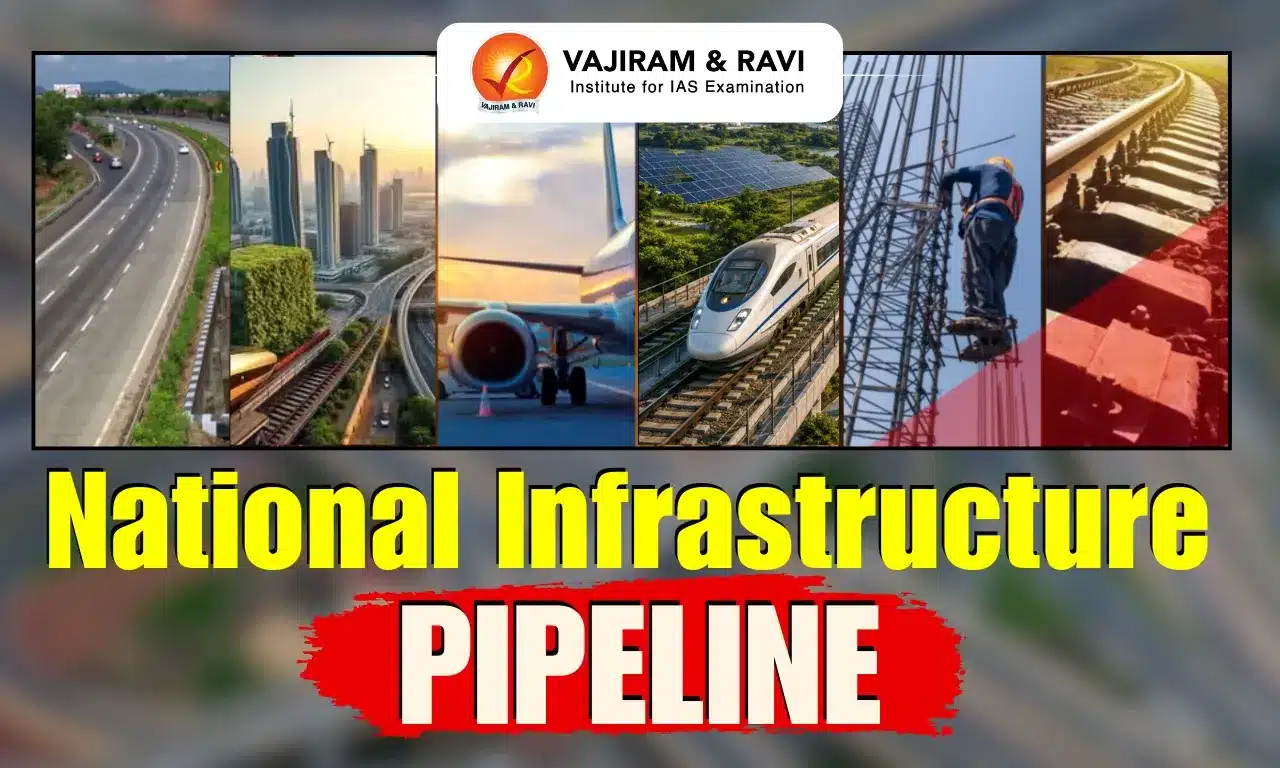
The National Infrastructure Pipeline (NIP) is India's comprehensive, forward-looking roadmap designed to build world-class infrastructure and propel the nation toward a $5 trillion economy. By outlining a massive projected capital expenditure across core sectors such as energy, roads, railways, and urban development, the NIP creates a steady pipeline of projects that generate substantial employment, significantly enhance the "ease of living", and boost the country's global industrial competitiveness.
The National Infrastructure Pipeline (NIP) provides the project pipeline, while financing is driven through a diversified mix of public expenditure, PPPs, institutional finance, asset monetisation under the National Monetisation Pipeline, Development Finance Institutions such as NaBFID and private investment, enabling large-scale infrastructure creation with shared financial risks.
National Infrastructure Pipeline Background
The National Infrastructure Pipeline (NIP) serves as India's long-term infrastructure roadmap, bringing together large-scale projects to strengthen connectivity, boost investment, and drive economic growth.
- Vision & Scale: The National Infrastructure Pipeline (NIP) was launched in 2019 to support India’s goal of becoming a $5 trillion economy.
- The NIP started with an investment target of ₹111 lakh crore for 2020–25, later expanding to nearly ₹160–185 lakh crore.
- NIP Funding & PPP Model: The NIP is implemented through a shared funding model with the Centre (39%), States (39%), and the private sector (22%).
- The NIP strongly promotes Public-Private Partnerships (PPP) and expanded Viability Gap Funding (VGF) to attract private investment in infrastructure, health, and education sectors.
- NIP Focus & Governance: The National Infrastructure Pipeline (NIP) includes greenfield and brownfield projects valued at ₹100 crore and above per project, and it was formulated and tracked through a task force led by the Secretary of the Department of Economic Affairs (DEA) under the Ministry of Finance.
- The NIP mainly focuses on Energy, Transport, Urban Infrastructure, Railways, Roads, and Affordable Housing.
- NIP Monitoring: All NIP projects are tracked through the official India Investment Grid platform to ensure transparency and timely execution.
- Union Budget 2026–27 sets India's public capital expenditure at a record ₹12.2 lakh crore, focusing on transport networks, regional urban hubs, and de-risking private investments.
National Infrastructure Pipeline Significance
The National Infrastructure Pipeline (NIP) provides a strategic roadmap for infrastructure development by identifying projects in advance, enabling coordinated investment, efficient implementation, and long-term economic growth.
- Strengthens Project Planning: The NIP improves project identification, detailed project reports (DPRs), and execution planning, reducing delays, cost overruns, and implementation risks.
- Facilitates Asset Monetisation: It complements the National Monetisation Pipeline (NMP) by enabling the monetisation of operational infrastructure assets and recycling capital for new infrastructure projects.
- Mobilises Long-term Finance: The NIP broadens infrastructure financing by encouraging municipal bonds, corporate debt markets, InvITs, and greater private sector participation.
- Improves Governance and Coordination: It promotes better inter-ministerial coordination, stronger monitoring mechanisms, and greater accountability for timely project implementation.
- Accelerates Project Execution: By encouraging advance land acquisition and statutory clearances, the NIP helps reduce project delays and enhances execution efficiency.
- Strengthens Cooperative Federalism: The pipeline promotes greater Centre–State collaboration, transparent resource allocation, and capacity building, with States playing a major role in infrastructure investment.
- Attracts Domestic and Foreign Investment: A predictable pipeline of projects enhances investor confidence and attracts sovereign wealth funds, pension funds, and foreign institutional investors.
- Promotes Sustainable and Inclusive Growth: The NIP supports the development of resilient, green, and inclusive infrastructure, contributing to balanced regional development and India's sustainable development goals (SDGs) targets.


National Infrastructure Pipeline v/s PM Gati Shakti
The National Infrastructure Pipeline (NIP) and PM Gati Shakti are complementary flagship initiatives aimed at accelerating infrastructure development in India. While NIP identifies and finances infrastructure projects, PM Gati Shakti ensures their integrated planning, coordination, and efficient execution.
| Parameter | PM Gati Shakti National Master Plan | National Infracstruture Pipeline (NIP) |
|
Purpose |
A GIS-based digital planning and coordination platform for integrated and multimodal infrastructure development. |
A national infrastructure investment pipeline that identifies bankable projects and mobilises public and private investment. |
|
Institutional Framework |
Launched in 2021 and implemented by DPIIT, Ministry of Commerce & Industry. |
Announced in 2019 and coordinated by the Department of Economic Affairs (DEA), Ministry of Finance. |
|
Implementation Framework |
Uses 1,700+ GIS data layers, integrating 57 Ministries/Departments and 36 States/UTs, with the Network Planning Group (NPG) evaluating projects. |
Covers around 13,000 projects worth ₹185 lakh crore across 33 sectors and 79 sub-sectors, tracked through the India Investment Grid. |
|
Role in Infrastructure Development |
Focuses on planning, coordination, and execution by improving multimodal connectivity and reducing implementation delays. |
Focuses on project identification, investment planning, and financing for infrastructure development. |
|
Funding & Progress |
Does not provide funding; 352 projects worth ₹16.10 lakh crore have been evaluated by the NPG. |
Provides an investment pipeline of ₹185 lakh crore (as of March 2025), and nearly 20% of projects have been completed, and 45% are under implementation. |
|
Complementarity |
Acts as the planning, coordination and project-integration framework for infrastructure projects. |
Acts as the investment and project pipeline, with many projects implemented through PM Gati Shakti. |
National Infrastructure Pipeline Challenges
Despite being a landmark initiative, the National Infrastructure Pipeline (NIP) faces major challenges in its execution due to the following reasons.
- Land Acquisition Delays: Delays in land acquisition, utility shifting, environmental clearances, and legal disputes frequently increase project costs and extend implementation timelines.
- Financing Constraints: The large capital requirements and long gestation periods of infrastructure projects create financing gaps and increase the asset-liability mismatch for financial institutions.
- Limited Private Sector Participation: Regulatory uncertainty, project risks, lengthy approval processes, and cost overruns continue to discourage greater private investment and PPP participation.
- High Fiscal Burden: Heavy reliance on public expenditure places significant pressure on government finances and limits fiscal space for other priority sectors.
- Regulatory and Coordination Bottlenecks: Multiple approvals, weak Centre–State coordination, and overlapping institutional responsibilities often delay project implementation.
- Slow Dispute Resolution and Contract Enforcement: Lengthy arbitration, contract enforcement delays, and prolonged litigation reduce investor confidence and slow infrastructure delivery.
- Capacity Constraints of Implementing Agencies: Limited technical, financial, and project management capacity, particularly among Urban Local Bodies (ULBs) and State agencies, affects project preparation, execution, and monitoring.
- Social and Rehabilitation Challenges: Land acquisition disputes, community displacement, and delays in rehabilitation and resettlement frequently lead to protests, litigation, and implementation delays.
National Infrastructure Pipeline Way Forward
The National Infrastructure Pipeline (NIP) requires stronger execution, faster clearances, and sustainable financing to achieve its transformative goals. The success of the NIP depends on improving project delivery, boosting private investment, and strengthening Centre–State coordination.
- Better Project Preparation: The NIP should focus on high-quality detailed project reports and proper planning to reduce delays, scope changes, and cost overruns.
- Expand Asset Monetisation: The NIP should strengthen the National Monetisation Pipeline (NMP) and monetise completed assets like roads, railways, and airports to generate funds for new infrastructure projects.
- Diversify NIP Financing: The NIP should deepen municipal bonds, corporate bond markets, and Infrastructure Investment Trusts (InvITs) to reduce dependence on bank financing.
- Strengthen Monitoring & Governance: Dedicated monitoring mechanisms and ministry-level steering committees are needed for faster implementation and financial coordination of the NIP.
- Faster Clearances & Land Acquisition: The NIP should adopt a plug-and-play model where land, utility, and environmental clearances are completed before tendering projects.
- Improve Centre–State Coordination: Since states account for a major share of NIP investments, stronger technical support, transparent funding, and capacity building are essential.
- Attract Global Capital: The NIP should attract sovereign wealth funds, pension funds, and foreign investors through stable policies and improved ease of doing business.
- Promote Sustainable Infrastructure: The NIP must ensure inclusive, climate-resilient, and sustainable infrastructure aligned with India’s SDG and green growth commitments.

 Last updated on Oct, 2026
→ UPSC 2027 Notification will be released on 13 January 2027 at upsconline.nic.in.
→ Check Nobel Prize 2026 Winners List here.
→ Download PIB PRiSM Monthly Magazine 2026 here.
→ Check UPSC Monthly Current Affairs Magazine The Recitals here.
→ Check out the latest UPSC Syllabus here.
→ Download UPSC Model Answers for Mains 2026
→ UPSC Mains Question Paper 2026 is out now for Essay & GS Paper 1, 2, 3 & 4.
→ UPSC Calendar 2027 has been released.
→ Enroll in Vajiram & Ravi’s UPSC Mains Test Series 2027 for structured answer writing practice, expert evaluation, and exam-oriented feedback.
→ Join Vajiram & Ravi’s UPSC Mentorship Program 2027 for personalized guidance, strategy planning, and one-to-one support from experienced mentors.
→ Go through the UPSC Mains Previous Year Papers to enhance your preparation.
→ UPSC has released UPSC Toppers List 2025 with the Civil Services final result on its official website.
→ Also check Best UPSC Coaching in India
National Infrastructure Pipeline FAQs
Q1. What is the National Infrastructure Pipeline in India?+
Q2. Which ministry launched the National Infrastructure Pipeline?+
Q3. When was National Infrastructure Pipeline first announced?+
Q4. What are the major sectors under National Infrastructure Pipeline?+
Q5. What is the role of the National Infrastructure Pipeline?+
Tags: National Infrastructure Pipeline quest upsc economy notes