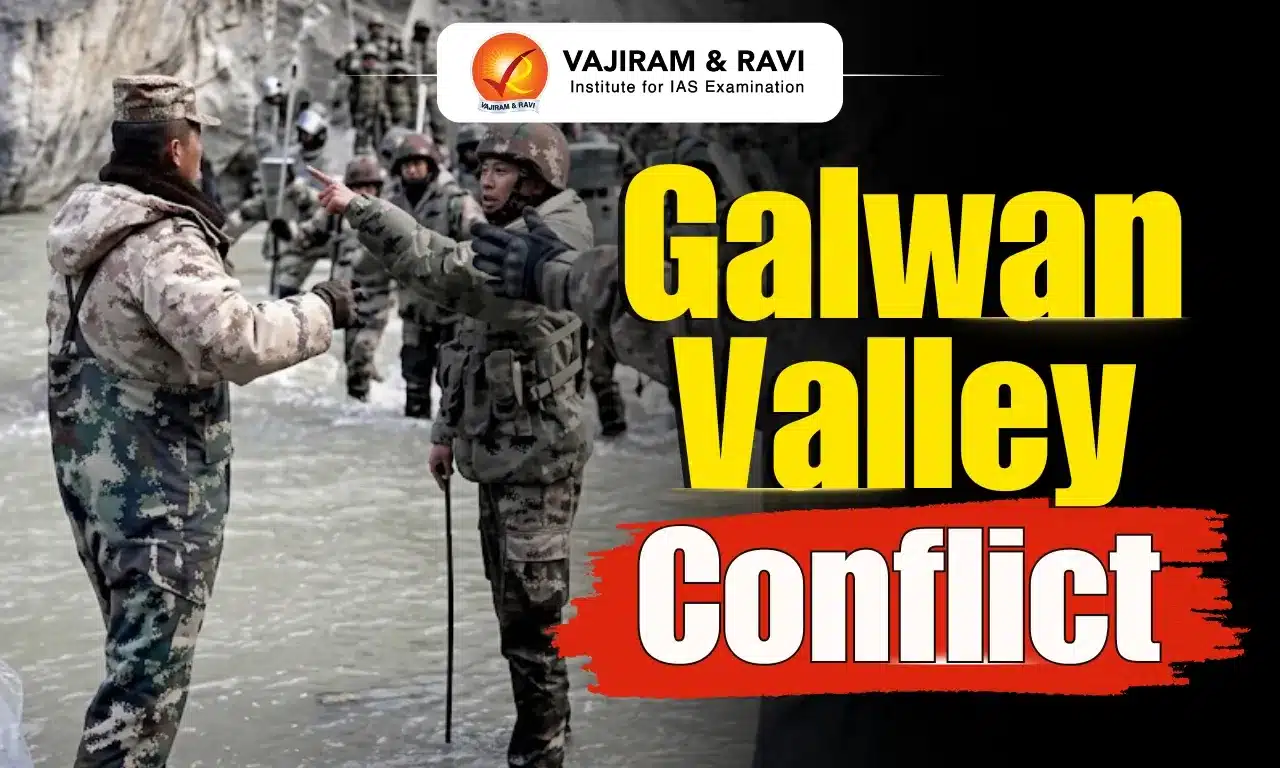
The Galwan Valley Conflict was a violent confrontation between Indian and Chinese troops in Eastern Ladakh on 15 June 2020. It occurred along the Line of Actual Control (LAC) amid a broader military standoff between India and China in Eastern Ladakh.
The Galwan Valley Clash transformed India-China relations by exposing the fragility of border-management arrangements along the Line of Actual Control (LAC). It also resulted in prolonged military deployment, reduced political trust, and a reassessment of India’s strategic approach towards China.
Galwan Valley Conflict Between India and China
Galwan Valley Conflict refers to the violent confrontation between Indian and Chinese troops at Patrolling Point-14 (PP-14) in Eastern Ladakh on 15 June 2020. It was the first fatal India-China border clash in 45 years, resulting in prolonged deployment along the Line of Actual Control (LAC), a sharp decline in bilateral trust, and renewed emphasis on border security and diplomatic engagement.
Galwan Valley Conflict 2020 Background
The background to the Galwan Valley conflict lies in the unresolved India-China boundary dispute and differing perceptions of the LAC. India and China do not have a mutually agreed and demarcated boundary in several sectors. Consequently, both sides have different perceptions regarding the alignment of the LAC.
- The 1962 India-China War left the western sector boundary unresolved. India claims Aksai Chin as part of Ladakh, while China controls it. China claims Arunachal Pradesh, particularly the area it calls “South Tibet".
- Before the Galwan incident, India and China had developed mechanisms for managing border tensions. The 1993 and 1996 agreements required both countries to respect the LAC and maintain military forces at agreed minimum levels.
- However, the 2020 developments showed that these arrangements were insufficient when troop concentrations and competing territorial claims increased sharply.


Galwan Valley Conflict Causes
The Galwan Valley Clash resulted from unresolved boundary disputes, competing strategic interests, and the breakdown of existing border management mechanisms along the Line of Actual Control (LAC).
- Unresolved Boundary Dispute: China occupies 38,000 sq km of Indian territory in Aksai Chin, while India rejects Pakistan's 1963 cession of 5,180 sq km of the Shaksgam Valley to China.
- Ambiguity of the LAC: The absence of a mutually accepted LAC alignment has led to recurring patrol disputes and military face-offs.
- Chinese Military Build-up: In April and May 2020, China deployed troops and military assets at multiple locations in Eastern Ladakh, heightening tensions.
- Border Infrastructure Development: India’s construction and upgrading of the DS-DBO road and feeder routes improved its military mobility. China objected to Indian infrastructure activity in the Galwan area.
- Escalating Border Tensions: Simultaneous face-offs at Pangong Tso, Galwan Valley, and Naku La reflected a broader deterioration in border relations.
- Immediate Trigger: Differences over implementing the 6 June 2020 disengagement agreement culminated in the 15 June 2020 clash at PP-14.
Galwan Valley Conflict Timeline
The Galwan Valley conflict unfolded through military deployments, failed de-escalation, violent clashes, strategic manoeuvres, renewed tensions, and eventual disengagement efforts between India and China.
- April-May 2020: Chinese troop deployments at multiple locations in Eastern Ladakh, including the Galwan Valley, triggered a military standoff.
- 6 June 2020: Indian and Chinese Corps Commanders met at Chushul-Moldo and agreed on de-escalation and disengagement.
- 15 June 2020: A violent clash at Patrolling Point-14 (PP-14) led to the death of 20 Indian soldiers and casualties on the Chinese side.
- August 2020: India occupied strategic heights on the Kailash Range, strengthening its position in the Chushul sector.
- September 2021: Tensions resurfaced near Pangong Tso in Ladakh as both sides accused each other of violating border agreements, and warning shots were reportedly fired.
- October 2024: India and China announced an understanding on patrolling arrangements in Depsang and Demchok, facilitating disengagement in the remaining eastern Ladakh friction areas.
Galwan Valley Strategic Importance
Galwan Valley is a strategically important sector along the Line of Actual Control (LAC) in Eastern Ladakh due to its proximity to Aksai Chin and key military routes.
- Strategic Location: The valley lies close to the LAC and Aksai Chin, making it an important area for border surveillance and military operations.
- Access to Key Military Areas: It is located near the Darbuk-Shyok-Daulat Beg Oldie (DSDBO) Road, which provides access to Daulat Beg Oldie (DBO) and the Karakoram Pass, making it crucial for military logistics and troop movement.
- Importance for China: The valley helps secure Aksai Chin and the Xinjiang–Tibet corridor, including the nearby G219 Highway, an important route for military movement and connectivity.
- Infrastructure Competition: Both India and China have strengthened roads, bridges, and military infrastructure in the region to improve connectivity and operational capability, increasing strategic competition along the border.
- Historical Significance: The valley has remained a sensitive sector since the 1962 Sino-Indian War, reflecting the unresolved India-China boundary dispute.
- River System: The Galwan River, a tributary of the Shyok River, flows through the valley before joining the Indus River, adding to its geographical importance.
Galwan Valley Border Agreements
India and China have signed several agreements to maintain peace along the LAC. The Galwan clash raised questions about their implementation and effectiveness.
- 1993 Agreement on the Maintenance of Peace and Tranquillity: Laid the foundation for preserving peace and stability along the LAC.
- 1996 Agreement on CBMs: Restricted the use of firearms, large-scale military exercises, and escalation near the LAC.
- 2005 Protocol on the Implementation of CBMs: Prescribed procedures for implementing confidence-building measures and managing border interactions.
- 2012 WMCC: Established a structured platform for regular diplomatic and military consultations on border issues.
- 2013 Border Defence Cooperation Agreement (BDCA): Strengthened communication and coordination to prevent border incidents and maintain peace along the LAC.
Galwan Valley Conflict 2020 Aftermath
The Galwan Valley Conflict significantly reshaped India-China relations, leading to sustained military deployment, a decline in bilateral trust, changes in India's security strategy, and a renewed geopolitical focus on the Indo-Pacific.
- Galwan Valley Conflict Casualties: During the June 2020 Galwan Valley border skirmish, India officially reported 20 soldiers killed. China officially acknowledged 4 military deaths months later.
- Military Consequences: Both countries strengthened troop deployment, border infrastructure, and surveillance capabilities along the LAC, leading to sustained militarisation.
- Strategic Consequences: India accelerated defence modernisation, strengthened border management, and enhanced focus on self-reliance and integrated military preparedness.
- Economic Consequences: India adopted measures to reduce strategic dependence on China through tighter investment scrutiny, restrictions on selected Chinese applications, and resilient supply chains.
- Geopolitical Implications: The conflict reinforced the strategic importance of the Indo-Pacific, strengthened India's engagement with the QUAD countries, and heightened global attention on China's border assertiveness.
Galwan Valley Conflict Way Forward
The Galwan Valley Conflict highlighted the need to balance sustained diplomatic engagement with credible military preparedness to ensure lasting peace and stability along the LAC.
- Strengthen Dialogue and Military Diplomacy: Sustain political, diplomatic, and military engagement through the WMCC, Corps Commander-level talks, military-to-military dialogues, and hotlines to prevent misunderstandings and manage border incidents.
- Enhance Border Management: Establish clear patrolling protocols, periodically review and strengthen CBMs, and improve coordination mechanisms to reduce the risk of future confrontations.
- Strengthen Defence Preparedness: Modernise border infrastructure, enhance Intelligence, Surveillance and Reconnaissance (ISR), improve logistics, rapid deployment capabilities, mountain warfare training, and joint theatre operations to ensure credible deterrence.
- Leverage Technology and Build Strategic Resilience: Invest in AI-enabled surveillance, drones, satellite monitoring, secure communication systems, electronic warfare capabilities, and diversify defence supply chains to strengthen long-term security.

 Last updated on Oct, 2026
→ UPSC 2027 Notification will be released on 13 January 2027 at upsconline.nic.in.
→ Check Nobel Prize 2026 Winners List here.
→ Download PIB PRiSM Monthly Magazine 2026 here.
→ Check UPSC Monthly Current Affairs Magazine The Recitals here.
→ Check out the latest UPSC Syllabus here.
→ Download UPSC Model Answers for Mains 2026
→ UPSC Mains Question Paper 2026 is out now for Essay & GS Paper 1, 2, 3 & 4.
→ UPSC Calendar 2027 has been released.
→ Enroll in Vajiram & Ravi’s UPSC Mains Test Series 2027 for structured answer writing practice, expert evaluation, and exam-oriented feedback.
→ Join Vajiram & Ravi’s UPSC Mentorship Program 2027 for personalized guidance, strategy planning, and one-to-one support from experienced mentors.
→ Go through the UPSC Mains Previous Year Papers to enhance your preparation.
→ UPSC has released UPSC Toppers List 2025 with the Civil Services final result on its official website.
→ Also check Best UPSC Coaching in India
Galwan Valley Conflict FAQs
Q1. Who controls Galwan Valley now?+
Q2. What happened during the Battle of Galwan?+
Q3. Did India lose any land in the Galwan Clash?+
Q4. How many were killed in Galwan?+
Q5. Who is the hero of Battle of Galwan?+
Tags: battle of galwan galwan valley clash galwan valley conflict quest UPSC International Relations and Institutions Notes