


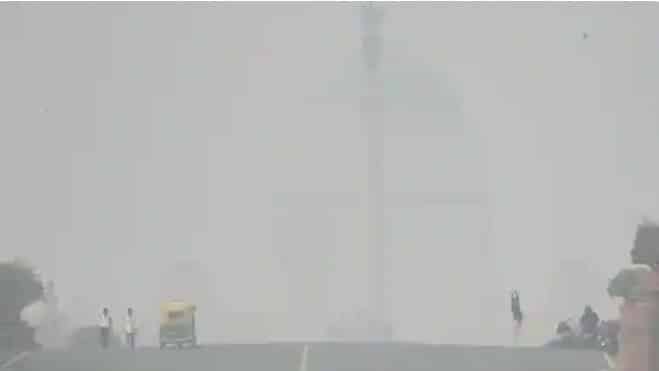
Delhi-NCR Air Pollution Latest News
- Amid persistently high air pollution levels in Delhi-NCR, Union Environment Minister has directed stricter enforcement of pollution-control measures, including sealing 191 non-compliant industries and fixing administrative accountability for delays.
- The review meeting involving Delhi, Haryana, UP and Rajasthan highlighted the need for coordinated regional action, as air pollution transcends state boundaries.
Industrial Emissions
- Strict enforcement:
- 191 polluting industries have been directed to be sealed by the Central Pollution Control Board (CPCB) for failing to install Air Pollution Control Devices (APCDs).
- Of the 2,345 targeted industrial units, 2,298 (approximately 98%) have been connected to the Online Continuous Emission Monitoring System (OCEMS). The remaining 47 units have been closed or sealed.
- Strict compliance with the particulate matter emission limit of 50 mg/Nm³ has been directed.
- Non-compliant industries may face closure, electricity disconnection and sealing.
- Administrative accountability:
-
- Haryana, UP and Rajasthan have been asked to nominate secretary-level officers to supervise pollution-control measures in 15 cities (seven in Haryana and four each in UP and Rajasthan).
- These officers will conduct field inspections and submit weekly progress reports to the Commission for Air Quality Management (CAQM).
- CAQM has been asked to issue notices and initiate criminal prosecution against officials failing to discharge their responsibilities.


Vehicular Pollution and Traffic Decongestion
- ANPR cameras: Transport departments have been directed to install Automatic Number Plate Recognition (ANPR) cameras by November 30. Failure may invite criminal prosecution of responsible officials.
- Multi-lane free flow (MLFF): The Municipal Corporation of Delhi (MCD) must complete installation of MLFF systems at 154 Delhi border entry points by December 31, 2026, to reduce congestion and vehicle idling.
- Traffic congestion: Immediate corrective measures have been directed at 233 identified congestion points across NCR, alongside fresh assessments by states.
- PARIVARTAN scheme: The scheme is to be expedited to replace pre-BS-VI trucks and buses with BS-VI-compliant, CNG and electric vehicles by 2028.
Road Dust Management and Construction Activities
- Only 3,221 km of the targeted 5,480 km of roads have been redeveloped.
- Road-owning agencies have been directed to prioritise repair of potholes and damaged footpaths, maintenance of central verges, and end-to-end paving of roads.
- Mechanical road-sweeping machines must operate at full capacity in double shifts, supported by digital tracking and AI-based monitoring through Integrated Command and Control Centres (ICCCs).
- Physical inspections of more than 3,000 active construction sites have been directed to ensure compliance with dust-control measures.
Municipal Solid Waste Management
- NCR faces a shortfall of 6,747 tonnes per day in municipal solid waste processing capacity.
- States have been directed to prevent open dumping and burning of waste and expedite the remediation of legacy waste at four major landfill sites (Okhla, Ghazipur, Bhalswa, and Bandhwari).
Graded Response Action Plan (GRAP)
- All agencies have been directed to ensure strict implementation of the GRAP.
- NCR states have been encouraged to adopt Delhi’s hotspot-focused winter action plan, covering:
- Traffic management and decongestion.
- Work-from-home measures.
- Restrictions on construction activities.
- Prevention of open waste and biomass burning.
- Technology-driven monitoring through Delhi’s ICCC and CAQM’s PAVAN platform will strengthen enforcement and track pollution-control measures.
Delhi’s Air Quality – Persistently ‘Very Poor’
- Delhi’s 24-hour average Air Quality Index (AQI) is hovering around 370.
- Of the 59 monitoring stations reporting data – 17 recorded severe air pollution, 38 recorded very poor air quality, 3 recorded poor air quality, and only 1 recorded moderate air quality. PM10 was the predominant pollutant.
- Major sources of pollution are vehicular emissions, stubble burning, firecrackers, etc.
Key Challenges
- Fragmented governance: Multiple state agencies and municipal bodies complicate coordinated enforcement.
- Implementation deficit: Delays in road redevelopment, waste processing and installation of pollution-control equipment undermine existing regulations.
- Vehicular dependence: Traffic congestion and older commercial vehicles continue to contribute significantly to emissions.
- Transboundary pollution: Pollution from stubble burning, industries and transport across NCR requires inter-state coordination.
- Weak accountability: Delayed action and inadequate monitoring reduce the effectiveness of pollution-control measures.
Way Forward
- Strengthen the CAQM’s coordinating and enforcement capacity across NCR.
- Shift from episodic winter interventions to year-round, airshed-based pollution management.
- Accelerate public transport, electric mobility and cleaner industrial technologies.
- Expand scientific source apportionment and real-time emissions monitoring.
- Strengthen municipal waste segregation, processing and scientific landfill remediation.
- Ensure measurable accountability through time-bound targets, independent inspections and transparent public reporting.
Conclusion
- Delhi-NCR’s air pollution crisis requires a transition from reactive emergency measures to sustained, science-based and regionally coordinated air-quality governance.
- Effective implementation, institutional accountability and cleaner urban infrastructure are essential to securing the constitutional right to a clean and healthy environment.

 Last updated on Nov, 2026
→ UPSC 2027 Notification will be released on 13 January 2027 at upsconline.nic.in.
→ Check Nobel Prize 2026 Winners List here.
→ Download PIB PRiSM Monthly Magazine 2026 here.
→ Check UPSC Monthly Current Affairs Magazine The Recitals here.
→ Check out the latest UPSC Syllabus here.
→ Download UPSC Model Answers for Mains 2026
→ UPSC Mains Question Paper 2026 is out now for Essay & GS Paper 1, 2, 3 & 4.
→ UPSC Calendar 2027 has been released.
→ Enroll in Vajiram & Ravi’s UPSC Mains Test Series 2027 for structured answer writing practice, expert evaluation, and exam-oriented feedback.
→ Join Vajiram & Ravi’s UPSC Mentorship Program 2027 for personalized guidance, strategy planning, and one-to-one support from experienced mentors.
→ Go through the UPSC Mains Previous Year Papers to enhance your preparation.
→ UPSC has released UPSC Toppers List 2025 with the Civil Services final result on its official website.
→ Also check Best UPSC Coaching in India
Delhi-NCR Air Pollution FAQs
Q1. Why does Delhi-NCR require an airshed-based approach to tackle air pollution?+
Q2. What are the major challenges in controlling industrial air pollution in India?+
Q3. How can technology improve urban air pollution management?+
Q4. What is the role of vehicular pollution in Delhi-NCR's air quality crisis?+
Q5. Why is municipal solid waste management critical to improving urban air quality?+
Tags: delhi-ncr air pollution