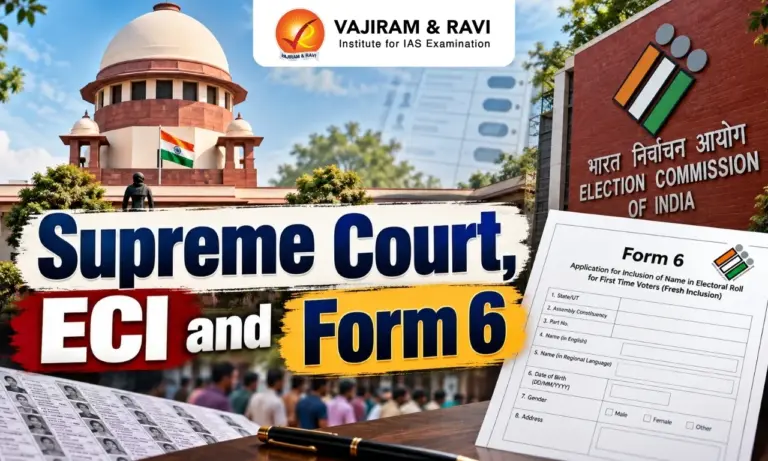
The Supreme Court, Election Commission of India (ECI) and Form 6 have come into focus following the Court’s recent clarification that it had not approved any modified version of Form 6 used during the Special Intensive Revision (SIR) of electoral rolls.
Why in News?
On October 5, 2026, a three-judge Bench headed by Chief Justice of India Surya Kant, along with Justices Joymalya Bagchi and V. Mohana, clarified that the Supreme Court had not approved any modified Form 6.
The Court said it would examine the ECI’s records to determine who introduced the changes to the form. The observation came during the hearing of a petition concerning alleged unilateral decisions relating to the SIR exercise.
What is Form 6?
Form 6 is the prescribed application form used by an eligible citizen for inclusion of their name in the electoral roll.
According to the ECI, a person who is eligible to be registered as a general elector can apply through Form 6 before the Electoral Registration Officer or Assistant Electoral Registration Officer. The form can also be submitted online through the ECI or the concerned Chief Electoral Officer’s website.
Form 6 is therefore an important instrument for voter registration and electoral participation.


Role of the Election Commission of India
The Election Commission of India is a constitutional body responsible for the superintendence, direction and control of elections in India.
Under Article 324 of the Constitution, the ECI has powers relating to:
- Elections to the Lok Sabha and State Legislative Assemblies.
- Elections to the offices of President and Vice-President.
- Preparation and revision of electoral rolls.
- Conduct and supervision of elections.
- Recognition of political parties and allocation of election symbols under the relevant laws and rules.
Constitutional Provisions Related to Electoral Rolls
The Constitution provides the legal framework for electoral rolls, voter registration and the conduct of elections through key provisions dealing with the Election Commission, non-discrimination and adult suffrage.
- Article 324: Vests the superintendence, direction and control of elections in the Election Commission of India.
- Article 325: Provides for one general electoral roll for every territorial constituency and prohibits exclusion on grounds only of religion, race, caste or sex.
- Article 326: Provides for elections to the Lok Sabha and State Legislative Assemblies based on adult suffrage, subject to constitutional and statutory qualifications.
- Article 327: Empowers Parliament to make laws relating to elections, including electoral rolls.
- Article 328: Empowers State Legislatures to make provisions relating to elections to State Legislatures, subject to Parliament’s laws.

 Last updated on Sep, 2026
→ UPSC 2027 Notification will be released on 13 January 2027 at upsconline.nic.in.
→ Asian Games 2026 are being held in Aichi-Nagoya, Japan, from 19 September to 4 October.
→ Check out the latest UPSC Syllabus here.
→ Download UPSC Model Answers for Mains 2026
→ UPSC Mains Question Paper 2026 is out now for Essay & GS Paper 1, 2, 3 & 4.
→ UPSC Calendar 2027 has been released.
→ Enroll in Vajiram & Ravi’s UPSC Mains Test Series 2027 for structured answer writing practice, expert evaluation, and exam-oriented feedback.
→ Join Vajiram & Ravi’s UPSC Mentorship Program 2027 for personalized guidance, strategy planning, and one-to-one support from experienced mentors.
→ Go through the UPSC Mains Previous Year Papers to enhance your preparation.
→ UPSC has released UPSC Toppers List 2025 with the Civil Services final result on its official website.
→ Also check Best UPSC Coaching in India
Supreme Court, ECI and Form 6 FAQs
Q1. What is Form 6?+
Q2. What is the Form 6 controversy?+
Q3. Did the Supreme Court approve the modified Form 6?+
Q4. Which constitutional article deals with the Election Commission?+
Q5. What is Special Intensive Revision?+
Q6. Which laws govern electoral rolls?+
Tags: eci eci and form 6 Form 6 supreme court