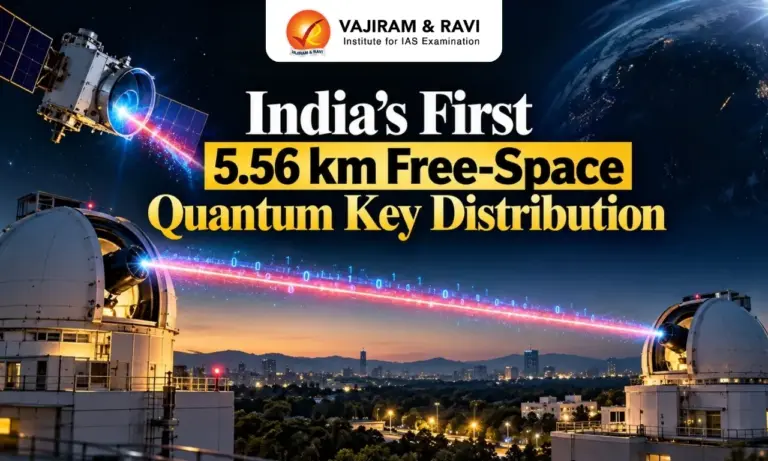
India has demonstrated its first 5.56 km Free-Space Quantum Key Distribution (QKD) link, marking an important step in quantum communication and cybersecurity. The demonstration was carried out by QNu Labs, BISAG-N and IIT Gandhinagar in Gujarat.
The technology can help protect sensitive information by using the principles of quantum mechanics to create secure encryption keys.
What Is Quantum Key Distribution (QKD)?
Quantum Key Distribution (QKD) is a technology that uses the principles of quantum mechanics to create and share secret encryption keys between two users.
These keys help encrypt and decrypt messages so that sensitive information can be protected from unauthorised access.
Unlike conventional encryption, QKD uses the properties of quantum particles to help detect attempts to intercept the key exchange.
How Does Free-Space Quantum Key Distribution Work?
Free-space QKD sends quantum signals through the atmosphere instead of using optical fibre cables for the entire communication link.
Its working involves the following steps:
- Generation of quantum signals: A device generates optical signals for creating secure keys.
- Transmission of signals: The signals travel through open space from a transmitter to a receiver.
- Key generation: Both users process the measurement results to establish a shared secret key.
- Security check: The error rate is checked to identify possible interference.
- Secure communication: The generated key is used to encrypt and decrypt messages.
This technology can be useful where laying optical fibre cables is difficult, provided suitable line-of-sight and atmospheric conditions are available.
Also Read:- Quantum Communication


Technologies Used in the Demonstration
The demonstration used various technologies which has been highlighted below in the table.
| Technologies Used in the Demonstration | |
|
Technology |
Simple Explanation |
|
Armos |
A hardware device developed by QNu Labs for Quantum Key Distribution. |
|
Vedic Kavach |
A security platform developed by BISAG-N to protect digital communication. |
|
Quantum Random Number Generation (QRNG) |
Uses quantum processes to generate random numbers for security applications. |
|
Post-Quantum Cryptography (PQC) |
Uses mathematical methods designed to protect information against attacks from quantum computers. |
|
Pointing, Acquisition and Tracking (PAT) |
Helps keep the transmitter and receiver properly aligned during communication. |
Difference Between QKD and Post-Quantum Cryptography
Both technologies aim to protect information from future cyber threats, but they work differently.
| Difference Between QKD and Post-Quantum Cryptography | ||
|
Basis |
Quantum Key Distribution (QKD) |
Post-Quantum Cryptography (PQC) |
|
Working |
Uses principles of quantum mechanics. |
Uses mathematical algorithms. |
|
Main purpose |
Helps establish secure encryption keys. |
Protects information using quantum-resistant algorithms. |
|
Equipment |
Requires specialised quantum devices. |
Can generally work on conventional computers. |
|
Security method |
Uses quantum properties to help detect interception. |
Uses algorithms designed to resist attacks from quantum computers. |
Significance of India’s Free-Space QKD Demonstration
- Better cybersecurity: It can help protect sensitive information from cyberattacks.
- National security: Quantum communication can support secure communication for defence and strategic organisations.
- Satellite communication: Free-space QKD can support future research on secure communication between satellites and ground stations.
- Government communication: It may help protect sensitive government data.
- Indigenous technology: The demonstration supports India’s efforts to develop domestic quantum technologies.
- Future communication networks: It provides a foundation for research into longer-distance quantum communication.
- Reduced dependence on fibre: Free-space links can be useful in areas where laying optical fibre cables is difficult.

 Last updated on Oct, 2026
→ UPSC 2027 Notification will be released on 13 January 2027 at upsconline.nic.in.
→ Check Nobel Prize 2026 Winners List here.
→ Download PIB PRiSM Monthly Magazine 2026 here.
→ Check UPSC Monthly Current Affairs Magazine The Recitals here.
→ Check out the latest UPSC Syllabus here.
→ Download UPSC Model Answers for Mains 2026
→ UPSC Mains Question Paper 2026 is out now for Essay & GS Paper 1, 2, 3 & 4.
→ UPSC Calendar 2027 has been released.
→ Enroll in Vajiram & Ravi’s UPSC Mains Test Series 2027 for structured answer writing practice, expert evaluation, and exam-oriented feedback.
→ Join Vajiram & Ravi’s UPSC Mentorship Program 2027 for personalized guidance, strategy planning, and one-to-one support from experienced mentors.
→ Go through the UPSC Mains Previous Year Papers to enhance your preparation.
→ UPSC has released UPSC Toppers List 2025 with the Civil Services final result on its official website.
→ Also check Best UPSC Coaching in India
India’s First 5.56 km Free‑Space Quantum Key Distribution FAQs
Q1. What is Quantum Key Distribution (QKD)?+
Q2. What is the distance of India's first free-space QKD link?+
Q3. Which organisations were involved in the demonstration?+
Q4. What is the National Quantum Mission?+
Q5. What is the difference between QKD and PQC?+
Tags: india’s first 5.56 km free‑space quantum india’s first 5.56 km free‑space quantum key distribution