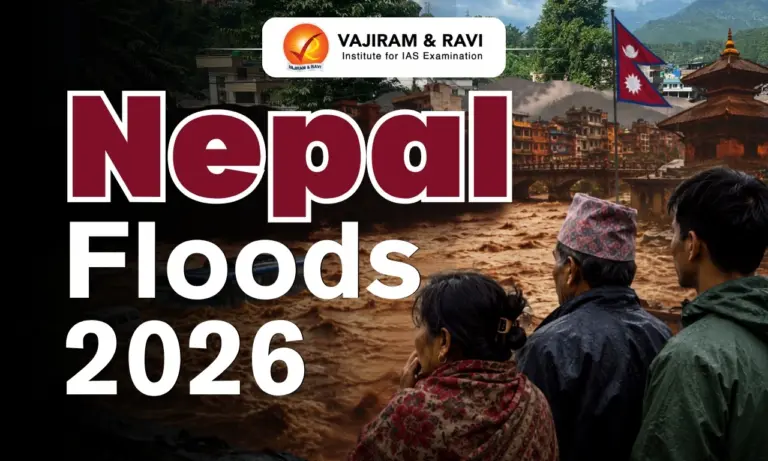
A Flash Flood is a sudden and rapid rise of water that can inundate areas within a short time. The Nepal Floods 2026 disaster occurred after an ice rock avalanche triggered a sudden surge in the Bhotekoshi River. The flood swept away villages, bridges and multi storey concrete buildings along the Nepal-Tibet border. The disaster caused extensive deaths, displacement, missing persons and infrastructure damage across affected areas.
Nepal Floods News 2026
The Nepal Flash Flood 2026 struck on Wednesday, August 26, after a glacial collapse and debris flow triggered catastrophic downstream flooding. The event affected parts of Nepal near the Tibet border. Initial reports linked the event to a 4.4 magnitude earthquake, but the U.S. Geological Survey later determined that no earthquake had occurred. The seismic event was revised to magnitude 5.2.
What is a Flash Flood?
A Flash Flood develops rapidly when a large volume of water reaches a river valley or low lying area within a short period. In the Himalayas, glacial events can intensify this hazard. It involves a sudden and powerful water surge that can destroy settlements, bridges, roads and other infrastructure with little warning.


Glacial Lake Outburst Flood (GLOF)
A Glacial Lake Outburst Flood occurs when water stored in or around a glacial lake is suddenly released, producing destructive downstream flooding. In the Nepal Flash Flood event, USGS identified a glacial collapse and debris flow rather than an earthquake as the trigger of the disaster.
Nepal Flood 2026 Highlights
The Nepal Flash Flood 2026 disaster originated in the Himalayan region near Tibet and rapidly affected downstream locations in Nepal, creating major human and infrastructure losses.
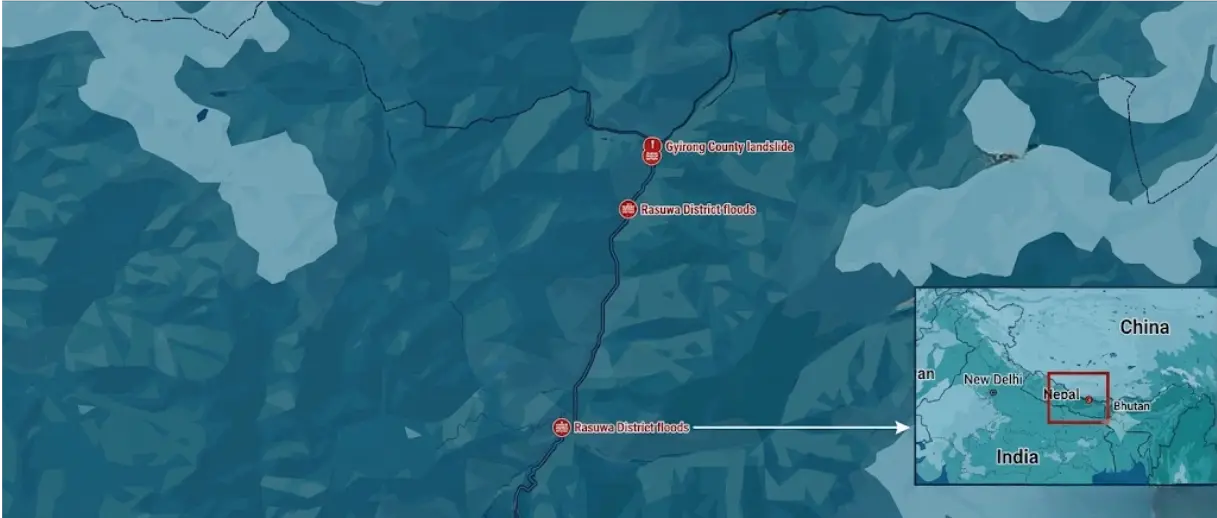
- Location: The Flash Floods affected the Nepal-Tibet border region.
- Districts: Rasuwa and Dhading among the Nepalese districts reporting deaths and destruction.
- River: The Bhotekoshi River surged following the ice rock avalanche. Its floodwaters swept through villages and damaged critical infrastructure along the river corridor.
- Death Toll: At least 165 people were confirmed killed in Nepal and China in the latest reported figures.
- Missing Persons: Nepal’s disaster agency reported 823 people out of contact. The figure included at least 579 tourists, while China separately reported 558 people missing.
- Indian Nationals: Nepal’s Foreign Minister Shishir Khanal said nearly 300 Indians were among those reported missing.
- Foreign Tourists: Nepal reported 468 tourists and travellers out of contact, including 393 foreigners and 75 Nepalis. Australia separately reported limited information about 34 missing citizens.
- Indian Tourist Groups: A 32 member Kolkata group travelling for the Kailash-Mansarovar Yatra became untraceable. The group included 30 tourists and two tour managers.
- Infrastructure Damage: Floodwaters destroyed or damaged bridges, roads, hydropower projects, villages and multi storey concrete buildings. Around a dozen hydropower projects were also affected.
- Humanitarian Impact: The disaster stranded tourists and pilgrims and disrupted communication and transport. Rescue operations faced difficulties because several remote affected areas remained difficult to access.
- International Response: Chinese President Xi Jinping ordered an all out effort to rescue and evacuate affected people. India offered comprehensive assistance and prepared to send food and relief material.
Nepal Flash Flood Reasons
The main causes of the Nepal Flash Flood disaster was a glacial collapse that generated an ice rock avalanche and powerful downstream debris flow.
- Glacial Collapse: Scientists initially believed that the lower portion of a Himalayan glacier collapsed and crashed into the valley. This triggered the destructive ice rock avalanche.
- Seismic Misidentification: The event was initially reported as a 4.4 magnitude earthquake. USGS analysis of seismic waves and satellite imagery later established that the tremors came from glacial collapse and debris flow.
- Avalanche Trigger: The ice rock avalanche rapidly displaced material and water into the valley. This created a sudden surge in the Bhotekoshi River and intensified downstream flooding.
- Himalayan Setting: The affected area lies in a high mountain environment where glaciers, steep valleys and rivers can transmit large amounts of water and debris rapidly downstream.
Also Read:- Karnali River
Nepal Floods Implications and Response of India
The Nepal Floods 2026 disaster created cross border flood concerns because rivers originating in Nepal can carry increased flows into Indian territory, especially Bihar and Uttar Pradesh.
- India’s Assistance: Prime Minister Narendra Modi spoke with Nepal’s Prime Minister Balen Shah and offered all possible assistance. India also planned military transport of food and relief material.
- Search and Rescue: India indicated that it could join search and rescue operations. The immediate priority remained locating survivors and assisting stranded Indian nationals.
- India’s Monitoring: India’s Ministry of Home Affairs closely monitored rising water levels because downstream flooding could affect border areas of Bihar and Uttar Pradesh.
- Uttar Pradesh Alert: Maharajganj and Kushinagar were placed on alert. Local administrations were directed to maintain preparedness because of possible downstream effects from Nepal.
- Bihar Alert: Bihar authorities anticipated increased Gandak River inflow and opened all 36 gates of the Gandak Barrage at Valmikinagar as a precaution.
- Bihar Districts: West Champaran, East Champaran, Gopalganj, Saran, Muzaffarpur and Vaishali were identified as potentially affected. Sitamarhi and Sheohar were also treated as sensitive districts.
- Gandak River: Nepal’s Gandak River is known as the Narayani. Its Devghat water level was 4.77 metres against a warning level of 7.30 metres and danger level of 9 metres.
- Expected Inflow: Officials projected a possible inflow of around 250,000 cusecs through the Gandak Barrage, compared with the existing discharge of about 80,000 cusecs.
- Evacuation: Around 5,000 people were moved from riverine areas of West Champaran. National and State Disaster Response Force teams were deployed in potentially affected locations.
- Border Implications: The flood demonstrated how a high altitude glacial event in the Nepal-Tibet region can create rapid downstream risks across international boundaries.
- Flood Comparison: Bihar recorded a maximum Gandak discharge of 224,000 cusecs on July 14, 2026. The discharge had reached 562,500 cusecs on September 28, 2024.
Also Read: Kosi River
List of Top 25 Worst Floods in India 2026
The list of Top 25 worst Floods in India as of 2026 has been tabulated below:
| List of Top 25 Worst Floods in India 2026 | |||
| S No | Year | Flood Region | Highlights |
|
1 |
2025 |
Uttarakhand |
Heavy rainfall triggered flash floods and landslides in Uttarakhand. At least 5 people died and 50+ were reported missing. |
|
2 |
2024 |
Wayanad, Kerala |
Heavy rainfall triggered devastating floods and landslides in Wayanad, killing at least 123 people and causing extensive damage. |
|
3 |
2024 |
Andhra Pradesh & Telangana |
Heavy rainfall caused widespread flooding and landslides across parts of Andhra Pradesh and Telangana, resulting in 27 deaths. |
|
4 |
2023 |
Chennai, Tamil Nadu |
Cyclone Michaung caused heavy rainfall and severe flooding in Chennai in December 2023. |
|
5 |
2022 |
Assam |
Heavy rainfall caused severe flooding across Assam, affecting large areas of the state. |
|
6 |
2021 |
Maharashtra |
Exceptionally heavy rainfall caused widespread flooding, particularly around Mahad and Chiplun. More than 250 people were killed and over 100 went missing. |
|
7 |
2021 |
Chamoli, Uttarakhand |
An avalanche/glacier-related event from Ronti Peak triggered a devastating flood in the Rishi Ganga-Dhauliganga valley. 200+ people died or were reported missing. |
|
8 |
2020 |
Hyderabad, Telangana |
Intense rainfall triggered severe urban flash floods in Hyderabad in October, causing 98 deaths. |
|
9 |
2019 |
Multiple States |
Widespread floods affected more than nine states, with Kerala, Madhya Pradesh, Karnataka, Maharashtra and Gujarat among the worst affected. |
|
10 |
2018 |
Kerala |
Exceptionally heavy monsoon rainfall caused one of Kerala’s worst floods. More than 445 people died, while about one million people were displaced. |
|
11 |
2017 |
Gujarat |
Heavy July rainfall caused severe flooding across Gujarat. Rainfall was around 40% above average, and more than 200 people died. |
|
12 |
2015 |
Tamil Nadu & Chennai |
Extremely heavy rainfall caused the Adyar and Cooum rivers to overflow, producing severe flooding. About 1.8 million people were affected, around 470 died and 40,000+ were displaced. |
|
13 |
2014 |
Jammu & Kashmir |
Continuous rainfall for more than a week triggered flash floods and landslides. More than 200 people died, while large parts of the region were submerged. |
|
14 |
2013 |
Uttarakhand |
Cloudburst, rapid melting of the Chorabari Glacier, Mandakini River flooding, flash floods and landslides combined to cause catastrophic destruction. More than 5,700 people were presumed dead. |
|
15 |
2007 |
Bihar |
Heavy rainfall and overflowing rivers caused one of Bihar’s worst floods, submerging more than 40% of the state and killing over 1,200 people. |
|
16 |
2006 |
Surat, Gujarat |
Sudden release of a huge volume of water from Ukai Dam into the Tapi River submerged about 80% of Surat, causing 200+ deaths. |
|
17 |
2005 |
Maharashtra & Mumbai |
Exceptional 24-hour rainfall caused catastrophic flooding across Maharashtra. At least 1,094 people died, while more than 14,000 homes were destroyed; Mumbai came to a standstill. |
|
18 |
1993 |
Multiple States |
Flash floods affected seven to eight states across India and killed about 530 people. |
|
19 |
1988 |
Punjab |
All major rivers in Punjab overflowed, causing the state’s first major recorded flood event of this type and widespread flooding. |
|
210 |
1987 |
Bihar |
Overflow of the Kosi River caused one of Bihar’s worst floods at the time. 1,399 people died, along with 302 animals, while property losses were estimated at about ₹68 billion. |
|
21 |
1979 |
Morbi, Gujarat |
The Machchhu-2 Dam on the Machchhu River breached on 11 August, inundating Morbi. The death toll is estimated at 1,800-2,500 people. |
|
22 |
1971 |
Lucknow, Uttar Pradesh |
Two embankment breaches occurred along the Gomti River after heavy monsoon rainfall. About one-fourth of Lucknow was submerged, while 268 deaths were reported across Uttar Pradesh during the two-month period of rains and flooding. |
|
23 |
1960 |
Lucknow, Uttar Pradesh |
Heavy rainfall in the Himalayan region caused the Gomti River to overflow, submerging almost half of Lucknow. More than 16 people died, and thousands were left homeless. |
|
24 |
1943 |
Madras (Chennai), Tamil Nadu |
Excessive rainfall lasting six days caused the Cooum and Adyar rivers to overflow. It was described as the worst flood to hit Madras at the time; the death toll is not known, and thousands were left homeless. |
|
25 |
1923 |
Lucknow, Uttar Pradesh |
Heavy monsoon rainfall caused the Gomti River to overflow, inundating the old city, civil lines and cantonment areas. Property, crops and infrastructure were extensively damaged; a reliable death toll is not specified. |

 Last updated on Oct, 2026
→ UPSC 2027 Notification will be released on 13 January 2027 at upsconline.nic.in.
→ Check Nobel Prize 2026 Winners List here.
→ Download PIB PRiSM Monthly Magazine 2026 here.
→ Check UPSC Monthly Current Affairs Magazine The Recitals here.
→ Check out the latest UPSC Syllabus here.
→ Download UPSC Model Answers for Mains 2026
→ UPSC Mains Question Paper 2026 is out now for Essay & GS Paper 1, 2, 3 & 4.
→ UPSC Calendar 2027 has been released.
→ Enroll in Vajiram & Ravi’s UPSC Mains Test Series 2027 for structured answer writing practice, expert evaluation, and exam-oriented feedback.
→ Join Vajiram & Ravi’s UPSC Mentorship Program 2027 for personalized guidance, strategy planning, and one-to-one support from experienced mentors.
→ Go through the UPSC Mains Previous Year Papers to enhance your preparation.
→ UPSC has released UPSC Toppers List 2025 with the Civil Services final result on its official website.
→ Also check Best UPSC Coaching in India
Nepal Flood 2026 FAQs
Q1. When did the Nepal Flood 2026 occur?+
Q2. Which districts were affected by the Nepal Flood 2026?+
Q3. What caused the Nepal Floods in 2026?+
Q4. What is a Glacial Lake Outburst Flood?+
Q5. How did the Nepal Flood 2026 affect Nepal's power supply?+
Q6. Does the Nepal Flood 2026 affect India?+
Q7. What is the death toll in the Nepal floods 2026?+
Q8. Were the Nepal floods caused by an earthquake?+
Q9. How did India respond to the Nepal Flash Floods 2026?+
Q10. Which Indian regions are on alert after the Nepal Flash Flood?+
Tags: flood nepal flood nepal flood 2026