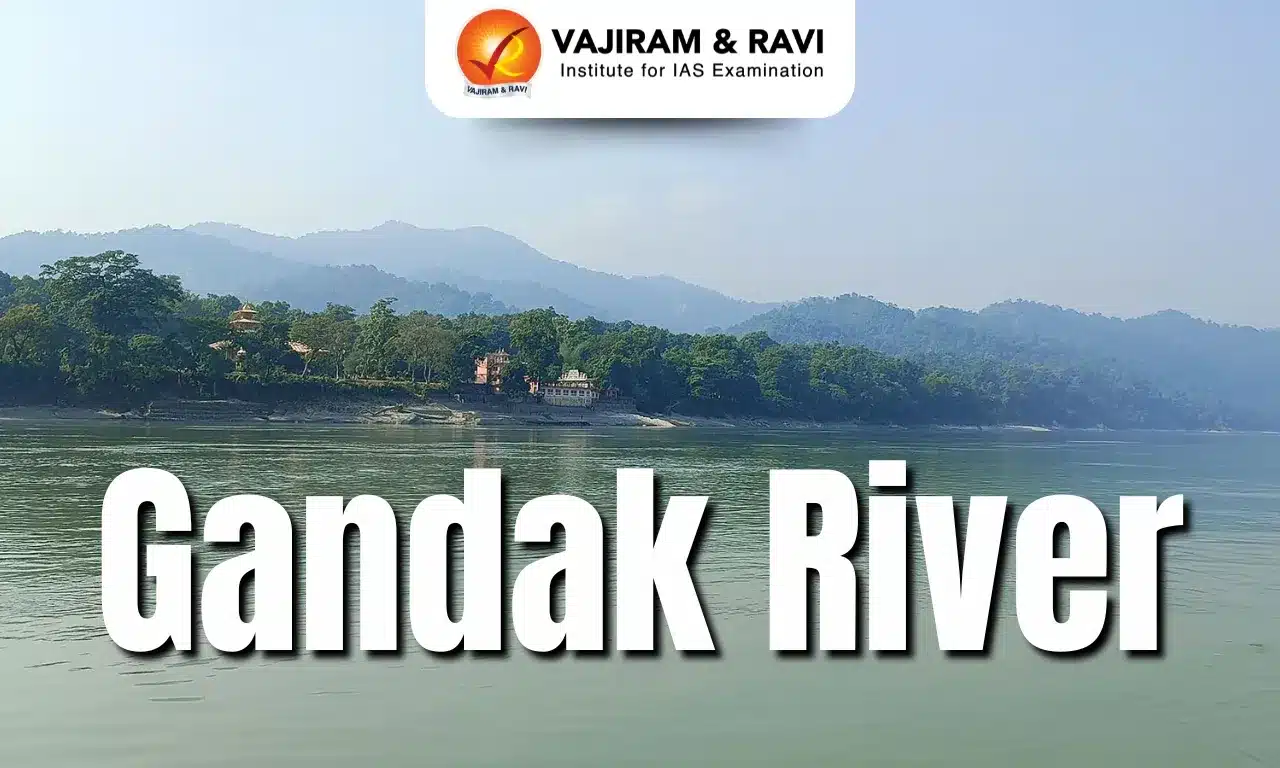
Gandak River Latest News
Due to heavy rainfall in Nepal’s catchment area, the water levels of the Gandak River in Bihar have been rising continuously.
About Gandak River
- It is one of the major rivers of North India and a significant left-bank tributary of the Ganga River.
- It is mentioned in the ancient Sanskrit epic Mahabharata.
- Course:
- It originates at an altitude of 7620 m above msl to the north of Dhaulagiri Mountain in Tibet near the Nepal border.
- It is formed by the union of the Kali and Trisuli Rivers, which rise in the Great Himalayas of Nepal.
- From their meeting point till the Indian border, the river is known as the ‘Kali Gandaki’ and ‘Narayani’ in Nepal.
- It enters India near Valmikinagar in Bihar and briefly touches Uttar Pradesh, forming a small stretch of boundary.
- The entry point of the river is at the Indo–Nepal border and is known as Triveni.
- After this, the river flows mainly through Bihar, covering districts like West Champaran, East Champaran, Gopalganj, and Saran.
- The Gandak finally joins the Ganga River opposite Patna, near Hajipur in Vaishali district, Bihar.
- It has a total length of about 630 kilometers, out of which 185 kilometers lie in Nepal and around 445 kilometers in India.
- The basin is bounded by the Himalayas to the north and the Ganga River to the south.
- On the sides, it lies between the Kosi basin in the east and the Karnali (Ghaghara) basin in the west. .
- There are about 1,710 glaciers and over 300 lakes in the upper catchment of Gandak.
- The basin includes three peaks over 8,000 m: Dhaulagiri, Manaslu, and Annapurna Massif.
- Due to the steep slope and loose soil in the upper catchment, Gandak carries a lot of silt and other deposits to the Indian side, resulting in a continuous shifting course of the river.
- While flowing through the Nepal Himalayas, it forms the Kali Gandaki Gorge, one of the deepest river gorges in the world.
- Two important protected areas, Chitwan National Park in Nepal and the adjacent Valmiki Tiger reserve in India, have been established in the basin.
- Major Tributaries: Daraudi, Seti, Madi, Marsyandi, and Budhi Gandaki.
News: NOA


 Last updated on Oct, 2026
→ UPSC 2027 Notification will be released on 13 January 2027 at upsconline.nic.in.
→ Check Nobel Prize 2026 Winners List here.
→ Download PIB PRiSM Monthly Magazine 2026 here.
→ Check UPSC Monthly Current Affairs Magazine The Recitals here.
→ Check out the latest UPSC Syllabus here.
→ Download UPSC Model Answers for Mains 2026
→ UPSC Mains Question Paper 2026 is out now for Essay & GS Paper 1, 2, 3 & 4.
→ UPSC Calendar 2027 has been released.
→ Enroll in Vajiram & Ravi’s UPSC Mains Test Series 2027 for structured answer writing practice, expert evaluation, and exam-oriented feedback.
→ Join Vajiram & Ravi’s UPSC Mentorship Program 2027 for personalized guidance, strategy planning, and one-to-one support from experienced mentors.
→ Go through the UPSC Mains Previous Year Papers to enhance your preparation.
→ UPSC has released UPSC Toppers List 2025 with the Civil Services final result on its official website.
→ Also check Best UPSC Coaching in India
Gandak River FAQs
Q1. Which major river is the Gandak a tributary of?+
Q2. Where does the Gandak River originate?+
Q3. Near which place does the Gandak River enter India?+
Q4. What is the total length of the Gandak River?+
Tags: gandak river