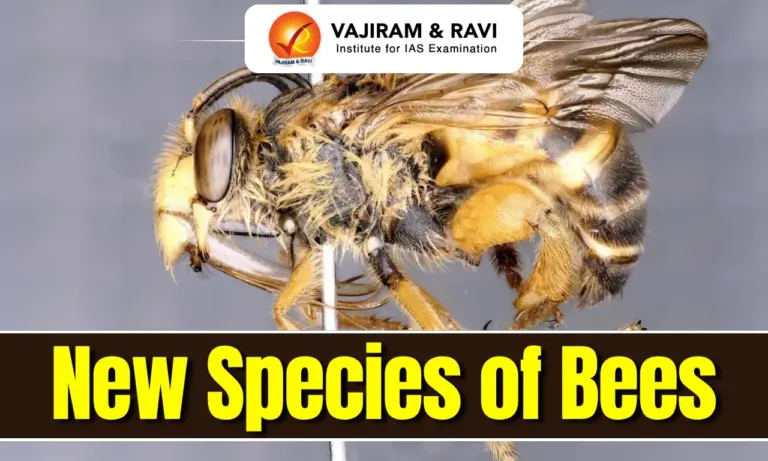
New Species of Bees Latest News
Researchers recently discovered two new species of solitary bees named Elaphropoda Triangulata and Habropoda Adi in Arunachal Pradesh.
About Elaphropoda Triangulata and Habropoda Adi
- They are two new species of solitary bees.
- They were discovered in Arunachal Pradesh.
- Elaphropoda triangulata is named after the triangle-shaped markings on its abdomen.
- Habropoda adi is named after the Adi indigenous community of Arunachal Pradesh, which inhabits the region where the bees were collected.
- They belong to the bee subfamily Anthophorinae, which consists largely of ground-nesting solitary bees.
- Solitary bees are important pollinators that help maintain healthy ecosystems and support agriculture.
- Unlike honeybees, they do not live in colonies and usually nest alone.
- These bees were collected using Malaise traps, a passive sampling method that captures flying insects over extended periods and is particularly effective in detecting elusive or low-density species that conventional netting often misses.
News: TH


 Last updated on Oct, 2026
→ UPSC 2027 Notification will be released on 13 January 2027 at upsconline.nic.in.
→ Check Nobel Prize 2026 Winners List here.
→ Download PIB PRiSM Monthly Magazine 2026 here.
→ Check UPSC Monthly Current Affairs Magazine The Recitals here.
→ Check out the latest UPSC Syllabus here.
→ Download UPSC Model Answers for Mains 2026
→ UPSC Mains Question Paper 2026 is out now for Essay & GS Paper 1, 2, 3 & 4.
→ UPSC Calendar 2027 has been released.
→ Enroll in Vajiram & Ravi’s UPSC Mains Test Series 2027 for structured answer writing practice, expert evaluation, and exam-oriented feedback.
→ Join Vajiram & Ravi’s UPSC Mentorship Program 2027 for personalized guidance, strategy planning, and one-to-one support from experienced mentors.
→ Go through the UPSC Mains Previous Year Papers to enhance your preparation.
→ UPSC has released UPSC Toppers List 2025 with the Civil Services final result on its official website.
→ Also check Best UPSC Coaching in India
New Species of Bees FAQs
Q1. What are Elaphropoda triangulata and Habropoda adi?+
Q2. Where were Elaphropoda triangulata and Habropoda adi discovered?+
Q3. Why is Elaphropoda triangulata named so?+
Q4. Why is Habropoda adi named so?+
Tags: new species of bees prelims pointers upsc current affairs upsc prelims current affairsprelims pointers