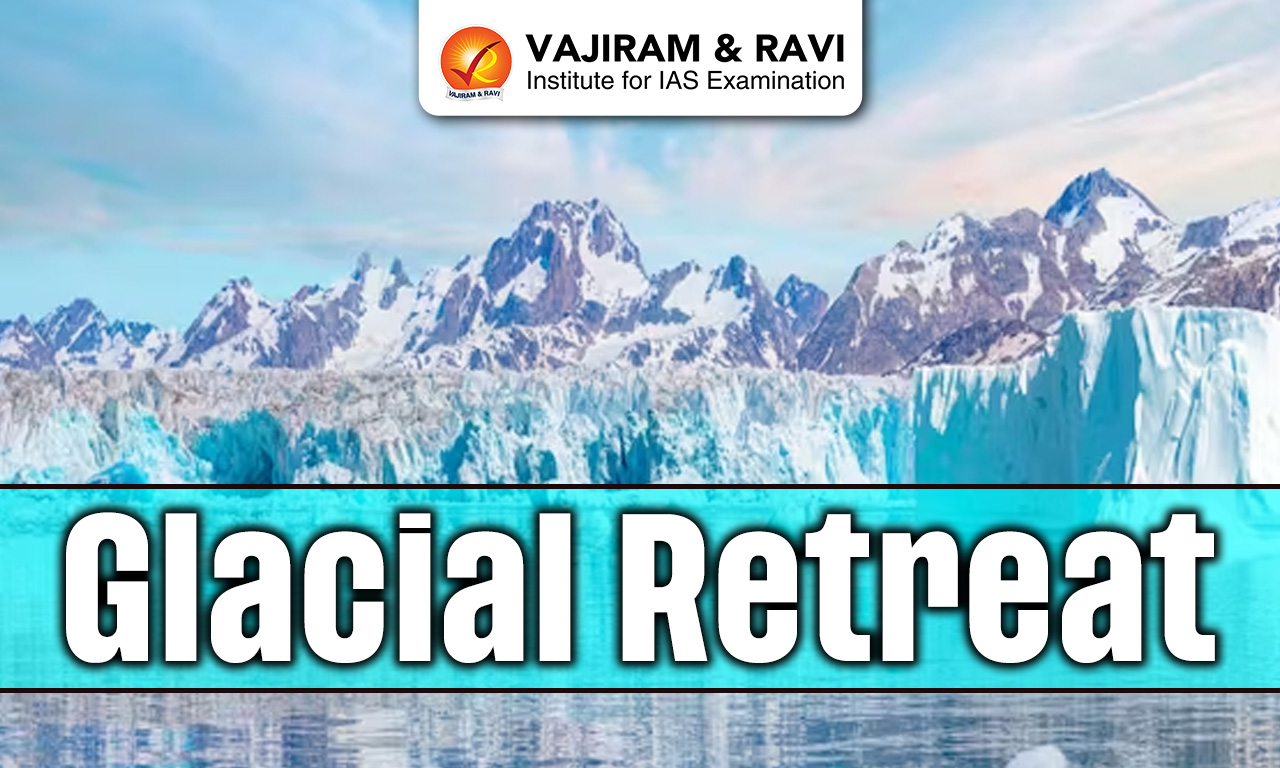
Glaciers are massive, slow moving bodies of ice formed by compacted snow over centuries. These cover about 10% of Earth’s land surface and store nearly 70% of global freshwater. In India, Himalayan Glaciers act as critical water sources for major rivers like the Ganga, Indus and Brahmaputra. However, altering global temperatures and climate change are accelerating Glacial Retreat, disturbing hydrological cycles and threatening water security, ecosystems and livelihoods across large populations dependent on Glacier fed systems.
Glacial Retreat
Glacial Retreat refers to the shrinking and backward movement of Glaciers due to imbalance between ice accumulation and melting processes globally. It occurs when melting exceeds snowfall accumulation, causing Glaciers to lose mass and length over time, exposing underlying land and altering landscape features significantly.
Since 1975, Glaciers have lost about 9 trillion tonnes of ice, with nearly 450 gigatonnes lost in 2024 alone (the fastest recorded rate of retreat globally). Melting Glaciers have contributed to sea level rise of approximately 18 mm between 2000 and 2023, increasing the vulnerability of coastal cities and island ecosystems worldwide.
Glacial Retreat Causes
Glacial Retreat is driven by both natural variability and human induced factors that influence Glacier mass balance and long term climatic conditions.
- Climate Change Impact: Rising global temperatures due to greenhouse gas emissions are the primary driver, increasing Glacier melt rates worldwide, particularly after industrialisation intensified carbon dioxide emissions.
- Black Carbon Deposition: Soot particles from industrial pollution reduce Glacier albedo, increasing absorption of solar radiation and accelerating melting, especially in Himalayan and Arctic regions.
- Precipitation Variability: Changes in snowfall patterns directly affect Glacier mass balance, where reduced snow accumulation weakens Glacier replenishment, leading to long term retreat trends.
- Topography and Morphology: Glacier characteristics like slope, elevation, debris cover thickness, snout geometry and presence of glacial lakes influence retreat rates and create heterogeneous Glacier responses.
- Ocean and Atmospheric Interactions: Warmer ocean temperatures and atmospheric circulation patterns contribute to melting of marine Glaciers, especially in regions like Greenland and Antarctica, enhancing ice loss.


Glacial Retreat Impacts
Glacial Retreat has multidimensional consequences affecting environment, economy, society and geopolitics across regions dependent on Glacier systems.
- Water Resource Decline: Retreat reduces long term water availability in Glacier fed rivers, threatening irrigation, drinking water and livelihoods of over 1.5 billion people globally dependent on these sources.
- Natural Disaster Risks: Increased Glacier melting leads to formation of glacial lakes and raises risks of Glacial Lake Outburst Floods (GLOFs), landslides, avalanches and flash floods in mountain regions.
- Sea Level Rise Effects: Melting Glaciers contribute to global sea level rise, intensifying coastal flooding, erosion and storm surges, impacting low lying countries and major urban centres.
- Hydropower Disruptions: Variability in Glacier meltwater affects hydropower generation, causing energy instability in regions such as the Andes and Alpine countries dependent on glacial rivers.
- Ecological and Social Impact: Glacier retreat alters ecosystems, threatens biodiversity and disrupts cultural and livelihood practices of indigenous communities, while increasing migration pressures and regional conflicts.
Glacial Retreat Data
Several global and Indian examples highlight the accelerating rate of Glacier Retreat and its measurable impacts on hydrology and geography.
- Hindu Kush Himalayan Glaciers: They show an average retreat rate of 14.9 ± 15.1 meters annually, with variations across Indus, Ganga and Brahmaputra basins due to climatic and topographic factors.
- Himalayan Glacier: The Dokriani Glacier in Uttarakhand is retreating at 15-20 m/year, while Chorabari Glacier shows a retreat of 9-11 m/year, indicating rapid ice loss in central Himalayas.
- Ladakh Glaciers: Pensilungpa and Durung Drung Glaciers in Ladakh show retreat rates of about 5.6 m/year and 12 m/year respectively, influenced by debris cover and local topography.
- Gangotri Glacier: The Gangotri Glacier system has lost nearly 10% of its snowmelt flow between 1980 and 2020, reflecting significant hydrological shifts due to warming temperatures.
- Yala Glacier: Yala Glacier in Nepal is projected to disappear by the 2040s, becoming a symbol of rapid Glacier loss and included in the Global Glacier Casualty List.
- Arctic and Global Trends: Northern Hemisphere marine terminating Glaciers created 2,466 km of new coastline between 2000 and 2020 due to retreat, largely driven by annual ice loss of 10.3 gigatons.
Glacial Retreat Challenges
Monitoring and managing Glacial Retreat pose significant scientific, technical and policy challenges due to variability and data limitations.
- Data Gaps and Monitoring Issues: Limited field data and inconsistent long term observations make it difficult to accurately assess Glacier mass balance and retreat patterns across regions.
- Heterogeneous Glacier Behaviour: Variations in topography, debris cover and climatic conditions lead to uneven retreat rates, complicating development of unified climate impact models.
- Rapid Landscape Transformation: Retreating Glaciers form new lakes and fragmented ice bodies, making measurement of Glacier length, area and volume more complex and dynamic.
- Technological Limitations: Traditional monitoring systems were designed for stable Glaciers and rapid melting requires advanced real time tracking through remote sensing and satellite technologies.
- Transboundary Governance Issues: Glacier fed rivers cross national boundaries and retreat intensifies water sharing conflicts, especially in basins like the Indus and Brahmaputra.
Glacial Retreat Measures
Addressing Glacial Retreat requires integrated climate action, scientific monitoring and policy interventions at local, national and global levels.
- Emission Reduction Strategies: Achieving net zero targets and reducing greenhouse gas emissions, especially carbon dioxide and black carbon, is essential to slow global warming and Glacier melting.
- Glacier Monitoring Systems: Expanding satellite based observation and establishing research stations like Himansh improves understanding of Glacier dynamics and supports early warning systems for disasters.
- Water Resource Management: Developing efficient irrigation, water conservation systems and climate resilient infrastructure ensures sustainable use of Glacier fed water resources under changing conditions.
- Disaster Risk Reduction: Implementation of GLOF guidelines, early warning systems and hazard mapping helps reduce risks to vulnerable Himalayan communities and infrastructure.
- International Cooperation: Strengthening transboundary water agreements, climate finance and collaborative research initiatives ensures coordinated response to Glacier retreat and associated global challenges.

 Last updated on Oct, 2026
→ UPSC 2027 Notification will be released on 13 January 2027 at upsconline.nic.in.
→ Check Nobel Prize 2026 Winners List here.
→ Download PIB PRiSM Monthly Magazine 2026 here.
→ Check UPSC Monthly Current Affairs Magazine The Recitals here.
→ Check out the latest UPSC Syllabus here.
→ Download UPSC Model Answers for Mains 2026
→ UPSC Mains Question Paper 2026 is out now for Essay & GS Paper 1, 2, 3 & 4.
→ UPSC Calendar 2027 has been released.
→ Enroll in Vajiram & Ravi’s UPSC Mains Test Series 2027 for structured answer writing practice, expert evaluation, and exam-oriented feedback.
→ Join Vajiram & Ravi’s UPSC Mentorship Program 2027 for personalized guidance, strategy planning, and one-to-one support from experienced mentors.
→ Go through the UPSC Mains Previous Year Papers to enhance your preparation.
→ UPSC has released UPSC Toppers List 2025 with the Civil Services final result on its official website.
→ Also check Best UPSC Coaching in India
Glacial Retreat FAQs
Q1. What is Glacial Retreat?+
Q2. What is the main cause of Glacial Retreat?+
Q3. How much ice have Glaciers lost globally?+
Q4. How does Glacial Retreat affect water resources?+
Q5. Which Himalayan Glacier shows significant retreat?+
Tags: geography geography notes glacial retreat