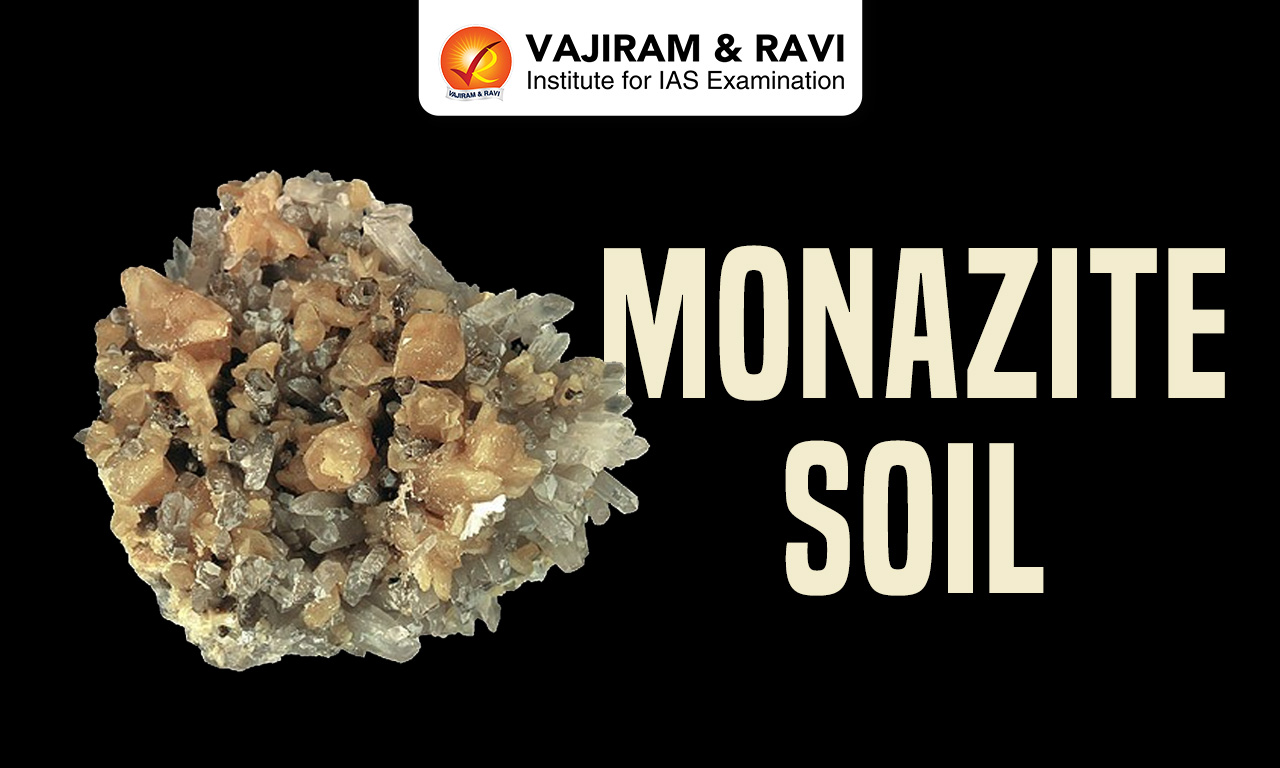
Monazite Soil refers to beach sand deposits rich in the mineral Monazite. Monazite is a reddish-brown phosphate that contains valuable rare earth elements and Thorium. It is highly significant due to its resistance to weathering and its concentration along coastal regions. The presence of Thorium makes it strategically important for nuclear energy development. India possesses substantial Monazite reserves, especially along its coasts, making it a crucial resource for energy security and advanced technologies.
Monazite Soil Features
Monazite Soil is unique due to its mineral composition, radioactivity and economic value derived from rare earth elements and Thorium deposits.
- Mineral Composition: Monazite is a phosphate mineral containing rare earth elements like lanthanum, cerium, praseodymium and neodymium, which possess magnetic, luminescent and electrochemical properties essential for advanced technologies and industrial applications.
- Resistance to Weathering: Monazite is highly resistant to chemical weathering, allowing it to accumulate in coastal and placer deposits over time, especially in beach sands where heavy minerals get concentrated naturally.
- Radioactive Nature: Monazite contains Thorium, a weakly radioactive element, making it an important atomic mineral and subject to strict regulatory control due to its potential use in nuclear energy programs.
- Rare Earth Element Source: It serves as the primary commercial source of rare earth elements in India, supporting industries like electronics, renewable energy, defense systems and communication technologies.
- Physical Characteristics: Monazite appears reddish-brown in color and occurs in granular form within beach sands, often associated with minerals like ilmenite, rutile, garnet and zircon in coastal placer deposits.
Monazite Soil Distribution
Monazite deposits are globally distributed in coastal and placer regions, with India having one of the largest concentrations of this valuable mineral resource.
- Global Distribution: Major Monazite deposits are found in India, Madagascar and South Africa, with coastal placer sands serving as the primary geological setting for these valuable rare earth bearing minerals.
- Indian Coastal Regions: The largest concentration in India occurs along the Kerala coast, followed by Tamil Nadu, Odisha, Andhra Pradesh, Maharashtra and Gujarat, where beach sand mineral deposits are abundant.
- Inland Deposits: Apart from coastal regions, Monazite is also found in inland placer deposits in Jharkhand, West Bengal and Tamil Nadu, indicating its wider geological presence beyond beaches.
- Resource Estimates: India possesses about 10.70 million tonnes of Monazite containing nearly 9,63,000 tonnes of Thorium oxide, with total in situ resources estimated at over 13 million tonnes in recent assessments.
- Production and Capacity: India produces around 4000 tonnes of Monazite annually, while installed processing capacity reaches about 10,000 tonnes, though actual output is limited due to regulatory and environmental constraints.


Monazite Soil Significance
Monazite Soil holds immense strategic, economic and technological importance due to its rare earth elements and Thorium content, which influence multiple sectors.
- Energy Security: Thorium present in Monazite can reduce dependence on imported uranium, strengthening national energy security and supporting long term nuclear power generation through indigenous resources.
- Nuclear Power Potential: India’s Thorium reserves account for about 25 percent of global reserves and can generate approximately 358,000 gigawatt years of electricity, ensuring sustainable energy supply for future generations.
- Rare Earth Applications: Rare earth elements extracted from Monazite are crucial for manufacturing electronics, electric vehicles, wind turbines, satellites and defense equipment due to their unique physical and chemical properties.
- Industrial and Economic Value: Monazite supports high value industries such as aerospace, telecommunications and renewable energy, contributing significantly to economic growth and technological advancement.
- Climate Change Mitigation: Thorium based nuclear energy offers a cleaner alternative to fossil fuels, helping reduce carbon emissions and supporting global efforts toward sustainable and low carbon energy systems.
Monazite Soil Regulation in India
Due to its radioactive nature and strategic importance, Monazite Soil is strictly regulated under various laws and institutions in India.
- Legal Classification: Monazite is classified as a “prescribed substance” under the Atomic Energy Act, requiring strict control over its mining, handling and export to ensure national security and safety.
- Regulatory Authority: The Department of Atomic Energy regulates Monazite under the Atomic Energy (Radiation Protection) Rules 2004, ensuring safe usage and preventing unauthorized access to radioactive materials.
- Licensing Requirements: Extraction, processing and export of Monazite require special licenses and companies must obtain approval from regulatory bodies like the Atomic Energy Regulatory Board for operations.
- Role of IREL: Indian Rare Earths Limited, a government owned entity, is the only authorized organization to process Monazite and manage its domestic use and export, ensuring centralized control.
- Mining Restrictions: Recent regulatory changes reduced permissible Monazite thresholds to zero in beach sand mining, effectively restricting private sector participation and preventing environmental damage and illegal extraction.

 Last updated on Sep, 2026
→ UPSC 2027 Notification will be released on 13 January 2027 at upsconline.nic.in.
→ Asian Games 2026 are being held in Aichi-Nagoya, Japan, from 19 September to 4 October.
→ Check out the latest UPSC Syllabus here.
→ Download UPSC Model Answers for Mains 2026
→ UPSC Mains Question Paper 2026 is out now for Essay & GS Paper 1, 2, 3 & 4.
→ UPSC Calendar 2027 has been released.
→ Enroll in Vajiram & Ravi’s UPSC Mains Test Series 2027 for structured answer writing practice, expert evaluation, and exam-oriented feedback.
→ Join Vajiram & Ravi’s UPSC Mentorship Program 2027 for personalized guidance, strategy planning, and one-to-one support from experienced mentors.
→ Go through the UPSC Mains Previous Year Papers to enhance your preparation.
→ UPSC has released UPSC Toppers List 2025 with the Civil Services final result on its official website.
→ Also check Best UPSC Coaching in India
Monazite Soil FAQs
Q1. What is Monazite Soil?+
Q2. Why is Monazite important for India?+
Q3. Where is Monazite mainly found in India?+
Q4. Is Thorium directly used in nuclear reactors?+
Q5. Who regulates Monazite mining in India?+