


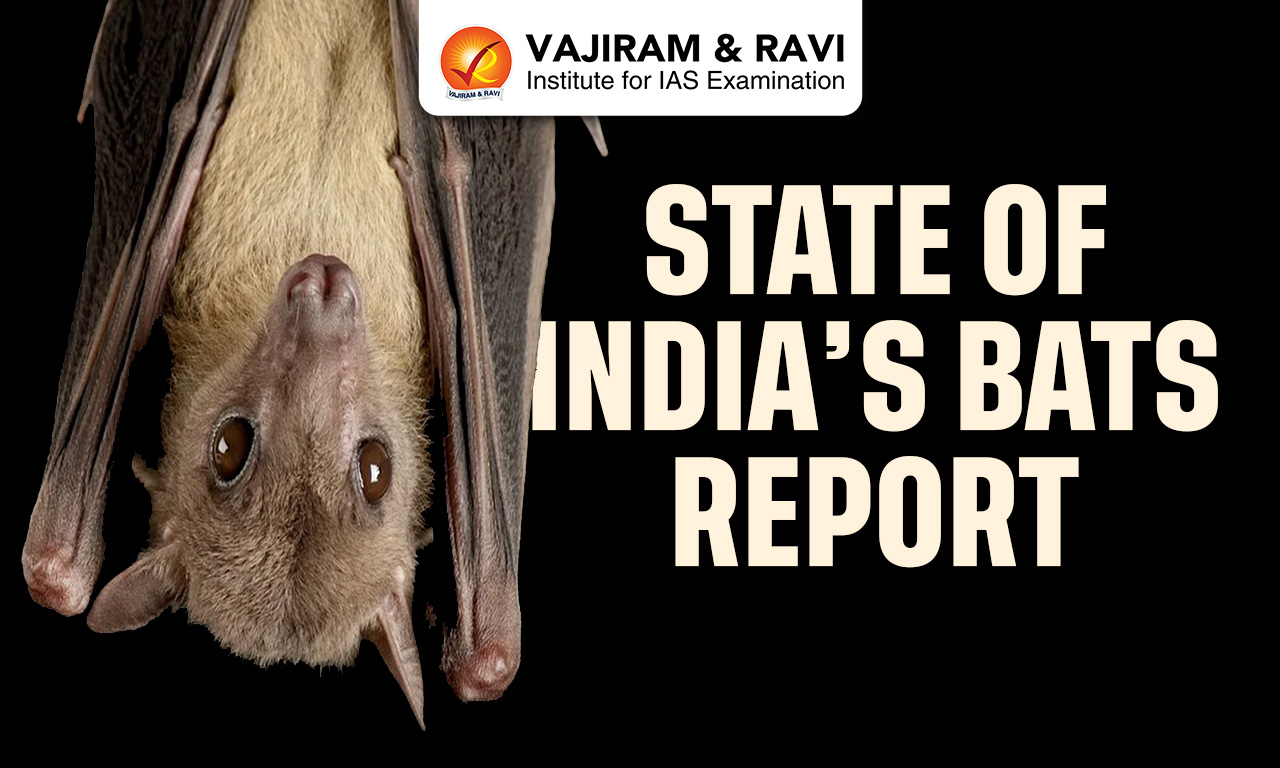
The State of India’s Bats Report (2024-25) is the first-ever national assessment of bat species in India, prepared by a team of 36 experts from 27 institutions in collaboration with the Nature Conservation Foundation (NCF) and Bat Conservation International (BCI).
State of India’s Bats Report (2024-25) Key Findings
State of India’s Bats Report (2024-25) highlights the growing neglect of bats despite their ecological importance and points to serious concerns such as data gaps, habitat loss, and rising threats from human activities. It also underlines the need for urgent research and conservation efforts.
High Diversity and Endemism:
- India hosts around 135 bat species, out of which 16 species are endemic, which means they are found only within the country.
- These endemic species are spread across different regions such as the Himalayas and Northeast India, Western Ghats, Andaman and Nicobar Islands, Peninsular India, Gangetic plains, and the Chotanagpur plateau.
Threatened Species: Seven bat species are listed under threatened categories by the International Union for Conservation of Nature, including critically endangered, endangered, and vulnerable species.
- Critically Endangered Bat Species: The Kolar Leaf-nosed Bat (Hipposideros hypophyllus) is classified as Critically Endangered and is known from a single cave in Kolar district, Karnataka.
- Endangered Bat species: Nicobar Leaf-nosed Bat (Hipposideros nicobarulae), Pomona Leaf-nosed Bat (Hipposideros pomona), Salim Ali’s Fruit Bat (Latidens salimalii), Nicobar Flying Fox (Pteropus faunulus), and Andaman Horseshoe Bat (Rhinolophus cognatus).
- Vulnerable Bat Species: Durga Das’s Leaf-nosed Bat (Hipposideros durgadasi) is listed as Vulnerable.
Threats to Bat Species: The report identifies multiple threats affecting bat populations.
- Urbanisation, deforestation, land-use changes, and climate change are major drivers of habitat loss. Mining and hunting also affect certain species.
- Additionally, negative public perception, especially after the COVID-19 pandemic, has increased stigma against bats, often portraying them only as disease carriers.
Uneven Distribution of Bats Across India: Bat diversity varies significantly across regions.
- West Bengal has the highest diversity with 68 species.
- It is followed by Meghalaya with 66 species, Uttarakhand with 52 species, Sikkim with 43 species, and Kerala and Karnataka with 41 species each.
- In contrast, Haryana and Punjab have only five species each, mainly due to limited forest cover and agricultural expansion.
- Even urban areas like Delhi host 15 species, showing adaptability of bats despite urbanisation pressures.
Habitat and Roosting Patterns: Bats in India roost in both natural and human-made environments.
- Common natural habitats include caves and trees, with caves being especially important due to their stable temperature and protection from predators.
- They are also found in buildings, wooden structures, and even historical monuments. For instance, Robber’s Cave in Maharashtra hosts one of the largest bat colonies in India.
Ecological Importance of Bats: The report strongly emphasises that bats provide essential ecosystem services.
- They contribute to pollination of plants, especially night-blooming species, and help in seed dispersal, which supports forest regeneration.
- They also provide natural pest control by consuming insects that damage crops, thereby benefiting agriculture. In addition, their droppings enrich the soil with nutrients.
- Thus, bats are essential for ecosystem stability, biodiversity conservation, and agricultural productivity.
Challenges Identified
The report highlights several systemic challenges that hinder effective bat conservation in India.
Bureaucratic and Institutional Gaps:
- A major issue is the presence of bureaucratic hurdles in obtaining research permissions, which slows down scientific studies and limits field-based understanding.
- This is compounded by the lack of dedicated research centres and insufficient institutional focus on bat ecology and conservation.
- As a result, several biodiversity-rich regions such as the Northeast, the Himalayas, and the Andaman and Nicobar Islands remain under-studied despite their ecological importance.
Data Deficiency:
- Another critical concern is the significant data deficiency, with around 35 bat species either unassessed or classified as data deficient, making it difficult to determine their true conservation status. This lack of reliable data prevents an accurate assessment of population trends and threats.
- For instance, the Khasian Leaf-nosed bat in Meghalaya faces pressures from hunting and mining, yet it is still not properly classified under global conservation categories.
Negative Perception about Bats:
- After the COVID-19 pandemic, bats are often viewed mainly as disease carriers, leading to stigma, reduced public support, and challenges for conservation efforts.


Recommendations of the State of India’s Bats Report (2024-25)
The report calls for urgent steps to improve conservation and understanding of bats in India.
- There is a need to increase research and monitoring, especially in under-studied regions.
- Disease surveillance systems should be strengthened in biodiversity hotspots such as the Northeast and Western Ghats.
- Public awareness must be improved to reduce stigma and highlight the ecological role of bats.
- Collaboration between government agencies, researchers, and conservation organisations should be enhanced.
- Conservation strategies should focus on protecting critical habitats like caves and forests.
About Bats
- Bats are unique mammals and form the largest order of mammals in India.
- They are the only mammals capable of true flight, which makes them ecologically distinct.
- Bats vary greatly in size. Some species are as large as small dogs, such as flying foxes with wingspans of up to two metres, while others like the bumblebee bat weigh only around two grams, making them among the smallest mammals in the world.
- Most small bats, known as microbats, use echolocation, a biological sonar system. They emit high-frequency ultrasonic sounds that bounce off objects, helping them navigate and locate prey even in complete darkness.
- Contrary to common myths, bats are not blind; many species have functional vision along with highly developed hearing.
- Bats are commonly seen hanging upside down, an adaptation that helps them take off easily since their wings and legs are not suited for ground-based takeoff.
- Bats are known to act as natural reservoirs for several viruses, often carrying them without showing symptoms due to their highly efficient immune systems. They have been associated with viruses such as Nipah virus, rabies, and SARS-like coronaviruses.
- Transmission of viruses to humans usually occurs indirectly, either through contact with bat saliva, urine, or feces, or via intermediate hosts. In India, fruit bats have been linked to Nipah virus outbreaks in Kerala. Additionally, the ability of some viruses to be transmitted from mother to offspring ensures their persistence across generations
- Bats are also associated with severe diseases like Marburg virus disease.

 Last updated on Oct, 2026
→ UPSC 2027 Notification will be released on 13 January 2027 at upsconline.nic.in.
→ Check Nobel Prize 2026 Winners List here.
→ Download PIB PRiSM Monthly Magazine 2026 here.
→ Check UPSC Monthly Current Affairs Magazine The Recitals here.
→ Check out the latest UPSC Syllabus here.
→ Download UPSC Model Answers for Mains 2026
→ UPSC Mains Question Paper 2026 is out now for Essay & GS Paper 1, 2, 3 & 4.
→ UPSC Calendar 2027 has been released.
→ Enroll in Vajiram & Ravi’s UPSC Mains Test Series 2027 for structured answer writing practice, expert evaluation, and exam-oriented feedback.
→ Join Vajiram & Ravi’s UPSC Mentorship Program 2027 for personalized guidance, strategy planning, and one-to-one support from experienced mentors.
→ Go through the UPSC Mains Previous Year Papers to enhance your preparation.
→ UPSC has released UPSC Toppers List 2025 with the Civil Services final result on its official website.
→ Also check Best UPSC Coaching in India
State of India’s Bats Report 2024-25 FAQs
Q1. Which organisations prepared the State of India’s Bats Report (2024-25)?+
Q2. How many bat species are found in India and how many are endemic?+
Q3. Which is the critically endangered bat species mentioned in the State of India’s Bats Report (2024-25)?+
Q4. As per State of India’s Bats Report (2024-25) which states have the highest and lowest bat diversity in India?+
Q5. What are the key ecosystem services provided by bats?+
Tags: state of indias bats report 2024-25








