What is Equator?
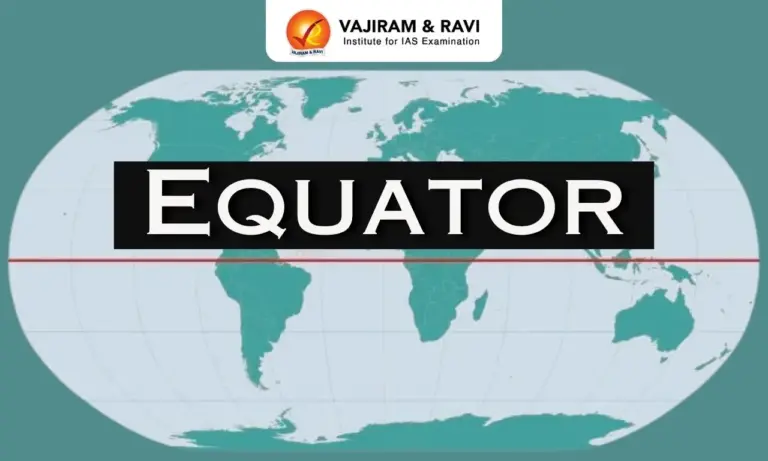
The Equator is an imaginary circle located at 0° latitude, halfway between the North Pole and the South Pole. It divides the Earth into two equal halves: the Northern Hemisphere and the Southern Hemisphere.
- Latitude: 0°.
- Location: It runs around the middle of the Earth, approximately halfway between the two poles.
- Length: Approximately 40,075 km (24,902 miles).
- Direction: It runs from west to east around the Earth.
- Hemisphere division: It divides the Earth into the Northern and Southern Hemispheres.
- Climate: Equatorial regions generally experience warm temperatures throughout the year and often receive heavy rainfall.
- Day and night: Places near the Equator usually experience nearly equal day and night lengths throughout the year.
Equator Passes through How Many Countries?
The Equator passes through 13 countries across three continents: South America, Africa, and Asia and Oceania. It crosses the landmass of 11 countries and the territorial waters of two island nations, the Maldives and Kiribati.
1. South America
The Equator passes through three countries in South America: Ecuador, Colombia and Brazil.
- Ecuador: Ecuador gets its name from the Spanish word for the Equator. The Equator passes through the northern part of the country, near Quito, its capital city.
- Colombia: The Equator crosses the southern part of Colombia in northwestern South America. The country experiences tropical climatic conditions in many regions due to its location near the Equator.
- Brazil: The Equator crosses northern Brazil, passing through the Amazon region. Macapá, the capital of Amapá state, is a well-known city located on the Equator.
2. Africa
The Equator passes through seven African countries: São Tomé and Príncipe, Gabon, the Republic of the Congo, the Democratic Republic of the Congo, Uganda, Kenya and Somalia.
- São Tomé and Príncipe: This island nation lies in the Gulf of Guinea, off the western coast of Central Africa. The Equator passes through Ilhéu das Rolas, a small islet located south of São Tomé Island.
- Gabon: Gabon is located on the west coast of Central Africa. The Equator crosses its territory, and the country has extensive tropical rainforests and a warm, humid climate.
- Republic of the Congo: The Equator passes through the central part of the Republic of the Congo. The country is home to tropical rainforests that form part of the wider Congo Basin.
- Democratic Republic of the Congo: The Equator crosses the Democratic Republic of the Congo, which contains a large part of the Congo Basin rainforest. The country has significant tropical biodiversity and extensive river systems.
- Uganda: The Equator crosses southern Uganda and passes through Lake Victoria. The country is known for its tropical landscapes, lakes and diverse wildlife.
- Kenya: The Equator crosses Kenya in East Africa. It passes through regions with different landscapes, including highlands, grasslands and areas near the Great Rift Valley.
- Somalia: The Equator crosses the southern part of Somalia along the eastern coast of Africa. The country has a long coastline along the Indian Ocean and generally experiences hot climatic conditions.
3. Asia and Oceania
The Equator is associated with three countries in this region: Indonesia, the Maldives and Kiribati. It crosses Indonesia’s landmass and passes through the territorial waters of the Maldives and Kiribati.
- Indonesia: Indonesia is an archipelago located in Southeast Asia. The Equator crosses several of its islands, including Sumatra, Borneo and Sulawesi, and many parts of the country experience a tropical climate.
- Maldives: The Maldives is an island nation in the Indian Ocean, southwest of India and Sri Lanka. The Equator passes through its territorial waters, making it one of the countries associated with the Equator without the line crossing its land.
- Kiribati: Kiribati is an island nation in the central Pacific Ocean. The Equator passes through its territorial waters, and the country is spread across a vast area of the Pacific.


Equator Passes through Which States of India?
The Equator does not pass through any state of India because India lies entirely in the Northern Hemisphere. The Equator is located at 0° latitude, while mainland India extends from approximately 8°4′ N to 37°6′ N latitude.
However, the Tropic of Cancer (23°30′ N) passes through eight Indian states. These states are:
- Gujarat
- Rajasthan
- Madhya Pradesh
- Chhattisgarh
- Jharkhand
- West Bengal
- Tripura
- Mizoram
Climate Around the Equator
The climate around the Equator is generally hot, humid and rainy throughout the year, with high temperatures and limited seasonal temperature variation.
- High temperatures: Temperatures remain high throughout the year, with many lowland areas averaging around 25°C to 28°C.
- Heavy rainfall: Many equatorial regions receive more than 2,000 mm of rainfall annually.
- High humidity: Warm temperatures and abundant moisture create humid conditions.
- Frequent thunderstorms: Rising warm, moist air leads to cloud formation, heavy showers and thunderstorms.
- Small seasonal temperature range: Differences between average monthly temperatures are generally low.
- Wet and dry seasons: Some regions receive rainfall throughout the year, while others experience distinct wet and dry seasons.
- Nearly equal day and night: The Equator receives approximately 12 hours of daylight and 12 hours of darkness throughout the year.
- Dense vegetation: Warm temperatures and abundant rainfall support tropical rainforests, particularly in the Amazon Basin, Congo Basin and parts of Indonesia.
- Regional variations: Elevation, ocean currents, prevailing winds and topography influence local temperatures and rainfall.
Why Is It Hot Around the Equator?
The Equator receives sunlight at a relatively high angle throughout the year. Solar energy is therefore concentrated over a smaller surface area than at higher latitudes, resulting in strong heating.
The main reasons for high temperatures around the Equator are:
- Direct solar radiation: Sunlight arrives at a high angle throughout the year, providing substantial energy to the Earth’s surface.
- Consistent day length: The Equator receives approximately 12 hours of daylight throughout the year, allowing regular solar heating.
- Warm, rising air: The Earth’s surface heats the air above it, causing warm air to rise and contributing to atmospheric convection.
- Moisture in the atmosphere: Water vapour helps retain heat and contributes to the formation of clouds and rainfall.
Natural Vegetation Around the Equator
The natural vegetation of equatorial regions depends mainly on temperature, rainfall, soil conditions and seasonal variations in moisture. Warm temperatures throughout the year allow plants to grow for much of the year wherever sufficient water and suitable soil conditions are available.
- Tropical rainforests: Areas receiving heavy rainfall throughout the year support dense, evergreen forests. The Amazon and Congo rainforests are major examples. These forests have multiple vegetation layers, broad-leaved trees and a wide variety of plant species.
- Tropical grasslands and savannas: Regions with distinct wet and dry seasons may support grasslands with scattered trees. Vegetation in these areas is adapted to seasonal water shortages and, in some places, periodic fires.
- Mangrove forests: Tropical coastal areas with suitable tidal conditions support mangroves. These salt-tolerant trees grow in sheltered coastal waters, estuaries and muddy intertidal zones.
- Wetland vegetation: Areas with waterlogged soils, floodplains and river margins support specialised vegetation, including aquatic plants and trees adapted to seasonal flooding.
- Rich biodiversity: Equatorial rainforests provide habitats for numerous species of plants, mammals, birds, reptiles, amphibians and insects. Their consistently warm conditions and abundant moisture support complex food webs.

 Last updated on Oct, 2026
→ UPSC 2027 Notification will be released on 13 January 2027 at upsconline.nic.in.
→ Check Nobel Prize 2026 Winners List here.
→ Download PIB PRiSM Monthly Magazine 2026 here.
→ Check UPSC Monthly Current Affairs Magazine The Recitals here.
→ Check out the latest UPSC Syllabus here.
→ Download UPSC Model Answers for Mains 2026
→ UPSC Mains Question Paper 2026 is out now for Essay & GS Paper 1, 2, 3 & 4.
→ UPSC Calendar 2027 has been released.
→ Enroll in Vajiram & Ravi’s UPSC Mains Test Series 2027 for structured answer writing practice, expert evaluation, and exam-oriented feedback.
→ Join Vajiram & Ravi’s UPSC Mentorship Program 2027 for personalized guidance, strategy planning, and one-to-one support from experienced mentors.
→ Go through the UPSC Mains Previous Year Papers to enhance your preparation.
→ UPSC has released UPSC Toppers List 2025 with the Civil Services final result on its official website.
→ Also check Best UPSC Coaching in India
Equator FAQs
Q1. What is the Equator?+
Q2. How many countries does the Equator pass through?+
Q3. Which continents does the Equator pass through?+
Q4. Does the Equator pass through India?+
Q5. Which Indian states does the Equator pass through?+
Q6. What is the latitude and length of the Equator?+
Q7. Why is the climate around the Equator hot?+
Tags: equator