Why in News?
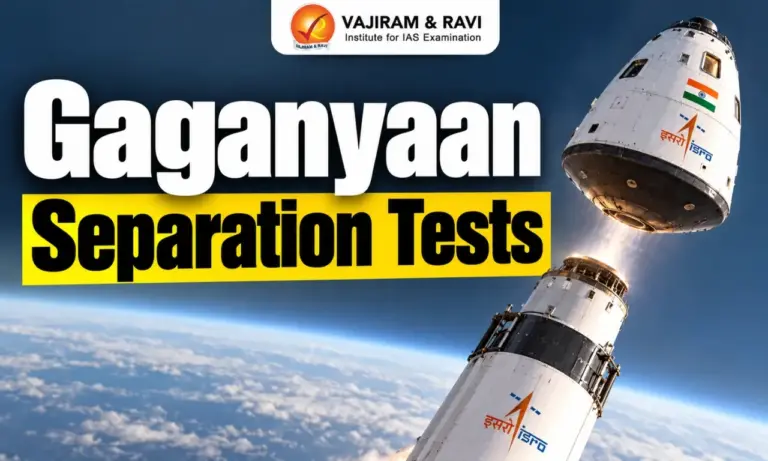
The Indian Space Research Organisation (ISRO) has successfully completed a series of Crew Module (CM)-Service Module (SM) separation tests for the Gaganyaan mission. These tests aim to ensure the safe separation of the crew module from the service module before the spacecraft re-enters Earth’s atmosphere. The first uncrewed Gaganyaan mission (G1) is targeted for launch in 2026.
What Is the Gaganyaan Mission?
- Gaganyaan is India’s human spaceflight mission developed by ISRO.
- It aims to demonstrate India’s capability to send humans into space and bring them safely back to Earth.
- The spacecraft’s Orbital Module consists of two main parts: the Crew Module and the Service Module.


What Are the Crew Module and Service Module?
The two modules perform different functions during the mission.
- Crew Module (CM)
- It is the part of the spacecraft designed to carry astronauts.
- It provides the necessary environment and protection for the crew during the mission.
- It includes critical systems such as avionics, navigation systems, and thermal protection components.
- Service Module (SM)
- It supports the crew module during the mission.
- It provides essential services and connections required for the spacecraft’s operation.
- The two modules remain connected during launch and the on-orbit phase of the mission.
What Are CM-SM Separation Tests?
The Crew Module and Service Module are connected through a separation system and umbilical connections that carry electrical and fluid services between them.
Before the spacecraft begins re-entry into Earth’s atmosphere, the Crew Module must separate from the Service Module. This process involves a sequence of carefully timed events using pyrotechnic devices and jettisoning systems.
ISRO conducted these tests to check whether the separation system can perform its intended function safely and reliably.
Key Highlights of the Separation Tests
- Testing location: The test setup was established at the Vikram Sarabhai Space Centre (VSSC), Thiruvananthapuram, Kerala.
- Simulated conditions: The tests recreated the overall Crew Module–Service Module assembly and the separation process.
- Umbilical disconnection: The tests simulated the cutting and separation of multiple connections between the two modules.
- Design validation: The tests helped validate the overall design and performance of the CM–SM separation system.
- Shock survivability: They demonstrated the ability of several critical Crew Module subsystems to withstand the shocks associated with separation.
Systems Validated During the Tests
The tests also assessed the robustness of important systems inside the Crew Module, including:
- Avionics systems used for spacecraft monitoring and control.
- Inertial Navigation Systems used to determine the spacecraft’s orientation and movement.
- Thermal Protection System components in the aft and conical heat shields, which help protect the module from extreme heat during re-entry.
- Crew Module Deployable Umbilical Shield, which protects the relevant area associated with the umbilical connections.
- Pyrotechnic devices used in the Crew Module Uprighting System.
- Components of the Thermal and Humidity Control System, which help maintain suitable environmental conditions inside the module.
Significance of the CM-SM Separation Tests
- Astronaut safety: Reliable separation is essential before the Crew Module returns to Earth.
- Mission reliability: The tests help confirm that the separation system is designed to operate as intended under simulated conditions.
- Protection of critical systems: They demonstrate the shock survivability of important onboard equipment.
- Preparation for the G1 mission: The results provide greater confidence in the separation system ahead of the first uncrewed Gaganyaan mission.
- Progress towards human spaceflight: Successful validation of key spacecraft systems is an important step towards India’s human spaceflight programme.
What Is the Vikram Sarabhai Space Centre (VSSC)?
- VSSC is a major ISRO centre located in Thiruvananthapuram, Kerala.
- It plays an important role in the development of launch vehicles and related space technologies.
- It contributes to India’s space programme through research, engineering, testing, and technology development.

 Last updated on Oct, 2026
→ UPSC 2027 Notification will be released on 13 January 2027 at upsconline.nic.in.
→ Check Nobel Prize 2026 Winners List here.
→ Download PIB PRiSM Monthly Magazine 2026 here.
→ Check UPSC Monthly Current Affairs Magazine The Recitals here.
→ Check out the latest UPSC Syllabus here.
→ Download UPSC Model Answers for Mains 2026
→ UPSC Mains Question Paper 2026 is out now for Essay & GS Paper 1, 2, 3 & 4.
→ UPSC Calendar 2027 has been released.
→ Enroll in Vajiram & Ravi’s UPSC Mains Test Series 2027 for structured answer writing practice, expert evaluation, and exam-oriented feedback.
→ Join Vajiram & Ravi’s UPSC Mentorship Program 2027 for personalized guidance, strategy planning, and one-to-one support from experienced mentors.
→ Go through the UPSC Mains Previous Year Papers to enhance your preparation.
→ UPSC has released UPSC Toppers List 2025 with the Civil Services final result on its official website.
→ Also check Best UPSC Coaching in India
Gaganyaan Separation Tests FAQs
Q1. What is the purpose of the CM–SM separation tests?+
Q2. Where were the Gaganyaan separation tests conducted?+
Q3. What are the two main components of the Gaganyaan Orbital Module?+
Q4. Why must the Crew Module separate from the Service Module?+
Q5. When is the first uncrewed Gaganyaan mission targeted for launch?+
Q6. Which critical systems were assessed during the tests?+
Tags: gaganyaan separation gaganyaan separation tests