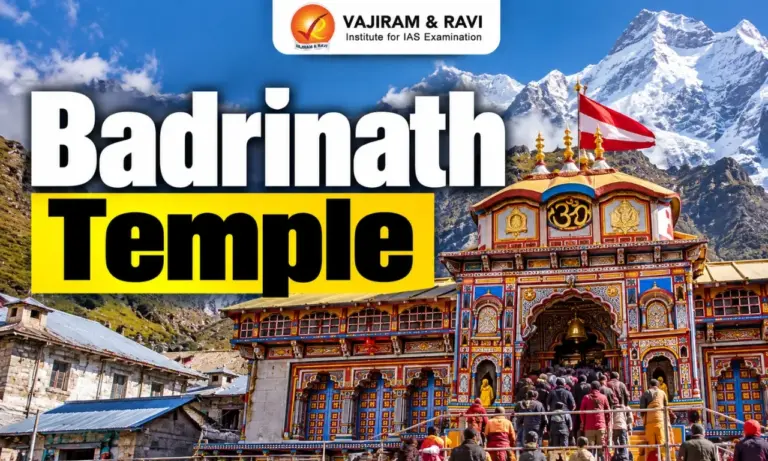
Badrinath Temple is an important Hindu pilgrimage site located in the Chamoli district of Uttarakhand. Dedicated to Lord Vishnu, the temple lies in the Garhwal Himalayas along the banks of the Alaknanda River. It is one of the four sacred sites of the Char Dham Yatra in Uttarakhand and holds great religious, cultural and historical importance.
The temple is also significant for understanding India’s religious traditions, Himalayan geography, pilgrimage tourism and cultural heritage.
History and Mythological Significance of Badrinath Temple
The Badrinath Temple is an ancient Hindu shrine dedicated to Lord Vishnu, located in the Chamoli district of Uttarakhand. It is one of the four sacred sites of the Char Dham pilgrimage in Uttarakhand and one of the 108 Divya Desams, which are sacred Vishnu temples revered in the Sri Vaishnava tradition.
Mythological Origins
- Lord Vishnu’s Penance: According to Hindu religious traditions, Lord Vishnu performed deep meditation at this site, making it an important centre of spiritual practice.
- Legend of the Badri Tree: According to popular belief, Goddess Lakshmi took the form of a berry tree (Badri) to protect Lord Vishnu from the harsh Himalayan weather while he meditated. This legend is associated with the names Badrikashram and Badrinath.
- Connection with the Mahabharata: Local traditions associate the region with the Pandavas and their final journey towards the Himalayas, as described in the Mahabharata.
Historical Development
- Ancient Origins: Badrinath is mentioned in Hindu religious literature, including the Vishnu Purana and Skanda Purana. These references highlight its longstanding religious importance.
- Role of Adi Shankaracharya: According to tradition, the philosopher and religious reformer Adi Shankaracharya revived the shrine’s importance during the 8th–9th century CE. He is believed to have recovered the black stone idol of Lord Badrinarayan from the Alaknanda River and established it for worship.
- Renovation and Reconstruction: Over the centuries, the temple underwent several repairs due to harsh climatic conditions and natural disasters. The Garhwal rulers and the royal family of Jaipur are associated with its restoration and development.
- Modern Administration: Today, the temple is managed by the Shri Badarinath Kedarnath Temple Committee (BKTC) under the applicable state legislation, which oversees temple administration and religious activities.
Religious and Cultural Significance
- Worship of Lord Vishnu: The temple is dedicated to Lord Vishnu, who is regarded as the preserver of the universe in Hinduism.
- Char Dham Yatra: Badrinath is one of the four pilgrimage sites in Uttarakhand, along with Yamunotri, Gangotri and Kedarnath.
- Larger Char Dham circuit: It is also one of the four sacred destinations in India’s wider Char Dham pilgrimage, along with Dwarka, Puri and Rameswaram.
- Religious traditions: The temple is associated with Hindu beliefs, pilgrimage practices and traditions connected with the Himalayan region.
- Cultural heritage: It represents the close relationship between religion, local communities and the natural environment in the Himalayas.


Architecture and Important Features
Badrinath Temple is known for its colourful entrance, traditional architectural features and location amid the Himalayan mountains.
- Main shrine: The inner sanctum houses the image of Lord Badrinarayan, a form of Lord Vishnu.
- Garbhagriha: The innermost chamber where the principal deity is worshipped.
- Mandapa: The hall used by devotees for religious activities and worship.
- Temple entrance: The entrance is decorated with colourful architectural elements.
- Tapt Kund: A natural hot spring near the temple where pilgrims traditionally bathe before worship.
- Alaknanda River: The river flows near the temple and forms part of the Ganga river system.
- Neelkanth Peak: This prominent Himalayan peak adds to the natural and religious importance of the region.
Char Dham Yatra of Uttarakhand
The Char Dham Yatra is a major Hindu pilgrimage covering four sacred sites in Uttarakhand.
|
Pilgrimage site |
Presiding deity or religious association |
|
Yamunotri |
Goddess Yamuna |
|
Gangotri |
Goddess Ganga |
|
Kedarnath |
Lord Shiva |
|
Badrinath |
Lord Vishnu |
The pilgrimage is generally undertaken during the warmer months because heavy snowfall and severe winter conditions make access to these Himalayan sites difficult.
Geographical Significance
Badrinath Temple is situated in the Himalayan region, where high mountains, river valleys and changing weather conditions influence human activities.
- Alaknanda River: The river is an important headstream of the Ganga and contributes to the drainage system of the Himalayas.
- Mountain environment: The region has steep slopes, high elevations and cold winters.
- Natural hazards: Landslides, heavy rainfall, snowfall and road blockages can affect pilgrimage and transport.
- Tourism and livelihoods: Pilgrimage supports hotels, transport services, local businesses and other tourism-related activities.
- Environmental concerns: Increasing tourist pressure and infrastructure development require sustainable waste management and protection of the fragile Himalayan ecosystem.

 Last updated on Oct, 2026
→ UPSC 2027 Notification will be released on 13 January 2027 at upsconline.nic.in.
→ Check Nobel Prize 2026 Winners List here.
→ Download PIB PRiSM Monthly Magazine 2026 here.
→ Check UPSC Monthly Current Affairs Magazine The Recitals here.
→ Check out the latest UPSC Syllabus here.
→ Download UPSC Model Answers for Mains 2026
→ UPSC Mains Question Paper 2026 is out now for Essay & GS Paper 1, 2, 3 & 4.
→ UPSC Calendar 2027 has been released.
→ Enroll in Vajiram & Ravi’s UPSC Mains Test Series 2027 for structured answer writing practice, expert evaluation, and exam-oriented feedback.
→ Join Vajiram & Ravi’s UPSC Mentorship Program 2027 for personalized guidance, strategy planning, and one-to-one support from experienced mentors.
→ Go through the UPSC Mains Previous Year Papers to enhance your preparation.
→ UPSC has released UPSC Toppers List 2025 with the Civil Services final result on its official website.
→ Also check Best UPSC Coaching in India
Badrinath Temple FAQs
Q1. Where is Badrinath Temple located?+
Q2. Which deity is worshipped at Badrinath Temple?+
Q3. Who revived the religious importance of Badrinath Temple?+
Q4. Which river flows near Badrinath Temple?+
Q5. What are the four sites of Uttarakhand's Char Dham Yatra?+
Q6. Why does Badrinath Temple close during winter?+
Tags: badrinath badrinath temple temple