Why in News?
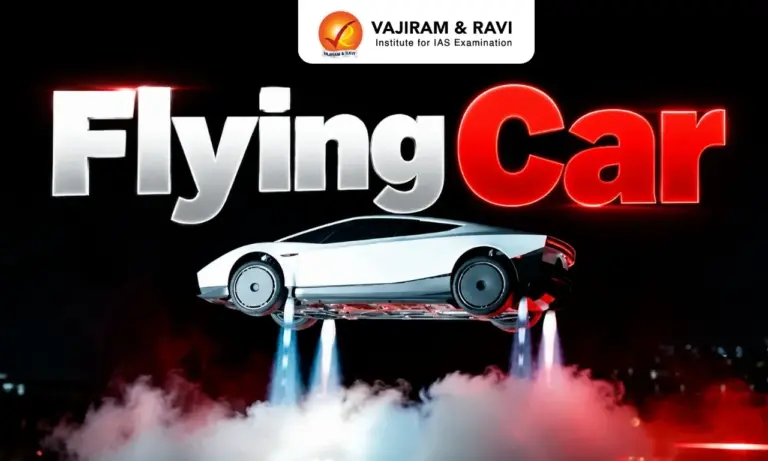
Elon Musk, CEO of Tesla and SpaceX, was in the news in October 2026 after unveiling the next-generation Tesla Roadster 2 at a SpaceX testing facility in Texas, United States, on 15 October 2026. The demonstration showed the electric sports car using SpaceX-developed rocket-style thrusters to lift briefly into the air, perform mid-air manoeuvres and land. Musk described it as a flying car and said the vehicle was expected to enter production in 2028.
What Is a Flying Car?
A flying car is a vehicle designed to travel through the air, and in some designs, also move on roads. It combines ideas from the automobile and aviation industries to offer a new form of personal or public transportation.
Modern flying vehicles are not all traditional cars that can drive on roads and then take off. Many are electric aircraft designed mainly for short-distance air travel. These include electric vertical take-off and landing (eVTOL) aircraft, which can take off and land vertically without needing a conventional long runway.


How Does a Flying Car Work?
Flying cars use a combination of aviation engineering, electric propulsion, sensors, software and navigation systems to operate safely.
- Electric propulsion: Electric motors power the rotors or propellers that generate the thrust required for flight.
- Vertical take-off and landing: Multiple rotors or other lifting systems allow an eVTOL aircraft to rise and land vertically.
- Flight control systems: Computers process information from sensors and help maintain balance, direction, altitude and speed.
- Navigation technology: Satellite navigation, digital maps and onboard sensors help determine the aircraft’s position and route.
- Battery systems: Rechargeable batteries supply electricity to the motors and other onboard systems.
- Communication systems: Connected systems help pilots and operators exchange information about routes, weather and flight conditions.
What Is eVTOL Technology?
eVTOL stands for Electric Vertical Take-Off and Landing. It refers to aircraft that use electric power and can take off and land vertically, making them suitable for certain urban transportation applications.
Unlike conventional aeroplanes, which generally require runways, eVTOL aircraft may operate from specially designed compact landing areas called vertiports.
Their main features include:
- Electric motors: Reduce direct emissions during operation compared with conventional fuel-powered aircraft.
- Multiple rotors: Provide lift and, in some designs, additional redundancy.
- Advanced flight software: Helps control the aircraft and coordinate its different systems.
- Compact infrastructure: May allow operations from rooftops or dedicated urban landing facilities, subject to safety requirements.
- Short-distance travel: Designed for applications such as airport transfers, medical transport and travel between nearby urban locations.
Role of Artificial Intelligence in Flying Cars
Artificial Intelligence (AI) plays an important role in the development of flying cars by improving navigation, safety, automation and flight management.
- Smart Navigation: AI analyses location, weather and traffic data to identify suitable routes.
- Obstacle Detection: AI-powered sensors help detect obstacles and reduce collision risks.
- Autonomous Flight: AI can support automated take-off, landing and flight control.
- Predictive Maintenance: AI monitors vehicle components to identify potential faults before they cause failures.
- Air Traffic Management: AI helps coordinate aircraft movements and manage airspace efficiently.
- Energy Management: AI can optimise battery use and energy consumption based on flight conditions.
- Enhanced Safety: AI analyses real-time sensor data to identify hazards and support timely responses.

 Last updated on Oct, 2026
→ UPSC 2027 Notification will be released on 13 January 2027 at upsconline.nic.in.
→ Check Nobel Prize 2026 Winners List here.
→ Download PIB PRiSM Monthly Magazine 2026 here.
→ Check UPSC Monthly Current Affairs Magazine The Recitals here.
→ Check out the latest UPSC Syllabus here.
→ Download UPSC Model Answers for Mains 2026
→ UPSC Mains Question Paper 2026 is out now for Essay & GS Paper 1, 2, 3 & 4.
→ UPSC Calendar 2027 has been released.
→ Enroll in Vajiram & Ravi’s UPSC Mains Test Series 2027 for structured answer writing practice, expert evaluation, and exam-oriented feedback.
→ Join Vajiram & Ravi’s UPSC Mentorship Program 2027 for personalized guidance, strategy planning, and one-to-one support from experienced mentors.
→ Go through the UPSC Mains Previous Year Papers to enhance your preparation.
→ UPSC has released UPSC Toppers List 2025 with the Civil Services final result on its official website.
→ Also check Best UPSC Coaching in India
Flying Car FAQs
Q1. What is a flying car?+
Q2. What is eVTOL technology?+
Q3. How is AI used in flying cars?+
Q4. What are the major benefits of flying cars?+
Q5. What are the main challenges of flying cars?+
Tags: flying flying car