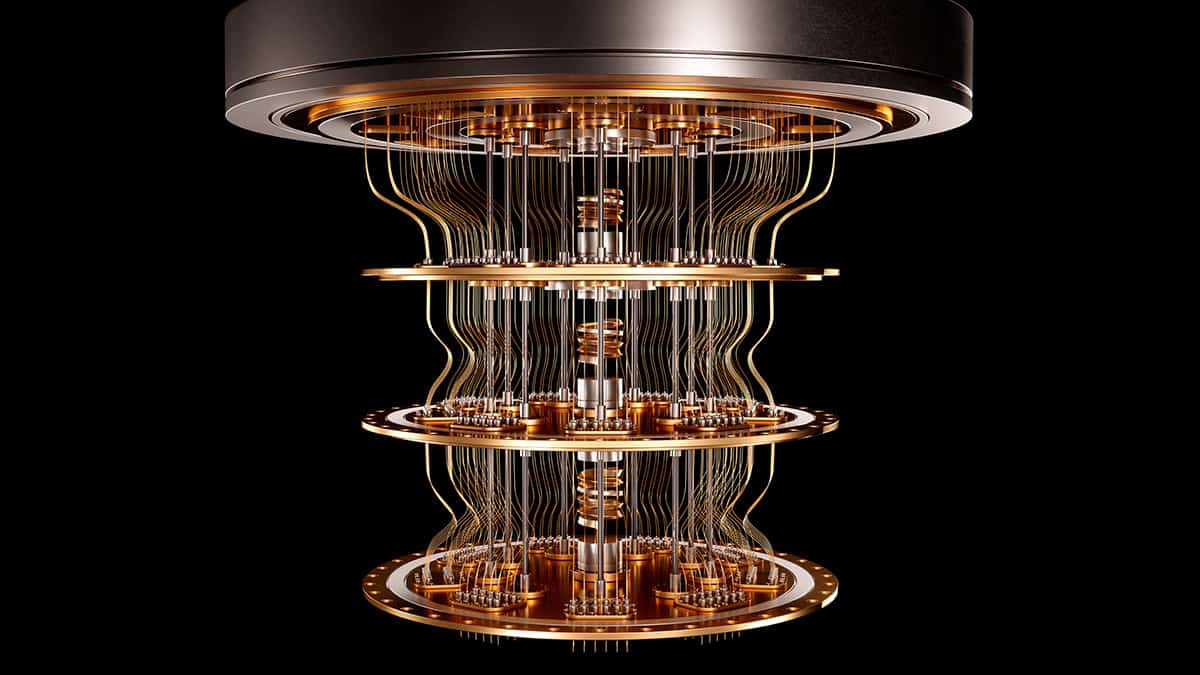
About Quantum Computing:
- It is an area of computer science that uses the principles of quantum theory.
- Quantum theory explains the behavior of energy and material on the atomic and subatomic levels.
- Quantum computers have the capability to sift through huge numbers of possibilities and extract potential solutions to complex problems and challenges.
- How does it work?
- Where classical computers store information as bits with either 0s or 1s, quantum computers use qubits.
- While classical bits always represent either one or zero, a qubit can be in a superposition of one and zero simultaneously until its state is measured.
- In addition, the states of multiple qubits can be entangled, meaning that they are linked quantum mechanically to each other.
- Qubits can be made by manipulating atoms, electrically charged atoms called ions, or electrons, or by nanoengineering so-called artificial atoms, such as circuits of superconducting qubits, using a printing method called lithography.
What is Superposition and Entanglement?
- They are two features of quantum physics on which quantum computing is based.
- They empower quantum computers to handle operations at speeds exponentially higher than conventional computers and with much less energy consumption.
- Superposition:
- A qubit places the quantum information that it contains into a state of superposition.
- This refers to a combination of all possible configurations of the qubit.
- Groups of qubits in superposition can create complex, multidimensional computational spaces.
- Complex problems can be represented in new ways in these spaces.
- Entanglement:
- Pairs of qubits can be made to become entangled.
- This means that the two qubits then exist in a single state.
- In such a state, changing one qubit directly affects the other in a manner that’s predictable.
- Quantum algorithms are designed to take advantage of this relationship to solve complex problems.
- While doubling the number of bits in a classical computer doubles its processing power, adding qubits results in an exponential upswing in computing power and ability.
Q1) What is Quantum Physics?
Quantum physics is the study of matter and energy at the most fundamental level. It aims to uncover the properties and behaviors of the very building blocks of nature.
Source: Explained | What is Microsoft’s planned ‘quantum supercomputer’?


 Last updated on Oct, 2026
→ UPSC 2027 Notification will be released on 13 January 2027 at upsconline.nic.in.
→ Check Nobel Prize 2026 Winners List here.
→ Download PIB PRiSM Monthly Magazine 2026 here.
→ Check UPSC Monthly Current Affairs Magazine The Recitals here.
→ Check out the latest UPSC Syllabus here.
→ Download UPSC Model Answers for Mains 2026
→ UPSC Mains Question Paper 2026 is out now for Essay & GS Paper 1, 2, 3 & 4.
→ UPSC Calendar 2027 has been released.
→ Enroll in Vajiram & Ravi’s UPSC Mains Test Series 2027 for structured answer writing practice, expert evaluation, and exam-oriented feedback.
→ Join Vajiram & Ravi’s UPSC Mentorship Program 2027 for personalized guidance, strategy planning, and one-to-one support from experienced mentors.
→ Go through the UPSC Mains Previous Year Papers to enhance your preparation.
→ UPSC has released UPSC Toppers List 2025 with the Civil Services final result on its official website.
→ Also check Best UPSC Coaching in India