Why in News?
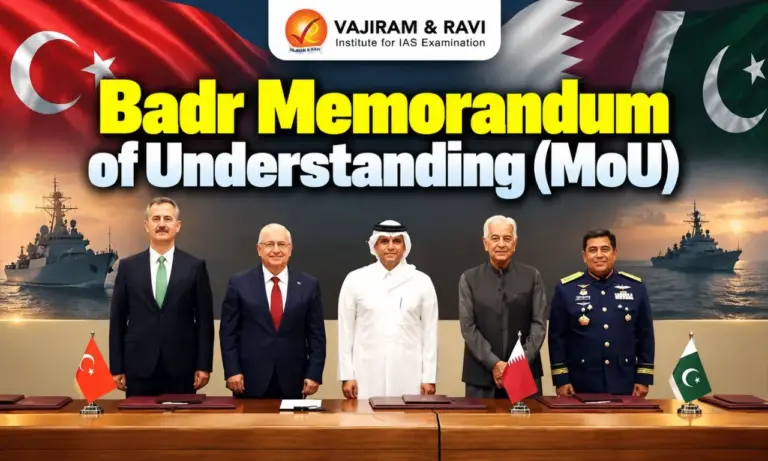
Pakistan, Turkey, Qatar and Indonesia signed the Badr Memorandum of Understanding (MoU) on 21 October 2026 in Doha, Qatar. The agreement aims to strengthen defence cooperation, joint military production, research and development (R&D), and technical training.
The agreement is important for India because it could strengthen Pakistan’s defence industry and influence regional security partnerships.
What is the Badr Memorandum of Understanding?
The Badr Memorandum of Understanding is a defence cooperation agreement among Pakistan, Turkey, Qatar and Indonesia. It aims to combine their technical expertise, industrial resources and financial capabilities to strengthen defence manufacturing.
Key facts about the Badr MoU:
- Date: 21 October 2026
- Place: Doha, Qatar
- Participating countries: Pakistan, Turkey, Qatar and Indonesia
- Main objective: Strengthening defence industries and military production
- Key areas: Joint manufacturing, research and development, technology cooperation and technical training
- Future expansion: Other friendly countries may join under mutually agreed conditions.
The word Badr means “full moon” and represents the idea of combining the strengths of the participating countries.
Also Read:- US-Iran MoU


Objectives of the Badr MoU
The agreement aims to strengthen domestic defence industries and reduce dependence on foreign suppliers.
- Joint defence production: Encourage countries to manufacture military equipment together.
- Research and development: Promote the development of modern defence technologies.
- Technology cooperation: Share technical knowledge and industrial expertise.
- Technical training: Improve the skills of defence personnel and engineers.
- Defence exports: Create opportunities to sell jointly manufactured equipment.
- Supply chain cooperation: Improve access to components, spare parts and maintenance facilities.
- Cost sharing: Distribute research and production costs among participating countries.
Role of Pakistan, Turkey, Qatar and Indonesia
Each country can contribute different resources and expertise to the agreement.
- Turkey: Can contribute defence technology, engineering expertise and experience in manufacturing drones, naval platforms and armoured vehicles.
- Pakistan: Can provide existing defence manufacturing facilities, technical personnel and military production experience.
- Qatar: Can support projects through financial resources, investment and defence procurement.
- Indonesia: Can explore joint manufacturing, technology cooperation and opportunities to strengthen its domestic defence industry.
Also Read:- Kishau Multipurpose Project
Why Is the Badr MoU a Concern for India?
The agreement is relevant to India because Pakistan’s participation could create additional opportunities for defence manufacturing and technical cooperation. However, its impact will depend on the capabilities developed under the agreement.
- Strengthening Pakistan’s defence industry: Joint production and technical cooperation could improve Pakistan’s ability to manufacture and maintain military equipment.
- Access to technology: Research and development partnerships may strengthen Pakistan’s technical capabilities, depending on the technologies shared.
- Pakistan-Turkey relations: The agreement could expand existing defence industrial cooperation between the two countries.
- India-Indonesia relations: Indonesia is an important Indian partner in Southeast Asia and the Indo-Pacific. The agreement could increase competition among defence suppliers, but it does not mean Indonesia will reduce cooperation with India.
- Regional security: Closer defence ties among the four countries could influence regional military partnerships and procurement decisions.
- Defence preparedness: The agreement highlights the importance of domestic manufacturing, advanced technology and strategic partnerships for India’s security.
Is the Badr MoU a Military Alliance Against India?
No, the Badr MoU is not, by itself, a military alliance against India. Its main focus is defence manufacturing, research and development, technical training and industrial cooperation.
The agreement does not establish a publicly stated collective defence obligation requiring all four countries to defend one another in the event of a military attack.
|
Basis |
Badr MoU |
Makkah Joint Defence Agreement |
|
Participants |
Pakistan, Turkey, Qatar and Indonesia |
Pakistan, Turkey and Saudi Arabia |
|
Main focus |
Defence industry and joint production |
Mutual defence and military cooperation |
|
Key activities |
Manufacturing, research and technical training |
Collective deterrence and defence commitments |
|
Defence commitment |
No publicly stated collective defence obligation |
Provides for collective defence against an armed attack |
The Makkah Joint Defence Agreement, signed by Pakistan, Turkey and Saudi Arabia in August 2026, provides for mutual defence against an armed attack. The Badr MoU, in contrast, focuses on defence industrial cooperation.
Badr MoU and the Changing Geopolitics of West Asia
The agreement reflects a broader trend in which countries are strengthening domestic defence industries and diversifying their international partnerships.
- Diversification of suppliers: Reduces dependence on a limited number of defence suppliers.
- Regional security: Encourages cooperation in response to changing security conditions.
- Industrial development: Supports local manufacturing and technical expertise.
- Economic opportunities: Creates potential for investment, employment and defence exports.
- Strategic partnerships: Builds long-term relationships among participating countries.
What Should India Do in Response to the Badr MoU?
India should focus on strengthening its own defence capabilities and maintaining strong regional partnerships.
- Indigenous defence production: Develop domestic capabilities in aircraft, missiles, drones and naval systems.
- Research and development: Invest in advanced defence technologies and innovation.
- Defence exports: Expand international partnerships and improve the competitiveness of Indian defence equipment.
- Regional cooperation: Strengthen defence ties with Indonesia and other Southeast Asian countries.
- Security monitoring: Assess actual projects and technology transfers under the Badr MoU.
- Diplomatic engagement: Maintain strong economic, strategic and security relations with West Asian countries.
Conclusion
The Badr Memorandum of Understanding aims to strengthen defence industrial cooperation among Pakistan, Turkey, Qatar and Indonesia through joint production, research and development, and technical training.

 Last updated on Oct, 2026
→ UPSC 2027 Notification will be released on 13 January 2027 at upsconline.nic.in.
→ Check Nobel Prize 2026 Winners List here.
→ Download PIB PRiSM Monthly Magazine 2026 here.
→ Check UPSC Monthly Current Affairs Magazine The Recitals here.
→ Check out the latest UPSC Syllabus here.
→ Download UPSC Model Answers for Mains 2026
→ UPSC Mains Question Paper 2026 is out now for Essay & GS Paper 1, 2, 3 & 4.
→ UPSC Calendar 2027 has been released.
→ Enroll in Vajiram & Ravi’s UPSC Mains Test Series 2027 for structured answer writing practice, expert evaluation, and exam-oriented feedback.
→ Join Vajiram & Ravi’s UPSC Mentorship Program 2027 for personalized guidance, strategy planning, and one-to-one support from experienced mentors.
→ Go through the UPSC Mains Previous Year Papers to enhance your preparation.
→ UPSC has released UPSC Toppers List 2025 with the Civil Services final result on its official website.
→ Also check Best UPSC Coaching in India
Badr Memorandum of Understanding (MoU) 2026 FAQs
Q1. What is the Badr Memorandum of Understanding?+
Q2. When and where was the Badr MoU signed?+
Q3. Which countries are part of the Badr MoU?+
Q4. What are the main objectives of the Badr MoU?+
Q5. Why is the Badr MoU important for India?+
Tags: badr memorandum of understanding badr memorandum of understanding (mou) 2026