


Locus Coeruleus Latest News
Previously thought to broadcast the same chemical signal throughout the brain, a new study finds that the locus coeruleus (LC) actually sends targeted messages that help control learning, attention, and behavior, according to new research in mice.
About Locus Coeruleus
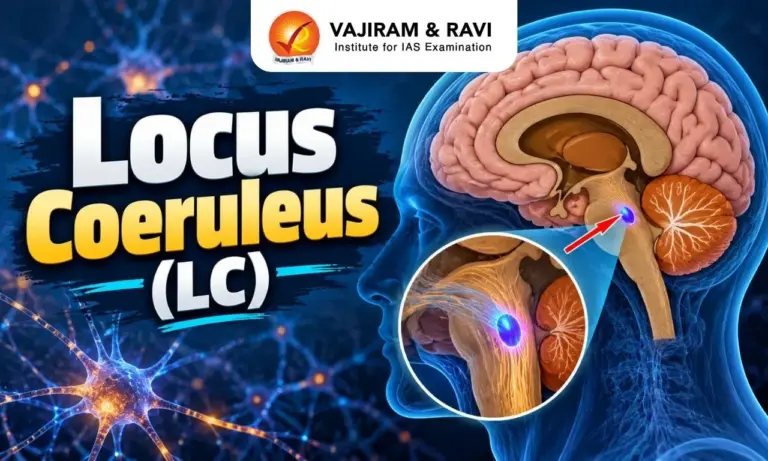
- The Locus Coeruleus (LC) is a small nucleus (cluster of nerve cells) located in the pons, a part of the brainstem.
- The Pons act as a connection between the cerebrum and cerebellum.
- The Locus Coeruleus gets its name from the Latin words for “blue place.”
- Although it contains only a small fraction of the brain’s neurons, it produces norepinephrine (NE), a chemical messenger that helps regulate attention, learning, heart rate, and the body’s reactions to stress and excitement.
- LC is the primary source of norepinephrine to the brain.
- Recent Findings:
- Scientists have long assumed that the LC operates like a loudspeaker, sending essentially the same norepinephrine signal across the brain.
- However, in a new study using brain imaging, recordings of neural activity, genetic techniques, and behavioral experiments, researchers discovered that the LC communicates through several distinct pathways.
- Rather than broadcasting one general message, it delivers signals to specific destinations, with different groups of neurons responding to different experiences.
- Different groups of cells communicate with specific regions of the nervous system.
- These pathways determine where signals trigger the release of norepinephrine, creating a much more organized communication network than previously recognized.
- Neurons in the upper (dorsal) portion of the LC primarily connect to the cerebral cortex and forebrain.
- Meanwhile, cells in the lower (ventral) portion send their signals mainly to the brainstem and spinal cord.
- This arrangement allows different parts of the LC to influence separate brain functions.
- Why the Discovery Could Matter for Brain Disorders?
- Norepinephrine plays a central role in regulating attention and mood, making it an important target for medications used to treat depression, anxiety, and ADHD.
- Neurons in the LC are also among the earliest brain cells to deteriorate in Alzheimer’s disease, suggesting that the new findings could have implications for understanding and treating these conditions.
- Current treatments that influence norepinephrine can affect multiple brain circuits at once, sometimes producing beneficial effects in one region while causing unwanted effects elsewhere.
- A clearer map of the LC’s specialized pathways could help scientists develop therapies that act more selectively on the circuits involved in particular symptoms.
News: SD


 Last updated on Oct, 2026
→ UPSC 2027 Notification will be released on 13 January 2027 at upsconline.nic.in.
→ Check Nobel Prize 2026 Winners List here.
→ Download PIB PRiSM Monthly Magazine 2026 here.
→ Check UPSC Monthly Current Affairs Magazine The Recitals here.
→ Check out the latest UPSC Syllabus here.
→ Download UPSC Model Answers for Mains 2026
→ UPSC Mains Question Paper 2026 is out now for Essay & GS Paper 1, 2, 3 & 4.
→ UPSC Calendar 2027 has been released.
→ Enroll in Vajiram & Ravi’s UPSC Mains Test Series 2027 for structured answer writing practice, expert evaluation, and exam-oriented feedback.
→ Join Vajiram & Ravi’s UPSC Mentorship Program 2027 for personalized guidance, strategy planning, and one-to-one support from experienced mentors.
→ Go through the UPSC Mains Previous Year Papers to enhance your preparation.
→ UPSC has released UPSC Toppers List 2025 with the Civil Services final result on its official website.
→ Also check Best UPSC Coaching in India
Locus Coeruleus FAQs
Q1. What is the Locus Coeruleus (LC)?+
Q2. Which neurotransmitter is primarily produced by the Locus Coeruleus?+
Q3. Why is the Locus Coeruleus important for brain function?+
Q4. What has recent research revealed about how the Locus Coeruleus communicates?+
Tags: locus coeruleus








