Emerging Science and Technology Latest News
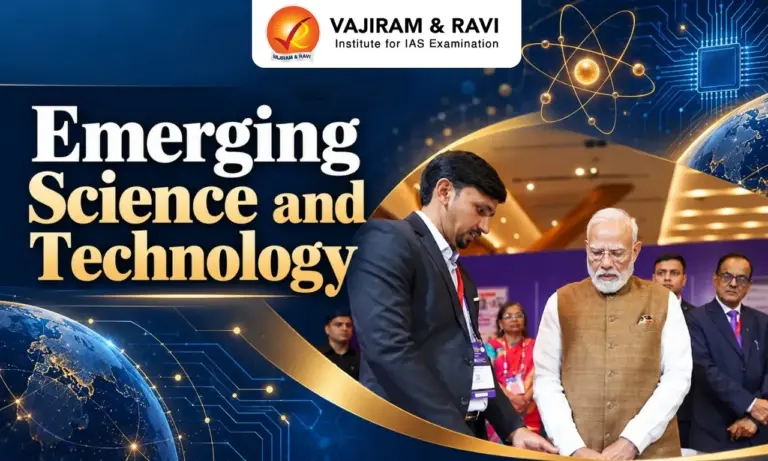
- Prime Minister Narendra Modi inaugurated the Emerging Science, Technology and Innovation Conclave (ESTIC) 2026 at Bharat Mandapam, New Delhi, emphasising measurable research outcomes, indigenous technologies and the contribution of science to India’s development.
Emerging Science, Technology and Innovation Conclave
- The Emerging Science, Technology and Innovation Conclave (ESTIC) 2026 brought together scientists, Nobel laureates, industry leaders, startup founders and young researchers to discuss India’s scientific and technological priorities.
- The central objective highlighted at the conclave was to move beyond discussions and establish measurable targets for innovation.
- Researchers and entrepreneurs were encouraged to identify technologies, prototypes, pilot projects or products they could develop over the next three years in support of Viksit Bharat.
- India’s scientific ambitions are increasingly focused on developing indigenous capabilities, creating globally competitive technologies and addressing domestic and international challenges.


India’s Transition Towards Scientific Leadership
- India’s scientific and technological trajectory has evolved from adopting innovations developed elsewhere towards building domestic research capabilities and contributing to global technological development.
- Examples highlighted at the conclave included:
- Space technology: Chandrayaan’s landing near the lunar south pole, the success of Mangalyaan and advances in satellite docking.
- Healthcare: Vaccines developed during the COVID-19 pandemic.
- Semiconductors and AI: Domestically developed AI models and Indian-made chips reaching international markets.
- Nuclear energy: Progress in indigenous fast breeder reactor technology.
- Battery technology: Research into batteries using Indian raw materials.
- These developments illustrate the growing range of India’s technological ambitions.
- Sustaining this progress requires investment in research, skilled human resources, industrial capacity and commercialisation.
Research Funding and Innovation Ecosystem
- A country’s technological capabilities depend substantially on the strength of its research ecosystem and its ability to translate scientific discoveries into commercially viable products.
- Anusandhan National Research Foundation
- The Anusandhan National Research Foundation (ANRF) is intended to strengthen research and innovation in India.
- The emphasis at ESTIC 2026 was on accelerating its work and expanding the country’s research capabilities.
- The conclave also highlighted a commitment of Rs. 1 lakh crore towards research and innovation through the Research Development and Innovation Fund.
- Bridging the Laboratory-to-Market Gap
- The Prime Minister referred to approximately Rs. 12,000 crore committed towards technologies ready to transition from laboratories to the market.
- Private-sector participation was described as matching the government’s contribution, taking the total commitment to approximately Rs. 24,000 crore.
- This approach seeks to address a major challenge in innovation policy: translating scientific research into practical applications, industrial products and economic value.
- The number of patent applications filed in India was also cited as having increased from approximately 50,000 to 1.5 lakh, reflecting the expansion of the country’s innovation ecosystem.
Artificial Intelligence and Scientific Judgement
- Artificial intelligence can accelerate routine tasks, improve productivity and assist researchers in analysing complex problems.
- However, its growing role also raises questions about scientific independence and the reliability of AI-generated results.
- The discussion at ESTIC 2026 emphasised that AI should support, rather than constrain, independent scientific thinking. Researchers must continue to question established assumptions, examine problems from new perspectives and ensure that AI-assisted findings meet appropriate standards of accuracy.
- The challenge is to integrate AI into scientific research without compromising critical thinking, verification and intellectual independence.
Nuclear Energy and Indigenous Technology
- India’s growing energy requirements make nuclear power an important component of its long-term energy strategy.
- The conclave highlighted the 500 MW Prototype Fast Breeder Reactor (PFBR), which had reached first criticality.
- This milestone represents an important stage in reactor development and supports India’s efforts to strengthen indigenous nuclear technology.
- The discussion also emphasised the significance of domestic technological capabilities in nuclear energy, semiconductors, space exploration and advanced batteries.
Making Science Relevant to Society
- A key principle emerging from the conclave was that scientific progress should be assessed by its practical contribution to society, not merely by its technical sophistication. Priority areas identified included:
- Healthcare: Developing technologies that improve health outcomes.
- Agriculture: Creating solutions that address agricultural challenges.
- Education and employment: Expanding opportunities through innovation.
- Disaster mitigation: Applying science and technology to reduce disaster risks.
- The emphasis on real-world applications highlights the importance of collaboration between research institutions, startups, industry and government.

 Last updated on Oct, 2026
→ UPSC 2027 Notification will be released on 13 January 2027 at upsconline.nic.in.
→ Check Nobel Prize 2026 Winners List here.
→ Download PIB PRiSM Monthly Magazine 2026 here.
→ Check UPSC Monthly Current Affairs Magazine The Recitals here.
→ Check out the latest UPSC Syllabus here.
→ Download UPSC Model Answers for Mains 2026
→ UPSC Mains Question Paper 2026 is out now for Essay & GS Paper 1, 2, 3 & 4.
→ UPSC Calendar 2027 has been released.
→ Enroll in Vajiram & Ravi’s UPSC Mains Test Series 2027 for structured answer writing practice, expert evaluation, and exam-oriented feedback.
→ Join Vajiram & Ravi’s UPSC Mentorship Program 2027 for personalized guidance, strategy planning, and one-to-one support from experienced mentors.
→ Go through the UPSC Mains Previous Year Papers to enhance your preparation.
→ UPSC has released UPSC Toppers List 2025 with the Civil Services final result on its official website.
→ Also check Best UPSC Coaching in India
Emerging Science and Technology FAQs
Q1. What is ESTIC 2026?+
Q2. What is the role of ANRF?+
Q3. What is the Prototype Fast Breeder Reactor?+
Q4. How does AI contribute to scientific research?+
Q5. Why is technology commercialisation important?+
Tags: emerging science and technology mains articles upsc current affairs upsc mains current affairs