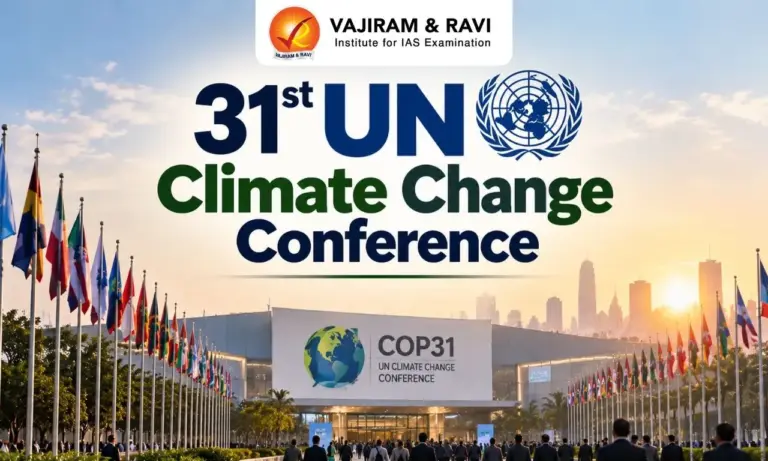
31st UN Climate Change Conference (COP31) will be held in Antalya, Turkiye, from November 9 to November 20, 2026. The conference will focus on climate finance, clean energy transition, methane reduction, climate adaptation and the implementation of global climate commitments.
31st UN Climate Change Conference (COP31) 2026 Key Highlights
The key highlights related to the 31st UN Climate Change Conference (COP31) 2026 have been tabulated below.
| 31st UN Climate Change Conference | |
|
Particulars |
Details |
|
Conference |
31st UN Climate Change Conference |
|
Full Form |
Conference of the Parties (COP) |
|
Dates |
November 9-20, 2026 |
|
Host Country |
Turkiye |
|
Venue |
Antalya Expo Center, Antalya |
|
COP31 President |
Murat Kurum |
|
President of Negotiations |
Chris Bowen, Australia |
|
World Leaders’ Summit |
November 11-12, 2026 |
|
Pre-COP31 |
October 5-8, 2026, in Fiji and Tuvalu |
What Is the 31st UN Climate Change Conference?
The 31st UN Climate Change Conference, also known as COP31, is an international climate summit organised under the United Nations Framework Convention on Climate Change (UNFCCC).
It brings together countries to discuss ways to reduce greenhouse gas emissions, address global warming and strengthen climate resilience. The conference also reviews progress under the Paris Agreement and encourages countries to implement their climate commitments.


Key Issues on the COP31 Agenda
- Climate Finance: Mobilising funds to help developing countries reduce emissions and adapt to climate change.
- Clean Energy Transition: Expanding solar and wind energy, improving energy efficiency and promoting electrification.
- Transition Away from Fossil Fuels: Implementing commitments to reduce dependence on coal, oil and natural gas.
- Methane Reduction: Controlling methane emissions from agriculture, fossil fuel production and waste management.
- Climate Adaptation: Strengthening resilience against floods, droughts, heatwaves and sea-level rise.
- Loss and Damage: Supporting countries facing severe and irreversible climate-related losses.
- Zero-Waste Initiatives: Promoting recycling, waste reduction and circular economy practices.
- Nationally Determined Contributions (NDCs): Strengthening national climate targets and their implementation.
COP31 Pre-COP Meeting: Fiji and Tuvalu
The Pre-COP31 meeting took place from October 5 to October 8, 2026, with preparatory events in Fiji and Tuvalu. The discussions highlighted the climate challenges faced by Pacific island nations.
Key concerns included sea-level rise, coastal erosion, climate finance, clean energy and ocean protection. These discussions helped highlight the priorities of vulnerable island nations ahead of the main conference.
India and COP31
India’s participation in COP31 is important for balancing climate action, economic growth, energy security and sustainable development.
India’s key priorities include:
- Climate Finance: Ensuring adequate and accessible funding for developing countries.
- Climate Justice: Recognising differences in historical emissions and national capacities.
- Renewable Energy: Expanding clean energy and improving energy efficiency.
- Climate Adaptation: Protecting agriculture, water resources and vulnerable communities.
- Technology Transfer: Improving access to affordable climate-friendly technologies.
India supports the principle of Common but Differentiated Responsibilities and Respective Capabilities (CBDR-RC). It recognises that all countries must address climate change, but their responsibilities and capacities differ according to their historical emissions and development needs.
Major International Climate Agreements
Major international climate agreements provide a global framework for reducing greenhouse gas emissions, limiting global warming, supporting climate adaptation and promoting international cooperation to address climate change.
| Major International Climate Agreements | |
|
Agreement |
Key Objective |
|
UNFCCC, 1992 |
Establishes a framework for international climate cooperation. |
|
Kyoto Protocol, 1997 |
Established emission-reduction commitments for developed countries during its commitment periods. |
|
Paris Agreement, 2015 |
Aims to limit global warming to well below 2°C and pursue efforts to limit it to 1.5°C. |
|
Glasgow Climate Pact, 2021 |
Strengthened global climate action, adaptation and finance discussions. |
|
UAE Consensus, COP28 |
Called for transitioning away from fossil fuels in energy systems. |
|
COP29, 2024 |
Established a new collective climate finance goal for developing countries. |
Major Challenges Before COP31
COP31 faces several challenges in achieving effective climate action, ensuring climate justice and implementing global climate commitments.
- Climate Finance Gap: Developing countries need adequate funding for climate mitigation and adaptation.
- Fossil Fuel Dependence: Many economies rely on coal, oil and natural gas for energy and industrial growth.
- Implementation Gap: Climate pledges do not always translate into effective action.
- Unequal Capacities: Developing countries face financial and technological constraints.
- Climate Justice: Countries differ over historical responsibilities and the distribution of climate burdens.
- Energy Security: Governments must balance emissions reduction with affordable and reliable energy supplies.
Way Forward
COP31 should focus on practical climate solutions, stronger international cooperation and equitable implementation of climate commitments.
- Improve Climate Finance: Ensure predictable, accessible and adequate funding for developing countries.
- Accelerate Clean Energy: Expand renewable energy, improve energy efficiency and strengthen electricity storage.
- Strengthen Adaptation: Invest in climate-resilient agriculture, water conservation and disaster preparedness.
- Reduce Methane Emissions: Improve emissions monitoring, industrial practices and waste management.
- Promote a Just Transition: Support workers and communities affected by the shift towards cleaner energy.
- Strengthen Accountability: Monitor national climate targets and improve the implementation of climate commitments.
Conclusion
The 31st UN Climate Change Conference (COP31) will provide an important platform for advancing global climate action. Its success will depend on effective climate finance, stronger national commitments and practical measures to reduce greenhouse gas emissions while protecting vulnerable communities.

 Last updated on Oct, 2026
→ UPSC 2027 Notification will be released on 13 January 2027 at upsconline.nic.in.
→ Check Nobel Prize 2026 Winners List here.
→ Download PIB PRiSM Monthly Magazine 2026 here.
→ Check UPSC Monthly Current Affairs Magazine The Recitals here.
→ Check out the latest UPSC Syllabus here.
→ Download UPSC Model Answers for Mains 2026
→ UPSC Mains Question Paper 2026 is out now for Essay & GS Paper 1, 2, 3 & 4.
→ UPSC Calendar 2027 has been released.
→ Enroll in Vajiram & Ravi’s UPSC Mains Test Series 2027 for structured answer writing practice, expert evaluation, and exam-oriented feedback.
→ Join Vajiram & Ravi’s UPSC Mentorship Program 2027 for personalized guidance, strategy planning, and one-to-one support from experienced mentors.
→ Go through the UPSC Mains Previous Year Papers to enhance your preparation.
→ UPSC has released UPSC Toppers List 2025 with the Civil Services final result on its official website.
→ Also check Best UPSC Coaching in India
31st UN Climate Change Conference FAQs
Q1. When and where will COP31 be held?+
Q2. Who will host COP31?+
Q3. What are the main issues of COP31?+
Q4. What is the role of India in COP31?+
Q5. What is the Paris Agreement?+
Q6. What is the CBDR-RC principle?+
Tags: 31st un climate change conference current affairs general studies