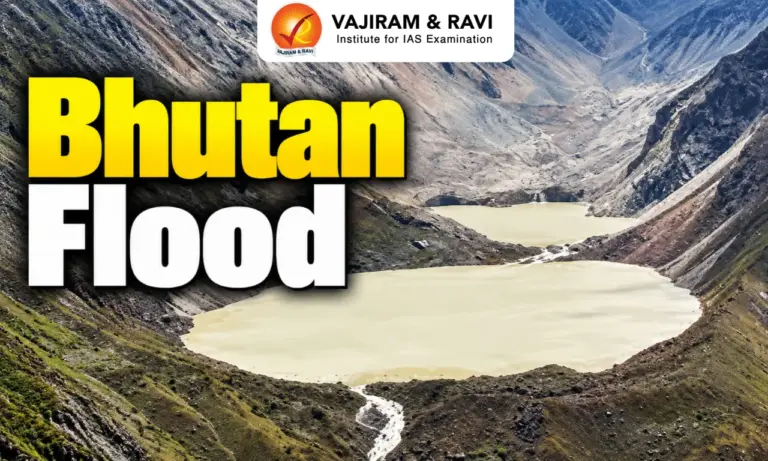
The Bhutan Flood incident of October 2026 highlights the growing vulnerability of Himalayan regions to climate induced disasters. A Glacial Lake Outburst Flood (GLOF) at Shintaphu Lake in Bhutan triggered flood warnings in parts of West Bengal and Assam. The event has raised concerns about downstream river systems, vulnerable settlements, hydropower infrastructure and the need for effective transboundary disaster management in the Himalayan region.
Bhutan Flood Latest News
On 30 October 2026, a Glacial Lake Outburst at Shintaphu Lake in Bhutan’s Gasa district triggered flood alerts in northern West Bengal and Assam. Authorities initiated evacuations in vulnerable settlements along the Sankosh River. Nearly 7.4 million cubic metres of water reportedly escaped from the breached lake, raising concerns about a sudden increase in downstream river levels. Disaster response teams were placed on alert.
Bhutan Flood 2026
The Bhutan Flood 2026 originated in the Himalayan region, with potential downstream consequences for settlements and infrastructure in India.
- Location: The GLOF occurred at Shintaphu Lake in the Lemthang region of Bhutan’s Gasa district. The lake is situated at the source of the Mo Chhu River.
- Vulnerable Glacial Lake: Shintaphu Lake is among Bhutan’s 17 potentially dangerous glacial lakes. Its geographical position makes a sudden release of accumulated water a potential threat to downstream settlements.
- River System Involved: Floodwater entered the Mo Chhu River, also called Mofu, which connects with the Sankosh River system. The Sankosh subsequently flows into the Brahmaputra River in Assam.
- Affected Areas: In India, Alipurduar and Jalpaiguri in West Bengal, parts of Darjeeling hills and Dhubri in Assam were identified as vulnerable to downstream flooding.
- Flood Movement: The floodwater crossed Srigang in Kabesa Gewog, around eight kilometres from Punakha Dzong. Authorities estimated that the surge could reach Indian border areas within six to eight hours.
- Evacuation Measures: Residents of vulnerable riverbank villages were instructed to move to safer locations. Loudspeaker announcements were made in settlements under Rampur I gram panchayat to facilitate evacuation.
- Infrastructure Damage: The flood damaged facilities at Gasa Tshachu hot spring and partially affected a solar irrigation lifting system in Punakha. Debris also covered a section of the Punakha-Gasa Highway.


Bhutan Flood Impacts
The Bhutan Glacial Flood 2026 demonstrates how disasters originating beyond national boundaries can affect downstream populations, economic infrastructure and river management.
- Impact on Bhutan: The sudden flood damaged tourism related facilities at Gasa Tshachu, affected irrigation infrastructure and deposited debris along the Punakha-Gasa Highway, disrupting local activities.
- Impact on West Bengal: Alipurduar and neighbouring vulnerable areas faced the possibility of inundation. Residents along the Sankosh riverbanks were advised to evacuate as a precautionary measure.
- Impact on Assam: Dhubri district was placed on alert because of the possibility of a sudden rise in Sankosh River water levels, creating risks for downstream settlements.
- Hydropower Infrastructure: The flood raised concerns about the Punatsangchhu hydropower project, an important India-Bhutan joint venture exposed to sudden changes in river discharge.
- Disaster Management Challenges: The incident highlights the difficulty of managing transboundary floods, as water released in one country can reach another within a few hours.
- Ecological and Human Risks: Such events can cause loss of life, displacement, agricultural damage, erosion and destruction of transport infrastructure, particularly in fragile Himalayan river valleys.
Bhutan Flood Management
Managing a Bhutan Glacial Lake Outburst Flood requires early warnings, coordinated evacuation, scientific monitoring and cooperation between upstream and downstream authorities.
- Early Warning Systems: Continuous monitoring of potentially dangerous glacial lakes and downstream river levels can provide authorities with sufficient time to issue warnings and organise evacuations.
- Disaster Response Forces: The National Disaster Response Force (NDRF) and State Disaster Response Force (SDRF) should maintain readiness for evacuation, rescue and emergency relief operations.
- Transboundary Cooperation: India and Bhutan need effective information sharing mechanisms to communicate glacial lake conditions, sudden water releases and downstream flood risks.
- River Monitoring: Regular monitoring of the Sankosh River and its tributaries can help identify sudden changes in discharge and support timely precautionary measures.
- Infrastructure Safety: Hydropower projects, roads, bridges and settlements in vulnerable Himalayan valleys require proper risk assessments and disaster resilient construction practices.
- Community Preparedness: Public awareness, evacuation routes, designated shelters and local disaster response teams can reduce casualties during sudden flooding events.
What is Glacial Lake Outburst Flood (GLOF)?
A Glacial Lake Outburst Flood (GLOF) is a sudden release of accumulated water from a glacial lake following the failure of its natural dam.
- Formation of Glacial Lakes: These lakes develop when retreating glaciers leave behind depressions that collect meltwater. Ice, rocks and accumulated moraine deposits can act as natural barriers.
- Moraine-Dammed Lakes: Such lakes are particularly vulnerable because their natural dams consist of loose rocks, sediments and buried ice, making them structurally unstable.
- Climate Change: Rising temperatures accelerate glacier melting and retreat, increasing meltwater accumulation and contributing to the formation and expansion of potentially dangerous glacial lakes.
- Natural Triggers: Heavy rainfall, cloudbursts, earthquakes, avalanches and landslides can disturb natural lake barriers, resulting in the sudden release of enormous water volumes.
- Downstream Destruction: GLOFs generate powerful flood surges carrying water, rocks and debris. These can destroy settlements, roads, bridges, agricultural land and hydropower infrastructure.
- Himalayan Vulnerability: The Hindu Kush Himalayan region faces significant GLOF risks because of expanding glacial lakes, fragile mountain ecosystems and settlements located along downstream river valleys.

 Last updated on Oct, 2026
→ UPSC 2027 Notification will be released on 13 January 2027 at upsconline.nic.in.
→ Check Nobel Prize 2026 Winners List here.
→ Download PIB PRiSM Monthly Magazine 2026 here.
→ Check UPSC Monthly Current Affairs Magazine The Recitals here.
→ Check out the latest UPSC Syllabus here.
→ Download UPSC Model Answers for Mains 2026
→ UPSC Mains Question Paper 2026 is out now for Essay & GS Paper 1, 2, 3 & 4.
→ UPSC Calendar 2027 has been released.
→ Enroll in Vajiram & Ravi’s UPSC Mains Test Series 2027 for structured answer writing practice, expert evaluation, and exam-oriented feedback.
→ Join Vajiram & Ravi’s UPSC Mentorship Program 2027 for personalized guidance, strategy planning, and one-to-one support from experienced mentors.
→ Go through the UPSC Mains Previous Year Papers to enhance your preparation.
→ UPSC has released UPSC Toppers List 2025 with the Civil Services final result on its official website.
→ Also check Best UPSC Coaching in India
Bhutan Flood FAQs
Q1. What caused the Bhutan Flood in October 2026?+
Q2. Which lake caused the Bhutan Glacial Lake Outburst Flood?+
Q3. Which Indian states are affected by the Bhutan Flood?+
Q4. Why is the Sankosh River on alert during the Bhutan Flood 2026?+
Q5. What is the difference between a flash flood and a Glacial Lake Outburst Flood?+
Tags: bhutan bhutan flood flood