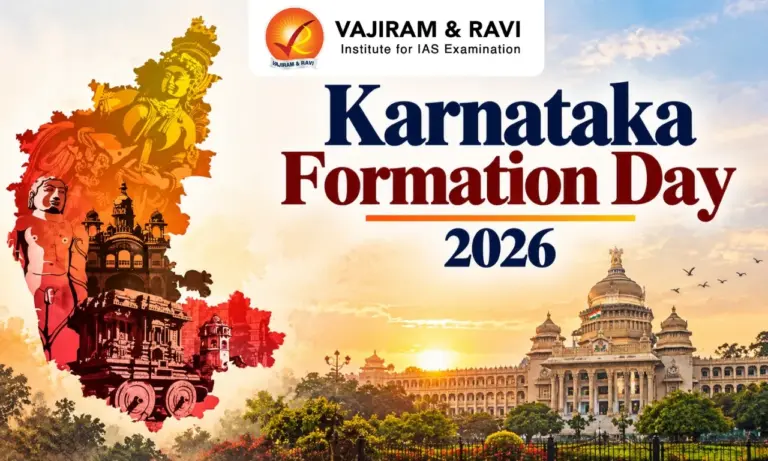
Karnataka marks the 70th anniversary of its formation in 2026, commemorating the integration of Kannada-speaking regions into a unified state in 1956. The occasion highlights an important phase in India’s post-Independence political history, particularly the reorganisation of states on
When is Karnataka Formation Day Celebrated?
Karnataka Formation Day, popularly known as Kannada Rajyotsava, is celebrated every year on 1 November. In 2026, Karnataka will mark its 70th anniversary, as the unified state was formed on 1 November 1956.
Why is Karnataka Formation Day Celebrated on 1 November?
Karnataka Formation Day is celebrated on 1 November because the States Reorganisation Act, 1956 came into effect on this date, bringing together Kannada-speaking regions from different administrative units to form the enlarged Mysore State.
Before 1956, Kannada-speaking regions were divided among several political and administrative units:
- The princely State of Mysore
- Bombay State
- Madras State
- Hyderabad State
- Coorg, which was a separate Part C State
Their integration on 1 November 1956 created a unified administrative unit for most Kannada-speaking regions. The state was initially named Mysore and was renamed Karnataka in 1973.


Historical Background, Karnataka Unification Movement
The demand for a unified Kannada-speaking state emerged from the desire to bring Kannada-speaking people and regions under a common administrative unit.
During British rule, Kannada-speaking areas were spread across different administrative territories. This division made it difficult to develop a common political and cultural identity.
The Karnataka Ekikarana (Unification) Movement gradually emerged to address this division. Aluru Venkata Rao was one of its prominent advocates and played an important role in mobilising support for the unification of Kannada-speaking regions.
The movement gained wider public and political support over time and contributed to the demand for linguistic reorganisation of states after Independence.
States Reorganisation Act, 1956: Formation of Mysore State
The demand for linguistic states gained momentum after the formation of Andhra State in 1953. This led the Union Government to establish the States Reorganisation Commission (SRC) to examine the reorganisation of Indian states.
States Reorganisation Commission (1953-1955)
The Commission was constituted on 29 December 1953, under the chairmanship of Justice Fazl Ali. Its other members were:
- H.N. Kunzru
- K.M. Panikkar
The Commission submitted its report in 1955. It examined linguistic, administrative, economic and national considerations while recommending the reorganisation of states.
States Reorganisation Act, 1956
Parliament enacted the States Reorganisation Act, 1956 on 31 August 1956. It came into effect on 1 November 1956.
Under Section 7, the enlarged Mysore State was formed by integrating:
- The existing Mysore State.
- Kannada-speaking districts of the erstwhile Bombay State, including Belgaum, Bijapur, Dharwar and North Kanara.
- Kannada-speaking areas of the erstwhile Hyderabad State, including Bidar, Gulbarga and Raichur.
- South Kanara district (excluding Kasaragod) and Kollegal taluk from the erstwhile Madras State.
- The former Coorg State.
Bellary district had already been transferred to Mysore State following the formation of Andhra State in 1953.
Why was Mysore State renamed Karnataka in 1973?
Although the unified state was formed in 1956, it initially retained the name Mysore, which was associated with the erstwhile princely state.
The demand for renaming the state grew to reflect the identity of all Kannada-speaking regions rather than only the historical Mysore region.
The Mysore Legislative Assembly and Legislative Council passed resolutions in 1972 recommending the change of name. Parliament subsequently enacted the Mysore State (Alteration of Name) Act, 1973.
The name Karnataka came into effect on 1 November 1973, during the tenure of Chief Minister Devaraj Urs.
Constitutional provisions related to the formation of states in India
The formation of Karnataka is an important example of Parliament’s power to reorganise states under the Constitution.
Article 3 – Formation of New States and Alteration of Boundaries
Article 3 empowers Parliament to:
- Form a new state by separating territory from an existing state or by merging territories.
- Increase or reduce the area of a state.
- Alter the boundaries of a state.
- Change the name of a state.
A Bill under Article 3 requires the President’s recommendation. If it affects a state’s area, boundaries or name, the President refers it to the concerned State Legislature for its views. However, Parliament is not bound by those views.
Article 4 – Supplemental Provisions
A law passed under Articles 2 and 3 may amend the First and Fourth Schedules of the Constitution and include related provisions. Such a law is not treated as a constitutional amendment under Article 368.
How is Karnataka Formation Day Celebrated?
Karnataka Formation Day is celebrated through official ceremonies and cultural programmes organised by the state government and Kannada-speaking communities.
Major observances include:
- Rajyotsava Awards: The Karnataka Government recognises individuals for their contributions to the state and Kannada culture.
- Cultural programmes: Events showcase Kannada literature, music, folk traditions and regional heritage.
- State anthem: Jaya Bharata Jananiya Tanujate, written by Kuvempu, is sung during celebrations.
- Public participation: Educational institutions, government offices and Kannada associations organise programmes to mark the occasion.
Karnataka Formation Day Significance
Karnataka Formation Day represents an important phase in the evolution of Indian federalism.
- Linguistic identity: It recognises the demand of Kannada-speaking people for a common administrative unit.
- Linguistic reorganisation: It demonstrates how language became an important consideration in reorganising Indian states after Independence.
- National integration: The unification brought historically and administratively diverse regions together within the Indian Union.
- Federal accommodation: It highlights how regional aspirations can be accommodated through constitutional and democratic processes.
The formation of Karnataka illustrates that linguistic diversity can be accommodated within a unified constitutional and political system.

 Last updated on Oct, 2026
→ UPSC 2027 Notification will be released on 13 January 2027 at upsconline.nic.in.
→ Check Nobel Prize 2026 Winners List here.
→ Download PIB PRiSM Monthly Magazine 2026 here.
→ Check UPSC Monthly Current Affairs Magazine The Recitals here.
→ Check out the latest UPSC Syllabus here.
→ Download UPSC Model Answers for Mains 2026
→ UPSC Mains Question Paper 2026 is out now for Essay & GS Paper 1, 2, 3 & 4.
→ UPSC Calendar 2027 has been released.
→ Enroll in Vajiram & Ravi’s UPSC Mains Test Series 2027 for structured answer writing practice, expert evaluation, and exam-oriented feedback.
→ Join Vajiram & Ravi’s UPSC Mentorship Program 2027 for personalized guidance, strategy planning, and one-to-one support from experienced mentors.
→ Go through the UPSC Mains Previous Year Papers to enhance your preparation.
→ UPSC has released UPSC Toppers List 2025 with the Civil Services final result on its official website.
→ Also check Best UPSC Coaching in India
Karnataka Formation Day 2026 FAQs
Q1. When is Karnataka Formation Day celebrated?+
Q2. Why is Karnataka Formation Day celebrated on 1 November?+
Q3. When was Mysore State renamed Karnataka?+
Q4. Which Act led to the formation of Karnataka in 1956?+
Q5. Who chaired the States Reorganisation Commission?+
Tags: karnataka day karnataka formation day karnataka formation day 2026