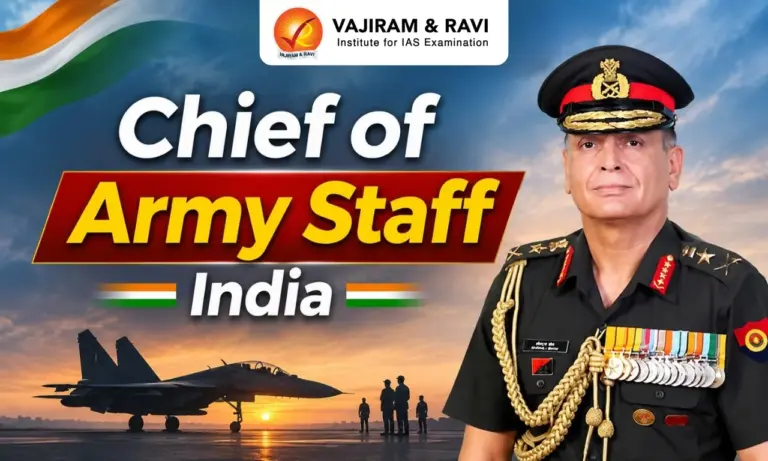
Chief of Army Staff of India is the highest-ranking serving officer and professional head of the Indian Army. The Army Chief is responsible for military operations, national security preparedness, training, administration and modernisation of the Army. The COAS holds the rank of a four-star General and works under the Ministry of Defence, providing military advice to the Government of India. As of November 2026, General Dhiraj Seth is serving as the 31st Chief of Army Staff, having taken charge on June 30, 2026, after the retirement of General Upendra Dwivedi.
Who is the Chief of Army Staff (COAS) of India?
The Chief of Army Staff (COAS) is the professional head of the Indian Army and is responsible for its overall command, administration and operational preparedness. The Army Chief plays an important role in protecting India’s territorial integrity, maintaining military readiness and advising the government on Army-related defence matters.
- Highest-ranking Army officer: The COAS is a four-star General and holds the highest regular military rank in the Indian Army. The position carries responsibility for the Army’s overall functioning and operational effectiveness.
- Supreme Commander: Under Article 53 of the Indian Constitution, the supreme command of India’s Defence Forces is vested in the President of India. However, the COAS exercises professional military leadership within the civilian-controlled defence structure.
- Headquarters: The Chief of Army Staff operates from Army Headquarters in New Delhi, where major decisions concerning military operations, personnel, training and capability development are coordinated.
- Military leadership: The COAS oversees the Army’s operational commands, training institutions and administrative structures. The officer is supported by the Vice Chief of Army Staff and other senior military officials.
- Historical background: After Independence, the head of the Indian Army was known as the Commander-in-Chief. The designation subsequently evolved, and the Commanders-in-Chief (Change in Designation) Act, 1955, established the title Chief of the Army Staff.
- Role in national security: The Army Chief helps ensure that the Indian Army remains prepared to respond to external threats, border tensions, armed conflicts and other responsibilities assigned by the government.
Current Chief of Army Staff of India 2026
General Dhiraj Seth is the current Army Chief. He took over as the 31st COAS in a ceremony at the South Block Lawns in New Delhi, succeeding General Upendra Dwivedi, who retired. The handover took place on 30 June 2026.
- Previous post: He had been the Vice Chief of the Army Staff since April 2026.
- Background: He studied at the National Defence Academy (NDA), Khadakwasla, and was commissioned into the Armoured Corps in December 1986. His career spans nearly four decades.
- A notable first: He is the first Armoured Corps officer to lead the Army since General Shankar Roy Chowdhury retired in 1997.
- Commands held: He has led an Armoured Regiment in the Desert Sector, an Armoured Brigade in the Western Theatre and a counter-insurgency force in Jammu and Kashmir. As a Lieutenant General he commanded the Sudarshan Chakra Corps (21 Corps), one of the Army’s main strike formations. He was also GOC, Delhi Area.
- Army Commander: He headed both South Western Command and Southern Command over about two and a half years, which is a rare distinction.
- Education: He is a graduate of the Higher Command Course and the National Defence College, and he attended the Command and Staff Course in Paris.
- Predecessor: General Upendra Dwivedi was the 30th COAS. He retired on the same day after more than four decades of service.


Appointment, Eligibility and Tenure of the Chief of Army Staff
The Chief of Army Staff in India is appointed through a government selection process that considers seniority, military experience, professional competence and operational requirements. The appointment follows India’s constitutional system of civilian control over the armed forces.
- Appointing authority: The President of India formally appoints the Army Chief, acting under the constitutional framework of the Union government. The selection is approved by the Appointments Committee of the Cabinet (ACC).
- Role of the ACC: The ACC consists of the Prime Minister and Union Home Minister. It considers senior military appointments, including the selection of the Chief of Army Staff.
- Eligibility criteria: The Army Chief is generally selected from senior serving Lieutenant Generals who possess extensive military command, operational and administrative experience. There is no single fixed statutory requirement that the senior-most officer must always be appointed.
- Selection process: Seniority is an important consideration, but the government may also evaluate professional performance, leadership ability, strategic experience and suitability for the position.
- Rank on appointment: An officer appointed as COAS holds the rank of a four-star General, making the individual the professional head of the Indian Army.
- Tenure of Army Chief: The normal tenure is three years or until the age of 62 years, whichever is earlier, subject to applicable service rules and government decisions.
- Legal framework: The appointment and service conditions operate within the constitutional framework, the Army Act, 1950, the Army Rules, 1954, and relevant government regulations and executive procedures.
- Civilian control: Although the COAS heads the Army professionally, important defence policy decisions remain under the civilian government, ensuring democratic oversight of the armed forces.
Powers and Responsibilities of the Chief of Army Staff
The Chief of Army Staff (COAS) oversees the Indian Army’s operational readiness, military planning, administration, modernisation and personnel management. The officer also provides professional military advice to the government and works with other defence authorities to strengthen national security.
- Operational command and control: The Army Chief exercises professional command over the Indian Army through its command structure. This includes overseeing operational formations and ensuring they remain prepared for military missions.
- National security and defence preparedness: The COAS monitors security challenges, military capabilities and operational requirements to help protect India’s borders and territorial integrity.
- Strategic planning and military advice: The Army Chief advises the Ministry of Defence and senior government leadership on Army-related military operations, security threats, force requirements and defence preparedness.
- Training and combat readiness: The COAS oversees military training, operational exercises and professional development to ensure that soldiers and officers are prepared for conventional and emerging security challenges.
- Modernisation and capability development: The Army Chief helps guide the introduction of advanced weapons, surveillance systems, military technology and modern equipment to improve combat effectiveness.
- Personnel management and discipline: The COAS supervises major policies concerning Army personnel, including training, career development, discipline, welfare and professional standards.
- Coordination with other armed forces: The Army Chief works with the Chief of Defence Staff (CDS), Chief of Naval Staff and Chief of Air Staff to strengthen joint planning and cooperation among the three services.
- Disaster response and emergency support: When directed by the government, the Indian Army assists civilian authorities during natural disasters, rescue operations and major emergencies. The COAS helps ensure that military formations remain prepared for such responsibilities.
- Resource management and future planning: The Army Chief helps identify long-term manpower, infrastructure, equipment and operational requirements, contributing to the Army’s transformation into a technologically advanced force.
List of Chiefs of Army Staff of India (1947-2026)
The list of Indian Army Chiefs from 1947 to 2026 reflects the evolution of the Indian Army’s leadership since Independence. The Army was initially headed by British Commanders-in-Chief before General K. M. Cariappa became the first Indian Commander-in-Chief on January 15, 1949. Since then, several distinguished military leaders have guided the Army through wars, security challenges and modernisation programmes.
Commanders-in-Chief of the Indian Army (1947-1949)
The Commanders-in-Chief of the Indian Army from 1947 to 1949 are listed below:
| Commanders-in-Chief of the Indian Army (1947-1949) | |
|
Name |
Tenure |
|
General Sir Robert Lockhart |
15 August 1947 – 31 December 1947 |
|
General Sir Roy Bucher |
1 January 1948 – 14 January 1949 |
Complete List of Indian Army Chiefs (1949-2026)
The of Chiefs of Army Staff of India ,from 1949 to 2026
| Complete List of Indian Army Chiefs (1949-2026) | ||
|
No. |
Chief of Army Staff |
Tenure |
|
1 |
General K. M. Cariappa (later Field Marshal) |
1949-1953 |
|
2 |
General K. S. Rajendrasinhji |
1953-1955 |
|
3 |
General S. M. Shrinagesh |
1955-1957 |
|
4 |
General K. S. Thimayya |
1957-1961 |
|
5 |
General P. N. Thapar |
1961-1962 |
|
6 |
General J. N. Chaudhuri |
1962-1966 |
|
7 |
General P. P. Kumaramangalam |
1966-1969 |
|
8 |
General S. H. F. J. Manekshaw (later Field Marshal) |
1969-1973 |
|
9 |
General G. G. Bewoor |
1973-1975 |
|
10 |
General T. N. Raina |
1975-1978 |
|
11 |
General O. P. Malhotra |
1978-1981 |
|
12 |
General K. V. Krishna Rao |
1981-1983 |
|
13 |
General A. S. Vaidya |
1983-1986 |
|
14 |
General K. Sundarji |
1986-1988 |
|
15 |
General V. N. Sharma |
1988-1990 |
|
16 |
General S. F. Rodrigues |
1990-1993 |
|
17 |
General B. C. Joshi |
1993-1994 |
|
18 |
General Shankar Roychowdhury |
1994-1997 |
|
19 |
General V. P. Malik |
1997-2000 |
|
20 |
General S. Padmanabhan |
2000-2002 |
|
21 |
General N. C. Vij |
2003-2005 |
|
22 |
General J. J. Singh |
2005-2007 |
|
23 |
General Deepak Kapoor |
2007-2010 |
|
24 |
General V. K. Singh |
2010-2012 |
|
25 |
General Bikram Singh |
2012-2014 |
|
26 |
General Dalbir Singh Suhag |
2014-2016 |
|
27 |
General Bipin Rawat |
2016-2019 |
|
28 |
General Manoj Mukund Naravane |
2019-2022 |
|
29 |
General Manoj Pande |
2022-2024 |
|
30 |
General Upendra Dwivedi |
2024-2026 |
|
31 |
General Dhiraj Seth |
30 June 2026 – Present |
Difference Between Chief of Army Staff (COAS) and Chief of Defence Staff (CDS)
The Chief of Army Staff (COAS) and Chief of Defence Staff (CDS) are two important senior military positions in India. While the COAS is responsible for leading the Indian Army, the CDS focuses on improving coordination, planning and integration among the Army, Navy and Air Force. Their key differences are discussed below:
|
Basis |
Chief of Army Staff (COAS) |
Chief of Defence Staff (CDS) |
|
Position |
Professional head of the Indian Army |
Senior military officer responsible for tri-service coordination |
|
Primary responsibility |
Army leadership, operations, administration and preparedness |
Jointness, integration and coordination among the three services |
|
Scope |
Indian Army |
Army, Navy and Air Force |
|
Rank |
Four-star General |
Four-star General or equivalent |
|
Military command |
Exercises command through the Army’s command structure |
Does not directly command the three individual service forces |
|
Advisory role |
Advises the government on Army-specific matters |
Principal military adviser to the Defence Minister on tri-service matters |
|
Departmental role |
Heads the Army’s professional leadership |
Heads the Department of Military Affairs (DMA) |
|
Tenure |
Normally 3 years or age 62, whichever is earlier |
Retirement age up to 65 years; no fixed three-year tenure prescribed |
|
Current officeholder (2026) |
General Dhiraj Seth |
General N. S. Raja Subramani |

 Last updated on Nov, 2026
→ UPSC 2027 Notification will be released on 13 January 2027 at upsconline.nic.in.
→ Check Nobel Prize 2026 Winners List here.
→ Download PIB PRiSM Monthly Magazine 2026 here.
→ Check UPSC Monthly Current Affairs Magazine The Recitals here.
→ Check out the latest UPSC Syllabus here.
→ Download UPSC Model Answers for Mains 2026
→ UPSC Mains Question Paper 2026 is out now for Essay & GS Paper 1, 2, 3 & 4.
→ UPSC Calendar 2027 has been released.
→ Enroll in Vajiram & Ravi’s UPSC Mains Test Series 2027 for structured answer writing practice, expert evaluation, and exam-oriented feedback.
→ Join Vajiram & Ravi’s UPSC Mentorship Program 2027 for personalized guidance, strategy planning, and one-to-one support from experienced mentors.
→ Go through the UPSC Mains Previous Year Papers to enhance your preparation.
→ UPSC has released UPSC Toppers List 2025 with the Civil Services final result on its official website.
→ Also check Best UPSC Coaching in India
Chief of Army Staff of India FAQs
Q1. Who is the current Chief of Army Staff of India in 2026?+
Q2. Who appoints the Chief of Army Staff in India?+
Q3. What is the tenure of the Chief of Army Staff in India?+
Q4. Who was the first Indian Chief of Army Staff?+
Q5. What are the main powers and responsibilities of the Chief of Army Staff?+
Q6. What is the difference between the Chief of Army Staff (COAS) and Chief of Defence Staff (CDS)?+
Q7. Which constitutional article deals with the supreme command of the Indian Armed Forces?+
Tags: army staff of india chief of army staff of india