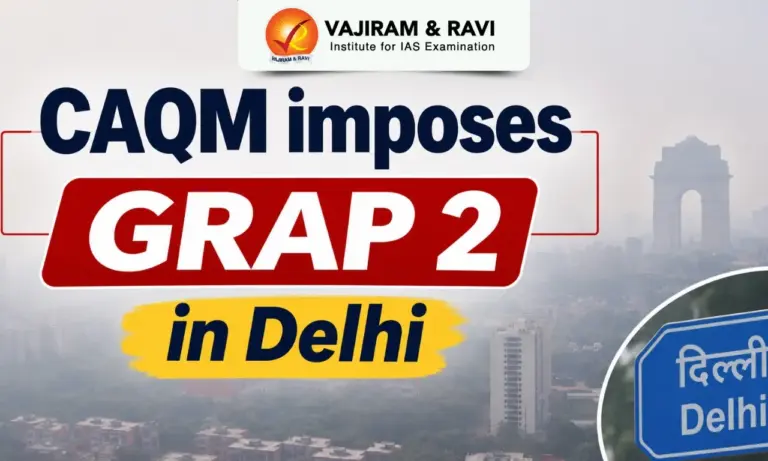
The Commission for Air Quality Management (CAQM) invoked Stage II of the Graded Response Action Plan (GRAP) across Delhi-NCR on November 2, 2026, with immediate effect, after Delhi’s Air Quality Index (AQI) reached 324, entering the Very Poor category for the first time this season. The decision aims to strengthen pollution-control measures and prevent further deterioration in air quality.
Why Was GRAP Stage 2 Invoked in Delhi?
Delhi’s air quality deteriorated sharply over three consecutive days, prompting the Commission for Air Quality Management (CAQM) to activate the second stage of GRAP.
- Delhi’s AQI increased from 117 (Moderate) on October 31 to 261 (Poor) on November 1 and 324 (Very Poor) on November 2, 2026.
- Unfavourable meteorological conditions contributed to the accumulation of pollutants, leading to a deterioration in air quality.
- The India Meteorological Department (IMD) and the Indian Institute of Tropical Meteorology (IITM) forecast that air quality was likely to remain in the Very Poor category over the coming days.
- Following a review of the prevailing air quality and weather forecasts, the CAQM’s GRAP Sub-Committee directed the immediate implementation of Stage I and Stage II measures across the entire National Capital Region (NCR).
What is GRAP Stage 2?
GRAP Stage 2 is the second level of emergency pollution-control measures under the Graded Response Action Plan (GRAP). It is activated when the AQI in Delhi-NCR enters the Very Poor category (301-400). It focuses on intensifying dust suppression, reducing vehicular emissions and discouraging the use of private vehicles.
- It is implemented under the direction of the Commission for Air Quality Management (CAQM).
- It applies across Delhi and the concerned National Capital Region (NCR) areas.
- Measures under GRAP Stage 1 continue alongside Stage 2.
- It introduces additional measures to control road dust, vehicular emissions and other sources of pollution.


Key measures under GRAP 2
Under Stage 2, authorities across Delhi-NCR are directed to intensify measures to control road dust, vehicular emissions and other pollution sources.
- Mechanical Road Cleaning: Daily mechanical or vacuum sweeping of identified roads, particularly during night and early morning hours.
- Water Sprinkling: Regular sprinkling of water mixed with dust suppressants on roads, especially at traffic congestion points and heavy-traffic corridors.
- Pollution Hotspots: Targeted pollution-control measures at identified hotspots across Delhi-NCR.
- Construction-Site Monitoring: Increased inspections of construction and demolition (C&D) sites to ensure compliance with dust-control norms.
- Higher Parking Charges: Increased parking fees to discourage the use of private vehicles.
- Public Transport: State governments are directed to increase the frequency of Metro, Regional Rapid Transit System (RRTS), and CNG and electric bus services.
- Staggered Office Timings: Government offices and municipal bodies in Delhi, Gurugram, Faridabad, Ghaziabad and Gautam Buddha Nagar are directed to introduce staggered working hours.
- Electric Heaters: Resident Welfare Associations (RWAs) are required to provide electric heaters to security, sanitation and other outdoor staff to prevent the burning of biomass and waste for warmth.
Also Read:-Delhi Air Pollution 2026
What should citizens do during GRAP Stage 2?
The CAQM has also issued an advisory encouraging citizens to reduce activities that contribute to air pollution.
- Use public transport, carpool or share private vehicles wherever possible.
- Avoid unnecessary use of personal vehicles and switch off engines at traffic signals.
- Maintain vehicles properly and keep valid Pollution Under Control (PUC) certificates.
- Avoid open burning of garbage, leaves, biomass and other waste.
- Avoid dust-generating construction activities during the winter pollution season.
- Prefer less congested routes to reduce vehicular emissions.
- Limit the use of diesel generator sets.
- Work from home wherever possible, depending on the nature of employment.
What is the Graded Response Action Plan (GRAP)?
The Graded Response Action Plan (GRAP) is a set of emergency pollution-control measures implemented in Delhi-NCR to prevent further deterioration in air quality. It was first notified in 2017 and is implemented under the direction of the Commission for Air Quality Management (CAQM).
The plan classifies air pollution into four stages based on the Air Quality Index (AQI).
|
Stage |
AQI Category |
AQI Range |
|
GRAP 1 |
Poor |
201-300 |
|
GRAP 2 |
Very Poor |
301-400 |
|
GRAP 3 |
Severe |
401-450 |
|
GRAP 4 |
Severe+ |
Above 450 |
Measures under the earlier stages continue when a higher stage is invoked.
What is the Commission for Air Quality Management (CAQM)?
The Commission for Air Quality Management (CAQM) is a statutory body established under the Commission for Air Quality Management in National Capital Region and Adjoining Areas Act, 2021.
- It coordinates and monitors measures to prevent and control air pollution in Delhi-NCR and adjoining areas.
- It issues directions to state governments and other authorities for controlling air pollution.
- It coordinates with the Central Pollution Control Board (CPCB), State Pollution Control Boards (SPCBs) and other agencies.
- It can impose restrictions on industrial activities, construction, transportation and other pollution-generating activities.

 Last updated on Nov, 2026
→ UPSC 2027 Notification will be released on 13 January 2027 at upsconline.nic.in.
→ Check Nobel Prize 2026 Winners List here.
→ Download PIB PRiSM Monthly Magazine 2026 here.
→ Check UPSC Monthly Current Affairs Magazine The Recitals here.
→ Check out the latest UPSC Syllabus here.
→ Download UPSC Model Answers for Mains 2026
→ UPSC Mains Question Paper 2026 is out now for Essay & GS Paper 1, 2, 3 & 4.
→ UPSC Calendar 2027 has been released.
→ Enroll in Vajiram & Ravi’s UPSC Mains Test Series 2027 for structured answer writing practice, expert evaluation, and exam-oriented feedback.
→ Join Vajiram & Ravi’s UPSC Mentorship Program 2027 for personalized guidance, strategy planning, and one-to-one support from experienced mentors.
→ Go through the UPSC Mains Previous Year Papers to enhance your preparation.
→ UPSC has released UPSC Toppers List 2025 with the Civil Services final result on its official website.
→ Also check Best UPSC Coaching in India
CAQM Imposes GRAP Stage 2 in Delhi NCR FAQs
Q1. Why did CAQM impose GRAP Stage 2 in Delhi in November 2026?+
Q2. What is the AQI range for GRAP Stage 2?+
Q3. Which authority implements GRAP in Delhi-NCR?+
Q4. Does GRAP Stage 2 impose a complete ban on construction activities?+
Q5. Do GRAP Stage 1 measures continue under GRAP Stage 2?+
Tags: grap stage 2 grap-2