


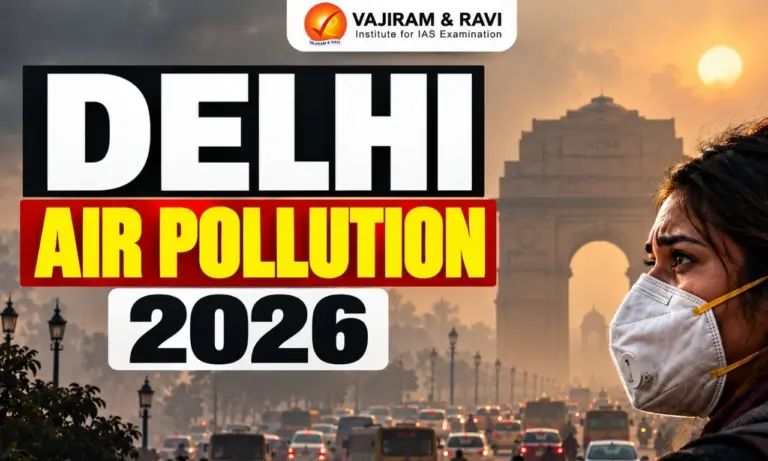
Delhi Air Pollution remains a major environmental challenge in 2026, with pollution coming from multiple sources such as vehicles, road and construction dust, industries, waste burning, biomass burning and regional sources. The focus of air-quality management has increasingly shifted from emergency action during severe pollution episodes to advance planning, source-specific control and year-round monitoring.
In 2026, the government introduced several measures under the Proactive Winter Air Quality Management Framework and strengthened coordination among Delhi, NCR states and central agencies. The latest review held in September 2026 also outlined targeted measures for hotspots, vehicles, dust, waste burning, public transport, industries and green areas.
What is Delhi Air Pollution?
Delhi air pollution refers to the presence of harmful gases and particulate matter in the atmosphere of Delhi at concentrations that can affect human health, ecosystems and overall quality of life.
Among different pollutants, PM2.5 is particularly important because these very small particles can penetrate deep into the respiratory system.
A 2026 assessment by the Commission for Air Quality Management (CAQM) identified PM2.5 as the dominant pollutant affecting Delhi’s AQI. It also highlighted that Delhi’s pollution is influenced by both local emissions and pollution transported across the wider NCR airshed.
Major Sources of Air Pollution in Delhi
Delhi’s air pollution cannot be attributed to a single source. Different sources become more important during different seasons.
1. Vehicular Emissions
Vehicles release PM2.5, nitrogen oxides and other pollutants, with traffic congestion and older vehicles increasing emissions.
- Road traffic: Cars, buses, trucks and two-wheelers are major contributors.
- Traffic congestion: Idling and slow-moving vehicles increase emissions.
- Diesel vehicles: Heavy-duty diesel vehicles can contribute significantly to particulate and nitrogen oxide emissions.
- Older vehicles: Vehicles with outdated emission standards generally produce higher emissions.
2. Road Dust
Dust from roads and unpaved surfaces becomes airborne due to vehicle movement, construction activity and wind.
- Resuspended dust: Moving vehicles lift settled dust into the atmosphere.
- Unpaved surfaces: Exposed soil and road edges generate additional dust.
- Poorly maintained roads: Damaged surfaces can increase dust generation.
- Mechanical sweeping: Road sweeping and dust-control measures are used to reduce resuspended particles.
3. Construction and Demolition Activities
Construction and demolition generate large quantities of dust and particulate matter, particularly when dust-control measures are inadequate.
- Construction dust: Excavation, drilling and material handling release particles.
- Demolition: Breaking and removing structures can generate significant dust.
- Construction materials: Cement, sand and other loose materials can become airborne.
- C&D waste: Poor handling and transportation of construction and demolition waste can add to particulate pollution.
4. Biomass and Crop-Residue Burning
Biomass and crop-residue burning in Delhi and surrounding regions can increase particulate pollution, particularly during the winter season.
- Crop-residue burning: Smoke from agricultural fields can enter the NCR airshed.
- Biomass burning: Burning of wood and other biomass releases particulate matter.
- Seasonal impact: Its contribution can become more significant during winter pollution episodes.
- Regional transport: Pollutants can travel across state boundaries depending on wind conditions.
5. Industrial Emissions
Industrial activities can release particulate matter, nitrogen oxides, sulphur compounds and other pollutants into the atmosphere.
- Industrial units: Emissions depend on the type of industry and fuel used.
- Thermal power plants: Power generation can contribute to particulate and gaseous emissions.
- Fuel combustion: Burning coal, oil or other fuels produces air pollutants.
- Emission-control systems: Poorly maintained or inadequate control systems can increase emissions.
6. Open Waste Burning
Burning municipal waste, garbage and other combustible materials in the open releases smoke, particulate matter and harmful gases.
- Garbage burning: Burning mixed waste releases multiple pollutants.
- Biomass burning: Leaves, wood and other organic waste can contribute to smoke.
- Local hotspots: Open burning can create concentrated pollution in residential and commercial areas.
- Enforcement: Zero-burning measures and field monitoring are used to prevent such activities.
7. Secondary Particulate Formation
Some PM2.5 is formed in the atmosphere when gases released from different sources undergo chemical reactions.
- Precursor gases: Pollutants from vehicles, industries and combustion contribute to secondary particle formation.
- Chemical reactions: Atmospheric gases can react to form fine particulate matter.
- Winter conditions: Atmospheric conditions can favour the accumulation of secondary particulates.
- Regional contribution: Secondary particles can originate from pollutants emitted across the wider NCR airshed.


Proactive Winter Air Quality Management Framework 2026-27
Proactive Winter Air Quality Management Framework 2026-27 is designed to control Delhi-NCR’s winter pollution through advance planning, preventive action and coordinated enforcement rather than waiting for air quality to deteriorate severely.
- The framework focuses on preventive measures before and during the winter pollution season, broadly covering the period from 1 November to 28 February.
- It works alongside the Graded Response Action Plan (GRAP) to strengthen preparedness and pollution control.
- The ‘No PUCC, No Fuel’ measure aims to prevent vehicles without a valid Pollution Under Control Certificate from purchasing fuel at designated fuel stations.
- Restrictions are planned on the entry of certain non-BS-VI commercial vehicles registered outside Delhi from 1 November 2026, with specified exemptions.
- Parking charges at authorised parking facilities are proposed to be doubled during the winter period to discourage excessive private vehicle use.
- Staggered office timings and work-from-home measures can be introduced to reduce traffic and commuting-related emissions during periods of poor air quality.
- Dust-generating demolition and outdoor civil construction activities face seasonal restrictions, along with stronger dust-control requirements at construction sites.
- Open burning of municipal waste, garbage and biomass is targeted through zero-burning measures, field monitoring and enforcement.
- The framework promotes public transport, electric vehicles and last-mile connectivity to reduce dependence on private vehicles.
Latest Delhi Air Pollution Measures in September 2026
In September 2026, the Centre and Delhi Government reviewed a time-bound strategy to control Delhi air pollution ahead of winter, focusing on vehicles, dust, construction, waste burning, industries and public transport.
- The ‘No PUCC, No Fuel’ measure will be implemented across 500 ANPR-enabled fuel stations to improve vehicle emission compliance.
- 42 pollution hotspots have been rectified, while 8 additional hotspots are targeted for completion by October 2026; 8 road stretches have also been made signal-free.
- Around 1,193 km of roads have been redeveloped, while the number of Mechanical Road Sweeping Machines has increased from 76 to 98 to control road dust.
- A ‘Zero Burning’ campaign will target open burning of municipal waste, garbage and biomass, supported by ward-level monitoring and enforcement.
- Delhi’s public transport fleet has reached 6,840 buses, including 5,088 electric buses, while last-mile connectivity is available at all 228 Metro stations.
- From 1 November 2026, certain non-BS-VI commercial vehicles registered outside Delhi will face entry restrictions, with specified exemptions for CNG and electric vehicles.
- Industrial pollution control will be strengthened through an AI-enabled Command and Control Centre, an increase in monitoring stations from 47 to 60, and 334 enforcement teams.
- The strategy also focuses on greening, construction-dust control, EV promotion, higher parking charges, citizen participation and NCR-level coordination to reduce pollution before and during the winter season.

 Last updated on Oct, 2026
→ UPSC 2027 Notification will be released on 13 January 2027 at upsconline.nic.in.
→ Check Nobel Prize 2026 Winners List here.
→ Download PIB PRiSM Monthly Magazine 2026 here.
→ Check UPSC Monthly Current Affairs Magazine The Recitals here.
→ Check out the latest UPSC Syllabus here.
→ Download UPSC Model Answers for Mains 2026
→ UPSC Mains Question Paper 2026 is out now for Essay & GS Paper 1, 2, 3 & 4.
→ UPSC Calendar 2027 has been released.
→ Enroll in Vajiram & Ravi’s UPSC Mains Test Series 2027 for structured answer writing practice, expert evaluation, and exam-oriented feedback.
→ Join Vajiram & Ravi’s UPSC Mentorship Program 2027 for personalized guidance, strategy planning, and one-to-one support from experienced mentors.
→ Go through the UPSC Mains Previous Year Papers to enhance your preparation.
→ UPSC has released UPSC Toppers List 2025 with the Civil Services final result on its official website.
→ Also check Best UPSC Coaching in India
Delhi Air Pollution 2026 FAQs
Q1. What are the major causes of Delhi air pollution?+
Q2. Why is Delhi air pollution worse during winter?+
Q3. What is the Proactive Winter Air Quality Management Framework?+
Q4. What is the 'No PUCC, No Fuel' rule?+
Q5. What is the role of CAQM in Delhi air pollution?+
Q6. What is AIRWISE?+
Tags: Delhi air pollution delhi air pollution 2026








