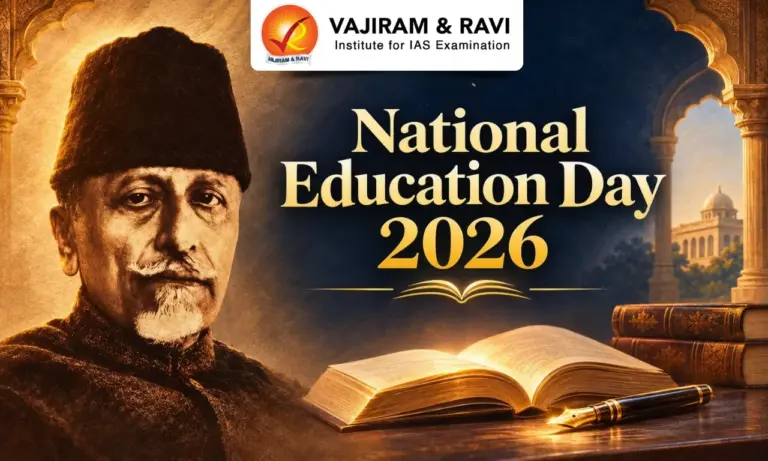
National Education Day 2026 is observed on 11 November 2026, on the birth anniversary of Maulana Abul Kalam Azad, the first Education Minister of independent India. The day recognises his contributions to India’s education system and highlights the importance of quality education, equal learning opportunities and literacy for all. The day has been celebrated every year since 2008, following an announcement by the Ministry of Human Resource Development (now the Ministry of Education). Schools, colleges and universities mark it with educational programmes, seminars, debates and awareness activities.
National Education Day 2026 Background
The history of National Education Day is closely connected with Maulana Abul Kalam Azad, who played an important role in shaping India’s education system after Independence. The day honours his efforts to promote education, scientific learning and the development of educational institutions.
- Establishment of National Education Day: On 11 September 2008, the Ministry of Human Resource Development (now the Ministry of Education) announced that 11 November would be observed every year as National Education Day to honour Maulana Abul Kalam Azad.
- First Celebration in 2008: The first National Education Day was celebrated on 11 November 2008. Since then, educational institutions across India have organised programmes to highlight the importance of education.
- Birth Anniversary of Maulana Abul Kalam Azad: The day marks the birth anniversary of Maulana Azad, who was born on 11 November 1888. He was a prominent freedom fighter, scholar, writer and educationist.
- India’s First Education Minister: Maulana Azad served as the first Education Minister of independent India from 1947 to 1958. During his tenure, he promoted primary education, higher education, technical learning and scientific research.
- Contribution to Higher Education: He played an important role in strengthening India’s higher education system and supporting institutions such as the University Grants Commission (UGC) and the Indian Institutes of Technology (IITs).
- Promotion of Cultural Institutions: He encouraged the development of institutions such as the Sahitya Akademi, Sangeet Natak Akademi, Lalit Kala Akademi and Indian Council for Cultural Relations (ICCR) to support India’s cultural and intellectual development.
- Recognition with Bharat Ratna: In recognition of his contributions to education, national development and the freedom struggle, Maulana Abul Kalam Azad was posthumously awarded the Bharat Ratna in 1992.
National Education Day 2026 Objectives
The main objective of National Education Day 2026 is to recognise the importance of education in national development and encourage equal access to learning opportunities. It also aims to keep alive the educational vision of Maulana Abul Kalam Azad, who believed that education was essential for the progress of every individual and society.
- Promote Universal Education: Encourage access to education for all children, particularly those from economically weaker sections, rural areas and disadvantaged communities.
- Improve Literacy and Awareness: Highlight the importance of literacy and encourage individuals of all ages to develop reading, writing and learning skills.
- Encourage Girls’ Education: Promote equal educational opportunities for girls and women, reflecting Maulana Azad’s belief that national development requires the participation of women.
- Strengthen Quality Education: Encourage improvements in teaching methods, educational infrastructure and learning resources to help students receive better education.
- Promote Scientific and Technical Education: Highlight the importance of science, technology, research and technical training in preparing students for modern challenges.
- Support Skill Development: Encourage vocational education and practical training to improve employability and prepare young people for different career opportunities.
- Spread Awareness About Educational Rights: Help students, parents and communities understand the importance of education and the need to remove social and economic barriers to learning.
- Promote International Educational Cooperation: Encourage collaboration between Indian and foreign educational institutions through internationalisation initiatives, academic exchanges and programmes such as Study in India.
- Honour Maulana Abul Kalam Azad’s Contributions: Remember his efforts to expand primary education, strengthen universities and promote scientific thinking in independent India.


Education in India
Education in India is supported by constitutional provisions, laws and government initiatives that aim to provide equal learning opportunities to every citizen. The Indian Constitution recognises education as a Fundamental Right for children aged 6 to 14 years and directs the government to promote accessible and inclusive education.
Over the years, several constitutional amendments, education policies and welfare programmes have been introduced to improve literacy, strengthen educational institutions and make quality education available to all sections of society.
Also Read:- Important Days in November 2026
Constitutional Provisions Related to Education in India
- Article 21A – Right to Education: Introduced through the 86th Constitutional Amendment Act, 2002, it guarantees free and compulsory education as a Fundamental Right for all children aged 6 to 14 years.
- Article 45 – Early Childhood Care and Education: Under the Directive Principles of State Policy (DPSP), it directs the State to provide early childhood care and education for children below six years of age.
- Article 39(f) – Protection of Children: Directs the State to ensure that children receive opportunities to develop in a healthy and dignified environment and are protected from exploitation and neglect.
- 42nd Constitutional Amendment Act, 1976: Shifted education from the State List to the Concurrent List, allowing both the Central and State Governments to make laws on education.
- 86th Constitutional Amendment Act, 2002: Besides introducing Article 21A, it revised Article 45 and added Article 51A(k), making it a Fundamental Duty of parents or guardians to provide educational opportunities to children aged 6 to 14 years.
- Article 46 – Educational Interests of Weaker Sections: Directs the State to promote the educational and economic interests of weaker sections, particularly Scheduled Castes (SCs) and Scheduled Tribes (STs).
Major Education Laws in India
- Right to Education (RTE) Act, 2009: Came into force on 1 April 2010 and provides free and compulsory elementary education to children aged 6 to 14 years, giving legal effect to Article 21A.
- 25% Reservation under the RTE Act: Section 12(1)(c) requires covered private unaided non-minority schools to reserve at least 25% of entry-level seats for children from economically weaker sections and disadvantaged groups.
- Equal Educational Opportunities: The RTE Act seeks to prevent discrimination against children from disadvantaged backgrounds and establishes standards relating to school infrastructure, teachers and elementary education.
Major Government Initiatives for Education in India
- National Policy on Education, 1986: Focused on educational equality, universal elementary education, women’s education, adult literacy and the use of technology in teaching, and supported initiatives such as Operation Blackboard and Navodaya Vidyalayas.
- Sarva Shiksha Abhiyan (SSA): Launched in 2001, it aimed to achieve universal elementary education by improving school infrastructure, providing educational resources and increasing enrolment among children aged 6 to 14 years.
- Mid-Day Meal Scheme: Introduced in 1995 to improve nutritional levels, encourage school attendance and reduce dropout rates. It now operates as PM POSHAN, providing nutritional support to eligible schoolchildren.
- Jawahar Navodaya Vidyalayas (JNVs): Introduced under the National Policy on Education, 1986, these residential schools provide quality education to talented students, particularly those from rural areas.
- Kendriya Vidyalayas (KVs): Established to provide quality education with a common curriculum, especially for children of transferable Central Government employees. The system predates the 1986 education policy.
- Information Technology in Education: The government has encouraged computers, digital classrooms, online learning platforms and technology-based teaching to improve educational access and learning outcomes.
- Samagra Shiksha Abhiyan: Introduced in 2018, it brought together Sarva Shiksha Abhiyan, Rashtriya Madhyamik Shiksha Abhiyan and Teacher Education programmes to improve education from pre-primary to senior secondary levels.
- National Education Policy (NEP) 2020: Focuses on inclusive and equitable education, foundational literacy, multidisciplinary learning, digital education, skill development and improving the overall quality of India’s education system.

 Last updated on Nov, 2026
→ UPSC 2027 Notification will be released on 13 January 2027 at upsconline.nic.in.
→ Check Nobel Prize 2026 Winners List here.
→ Download PIB PRiSM Monthly Magazine 2026 here.
→ Check UPSC Monthly Current Affairs Magazine The Recitals here.
→ Check out the latest UPSC Syllabus here.
→ Download UPSC Model Answers for Mains 2026
→ UPSC Mains Question Paper 2026 is out now for Essay & GS Paper 1, 2, 3 & 4.
→ UPSC Calendar 2027 has been released.
→ Enroll in Vajiram & Ravi’s UPSC Mains Test Series 2027 for structured answer writing practice, expert evaluation, and exam-oriented feedback.
→ Join Vajiram & Ravi’s UPSC Mentorship Program 2027 for personalized guidance, strategy planning, and one-to-one support from experienced mentors.
→ Go through the UPSC Mains Previous Year Papers to enhance your preparation.
→ UPSC has released UPSC Toppers List 2025 with the Civil Services final result on its official website.
→ Also check Best UPSC Coaching in India
National Education Day 2026 FAQs
Q1. When is National Education Day 2026 celebrated in India?+
Q2. Why is National Education Day celebrated in India?+
Q3. Who started National Education Day in India?+
Q4. What is the main objective of National Education Day 2026?+
Q5. What were Maulana Abul Kalam Azad's major contributions to education?+
Tags: national education day national education day 2026