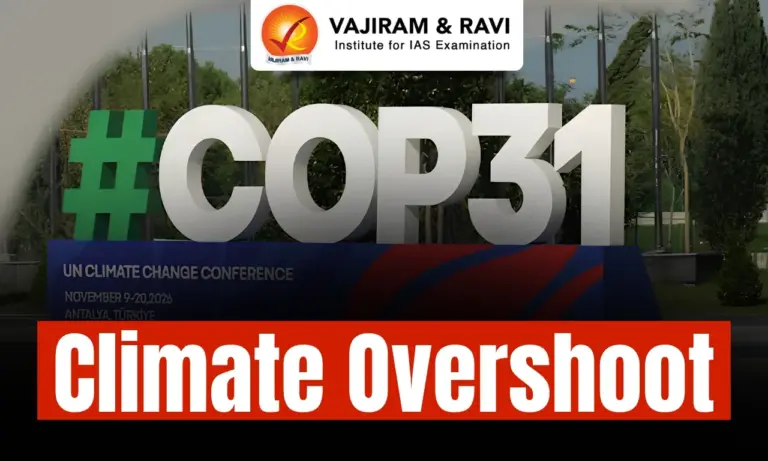
Climate Overshoot Latest News
- COP31 in Antalya, Turkey, has renewed debate over the concept of 1.5°C climate overshoot and the need for developed countries to fulfil their emissions-reduction and climate-finance commitments.
Understanding the 1.5°C Climate Overshoot
- The 2015 Paris Agreement aims to limit global warming to well below 2°C above pre-industrial levels while pursuing efforts to restrict it to 1.5°C.
- Climate overshoot refers to a situation in which global temperatures temporarily exceed the 1.5°C threshold before potentially returning to that level by the end of the century through large-scale carbon dioxide removal.
- The concept has gained prominence in climate negotiations. However, it raises concerns about whether future carbon-removal technologies and mitigation measures can realistically reverse the effects of excessive emissions.
- The central argument is that the possibility of returning to 1.5°C should not become an excuse for delaying immediate emissions reductions.


Developed Countries and Unfulfilled Climate Obligations
- Developed countries have historically contributed disproportionately to global greenhouse gas emissions. However, their domestic climate actions and financial commitments remain inadequate. Major Concerns include the following:
- Continued fossil-fuel dependence: Fossil fuels accounted for approximately 83% of primary energy consumption in the United States and 73% in the European Union in 2025.
- Expansion of fossil-fuel projects: Countries including the US, Norway, the UK, Germany, the Netherlands and Australia have continued approving oil and gas exploration or extraction projects.
- Inadequate climate finance: Although developed countries reported mobilising approximately $137 billion in climate finance in 2024, its estimated actual value was only $33–45 billion. Around 65% of public finance was provided as loans.
- Declining adaptation finance: Adaptation finance fell to $26 billion in 2023, against an estimated annual requirement of $310-365 billion by 2035.
- These developments highlight the gap between international climate commitments and their actual implementation.
Scientific and Economic Challenges of Climate Overshoot
- The United Nations Environment Programme (UNEP), in its report Limiting Overshoot: Navigating Exceedance of 1.5 Degrees Celsius and Pathways towards Return, examined the scale of carbon removal required to reverse temperature increases.
- The report highlighted that reversing just 0.1°C of warming would require permanently removing approximately 220 billion tonnes of CO₂ from the atmosphere.
- Current carbon-removal capacity remains inadequate:
- Natural systems, particularly forests and soils, remove approximately 2.2 billion tonnes of CO₂ annually.
- Direct air capture removes barely 2 million tonnes annually.
- Scaling up direct air capture could cost approximately $600 per tonne of CO₂ removed.
- Moreover, removing carbon dioxide from the atmosphere does not necessarily reverse all the climatic consequences caused by its original emission.
- This makes reliance on future carbon-removal technologies scientifically uncertain and economically challenging.
Climate Inequity and the Global South
- A major concern surrounding climate overshoot is the unequal distribution of its costs and responsibilities.
- Large-scale carbon removal requires land, forests and other natural resources. However, much of the land identified for carbon-removal projects is located in developing countries.
- Experts highlight that national climate pledges already rely on nearly 1.2 billion hectares of land for CO₂ removal, much of it in the Global South.
- This creates several concerns:
- Land-use conflicts: Land required for carbon-removal projects may compete with agriculture, food production and local livelihoods.
- Unequal responsibilities: Developed countries may outsource their emissions-reduction obligations through carbon credits and projects in developing countries.
- Development constraints: Carbon-removal projects may restrict the availability of land and natural resources needed for industrialisation.
- Biodiversity and indigenous rights: Large-scale land-use changes can affect ecosystems and communities dependent on forests and natural resources.
- The European Union’s Carbon Border Adjustment Mechanism (CBAM), covering sectors such as iron, steel, cement and aluminium, also raises concerns about the impact of unilateral climate-related trade measures on industrial development in the Global South.
Way Forward: Returning to the Basics of Climate Action
- Experts argue that COP31 must prioritise measurable climate commitments rather than relying on emerging narratives and future technological possibilities.
- Key priorities include:
- Immediate emissions reduction: Developed countries should undertake deep and sustained domestic emissions reductions and achieve net-zero well before 2050.
- Net-negative emissions: Countries with historically high emissions should pursue net-negative emissions within their own borders rather than relying excessively on developing countries’ forests and land.
- Predictable climate finance: Developing countries require grant-based public finance rather than loans or uncertain private investment commitments.
- Technology transfer: International negotiations must address intellectual property barriers that make clean technologies expensive for developing countries.
- Carbon-budget accountability: Countries should discuss the remaining global carbon budget and their respective historical contributions to emissions.
- Safeguards for overshoot pathways: Any proposed carbon-removal strategy must account for scientific uncertainty, technical feasibility, food security, biodiversity and indigenous communities.
- Article 9.1 of the Paris Agreement is particularly relevant, as it recognises the obligation of developed countries to provide financial resources to developing countries for mitigation and adaptation.
Source: TH

 Last updated on Nov, 2026
→ UPSC 2027 Notification will be released on 13 January 2027 at upsconline.nic.in.
→ Check Nobel Prize 2026 Winners List here.
→ Download PIB PRiSM Monthly Magazine 2026 here.
→ Check UPSC Monthly Current Affairs Magazine The Recitals here.
→ Check out the latest UPSC Syllabus here.
→ Download UPSC Model Answers for Mains 2026
→ UPSC Mains Question Paper 2026 is out now for Essay & GS Paper 1, 2, 3 & 4.
→ UPSC Calendar 2027 has been released.
→ Enroll in Vajiram & Ravi’s UPSC Mains Test Series 2027 for structured answer writing practice, expert evaluation, and exam-oriented feedback.
→ Join Vajiram & Ravi’s UPSC Mentorship Program 2027 for personalized guidance, strategy planning, and one-to-one support from experienced mentors.
→ Go through the UPSC Mains Previous Year Papers to enhance your preparation.
→ UPSC has released UPSC Toppers List 2025 with the Civil Services final result on its official website.
→ Also check Best UPSC Coaching in India
Climate Overshoot FAQs
Q1. What is climate overshoot?+
Q2. What is the global carbon budget?+
Q3. What is Article 9.1 of the Paris Agreement?+
Q4. What is direct air capture?+
Q5. Why is climate overshoot controversial for the Global South?+
Tags: climate overshoot mains articles upsc current affairs upsc mains current affairs